
Convert centimeters to yards or yards to centimeters with clear rounding choices and the exact unit relationship shown.
Table of contents
How to use our Centimeters to Yards Converter
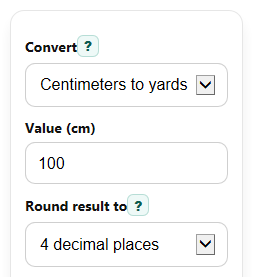
- Choose a direction in Convert so the tool knows whether your starting unit is centimeters or yards.
- Enter the number in Value. You can use 0, and negative values are allowed if you are converting a signed distance or position difference.
- Pick a display setting in Round result to. This changes how the answer looks on screen, not the math used underneath.
- Click Calculate to see Converted length, Formula used, and Exact unit relationship.
- Sanity-check the answer by matching the unit direction: 91.44 centimeters should equal 1 yard, and 100 centimeters should be a little more than 1 yard.
Definitions
Centimeter (cm): A metric length unit. There are 100 centimeters in 1 meter.
Yard (yd): A US and imperial length unit defined exactly as 0.9144 meter.
Converted length: The value after changing your entered length into the target unit selected by Convert.
Formula used: The equation the tool applied for your chosen direction, either yd = cm / 91.44 or cm = yd * 91.44.
Exact unit relationship: The fixed definition behind the math: 1 yard = 0.9144 meter = 91.44 centimeters exactly.
Round result to: A display setting for decimal places. It changes how the answer is shown, not the exact calculation.
Common mistakes and quick fixes
Mistake: Leaving Value blank and expecting a conversion.
Fix: Enter a number in Value , such as 100 or 91.44, then calculate again.
Mistake: Choosing the wrong option in Convert and reading the result backward.
Fix: If your starting number is in centimeters, use Centimeters to yards . If your starting number is in yards, use Yards to centimeters .
Mistake: Thinking Round result to changes the actual conversion factor.
Fix: Use any rounding setting you want for display, but read Exact unit relationship if you need the exact basis.
Mistake: Expecting Converted length to stay the same when you switch direction.
Fix: The target unit changes with Convert , so the number shown in Converted length will change too.
Mistake: Treating a negative Converted length as a calculator error.
Fix: A negative result simply keeps the sign from Value . For real physical lengths, enter a non-negative number instead.
Limitations & Key Assumptions / Boundary Conditions
- The converter assumes the international yard definition exactly: 1 yard = 91.44 centimeters.
- Rounding affects only the displayed Converted length. If you choose fewer decimal places, the shown value may look slightly different from the full-precision value.
- Very large or very small inputs are still converted by the same formula, but practical measuring tools may not match that precision in real life.
- Negative inputs are allowed because unit conversion math preserves sign, but most physical lengths are non-negative.
- This tool converts only between centimeters and yards. It does not handle feet, inches, meters, or mixed-unit entries.
Methodology
How the conversion is done
The calculator uses the exact relationship between yards, meters, and centimeters.
1 yd = 0.9144 m
1 m = 100 cm
1 yd = 91.44 cm
From that relationship, the two working formulas are:
yd = cm / 91.44
cm = yd * 91.44
Worked example
If Convert is set to centimeters to yards and Value is 100, divide 100 by 91.44.
yd = 100 / 91.44 = 1.0936132983...
If Round result to is 4 decimal places, Converted length is shown as 1.0936 yd.
If the direction is yards to centimeters and Value is 2, multiply by 91.44.
cm = 2 * 91.44 = 182.88
How rounding is handled
The tool calculates with the exact conversion basis first. Then it formats the displayed answer using your Round result to choice. Choosing full precision removes forced decimal-place rounding while still trimming extra trailing zeros in the display.
Assumptions used
This converter assumes the international yard definition and a direct unit conversion only. It does not adjust for measurement error, material stretch, or the limited precision of rulers, tape measures, or field markings.