
Enter psi, choose absolute or gauge pressure, and get the equivalent pressure in standard atmospheres (atm).
Advanced options
Table of contents
How to use our PSI to Atmospheres Converter
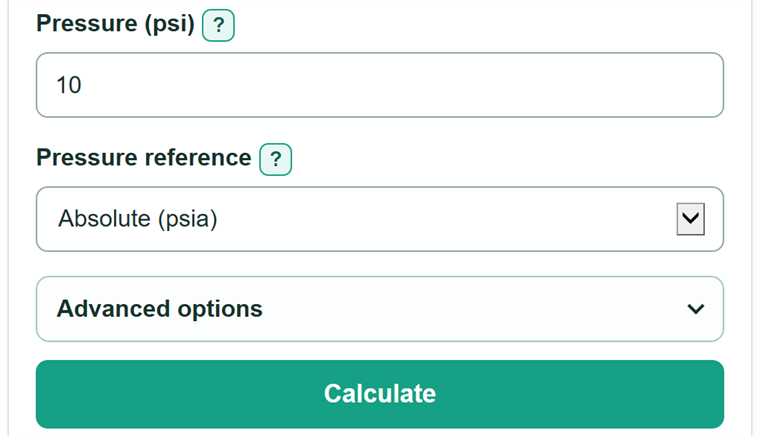
- Enter the pressure from your gauge, label, worksheet, or specification in Pressure (psi). You may enter a decimal, a properly grouped value such as 1,000, or a matching psia or psig suffix.
- Choose Absolute (psia) when the value is measured from a vacuum, or Gauge (psig) when a gauge reads zero at surrounding air pressure.
- Click Calculate. Pressure in standard atmospheres is the main answer; Converted absolute pressure shows the psi value used for that conversion.
- Sanity-check the result: 14.6959487755134 psia equals 1 atm. Under the calculator's standard reference, 0 psig also equals 1 atm.
Definitions
psi: Pounds-force per square inch, a pressure unit commonly used in the US.
atm: Standard atmosphere, an absolute-pressure unit defined as 101325 pascals.
Absolute pressure (psia): Pressure measured from a perfect vacuum. Zero psia is the vacuum boundary.
Gauge pressure (psig): Pressure measured relative to surrounding air pressure. A reading of 0 psig is not a vacuum.
Reference pressure added: The standard-atmosphere pressure added to a psig reading before it is converted to atm.
Common mistakes and quick fixes
Mistake: Treating a tire or compressor gauge reading as absolute pressure.
Fix: If the source is labeled psig or is an ordinary gauge reading, choose Gauge (psig) so the reference pressure is added.
Mistake: Entering a negative value in Absolute (psia) mode.
Fix: Absolute pressure cannot be below 0 psi. Choose Gauge (psig) only when the source value is actually a gauge reading.
Mistake: Typing 1,01 to mean 1.01 psi.
Fix: Use a decimal point for decimals: enter 1.01. Use commas only for thousands, such as 1,000.
Mistake: Choosing Gauge (psig) while entering a value with a psia suffix.
Fix: Match the suffix and selected reference. Choose Absolute for psia, or use psig with Gauge.
Mistake: Treating atm as bar or technical atmosphere.
Fix: The result is in standard atmospheres, written atm. Bar and technical atmosphere, written at, are different pressure units.
Limitations & Key Assumptions / Boundary Conditions
- Gauge mode assumes the gauge reference is exactly 1 standard atmosphere, or 14.6959487755134 psi. It does not adjust for local weather, elevation, or a pressurized enclosure.
- The converter returns standard atmospheres (atm), not bar or technical atmospheres (at).
- Gauge readings below -14.6959487755134 psi are rejected because they would produce negative absolute pressure under the stated reference assumption.
- Result decimal places changes displayed rounding only; it does not change the unrounded conversion.
- A bare psi number does not identify whether it is psia or psig. Use the reference printed on the gauge, label, manual, worksheet, or specification.
Methodology
How the conversion works
The calculator converts the entered pressure to absolute psi first. In Absolute (psia) mode, the entered value is already absolute. In Gauge (psig) mode, it adds one standard atmosphere before converting to atm.
reference pressure added = 0 psi for psia, or 14.6959487755134 psi for psig
absolute pressure in psi = entered pressure + reference pressure added
pressure in atm = absolute pressure in psi / 14.6959487755134
The conversion uses 1 atm = 14.6959487755134 psi, based on the defined standard atmosphere of 101325 Pa.
Worked example
For 10 psig, the calculator adds 14.6959487755134 psi, giving 24.6959487755134 psia. Dividing by 14.6959487755134 gives 1.680459639099761 atm. For 10 psia, no pressure is added, so the result is 0.680459639099761 atm.
Displayed rounding
Result decimal places controls only how many digits are shown. The calculation uses the unrounded converted value before it is displayed.