
Enter a pressure reading in psi or bar to convert it to the other unit while keeping the same gauge or absolute pressure reference.
Table of contents
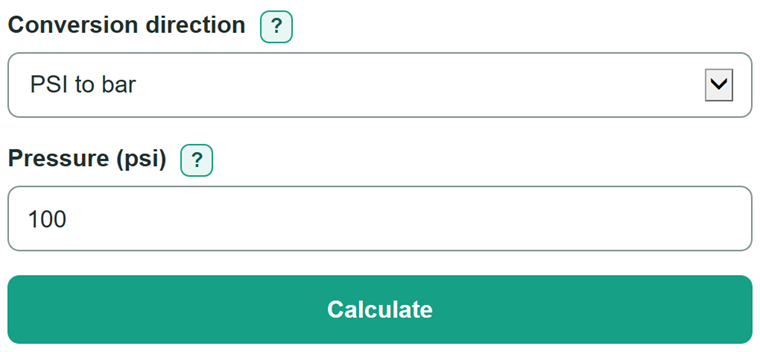
How to use our PSI to Bar Converter
- Choose PSI to bar when your source reading is in psi, or Bar to PSI when it is in bar.
- Enter one pressure value from a gauge, tire placard, manual, equipment label, or specification.
- Click Calculate to see the same pressure expressed in the other unit.
- Check that the result unit is the unit you need and that the conversion direction starts with the unit shown on your source.
Definitions
psi: Pounds per square inch, a pressure unit often shown on US gauges and tire placards.
bar: A pressure unit equal to 100,000 pascals. [1]
Pressure reference basis: The point used for comparison in a pressure reading. Converting units does not change that point.
Gauge pressure: Pressure measured relative to the surrounding air pressure.
Absolute pressure: Pressure measured relative to a perfect vacuum.
Common mistakes and quick fixes
Mistake: Entering a bar reading while PSI to bar is selected.
Fix: Choose the direction that starts with the unit printed beside your source reading.
Mistake: Typing a range such as "2 to 3" instead of one reading.
Fix: Enter one pressure value. Convert each endpoint separately to convert a range.
Mistake: Using a comma as a decimal mark, such as "1,5".
Fix: Use a decimal point for decimals, such as "1.5". Use commas only for thousands, such as "1,500".
Mistake: Adding the wrong unit suffix, such as "35 bar" in the Pressure (psi) field.
Fix: Remove the suffix or use the matching unit. The psi field accepts psi, and the bar field accepts bar.
Mistake: Treating the converted number as a recommended tire or equipment setting.
Fix: Keep the same pressure reference basis and follow the pressure specified by the vehicle or equipment manufacturer.
Limitations & Key Assumptions / Boundary Conditions
- The converter changes pressure units only. It does not determine a safe or correct tire, tank, hydraulic, or equipment pressure.
- Gauge pressure and absolute pressure are different reference bases. Use the same basis before and after conversion.
- A gauge, label, or manual may round its original reading. Extra digits in the converted value do not make that source measurement more precise.
- Negative values are accepted because gauge pressure can be below its reference pressure.
- The calculator accepts one finite number. It cannot convert ranges, formulas, malformed comma grouping, NaN, or Infinity.
Methodology
Calculation
The converter uses 1 psi = 0.06894757293168 bar, based on standard pressure-unit conversion relationships. [1]
pressure in bar = pressure in psi * 0.06894757293168
pressure in psi = pressure in bar / 0.06894757293168
Worked example
To convert 100 psi, multiply 100 by 0.06894757293168. The unrounded value is 6.894757293168 bar, or about 6.895 bar.
The calculator performs the conversion before rounding the displayed answer. Very small nonzero values use more decimal places or scientific notation so they do not appear as zero.