
Convert teaspoons to grams for common ingredients, with spoon-fill style and a realistic range so recipe weights make more sense.
Advanced options
Table of contents
How to use our Teaspoons to Grams Converter
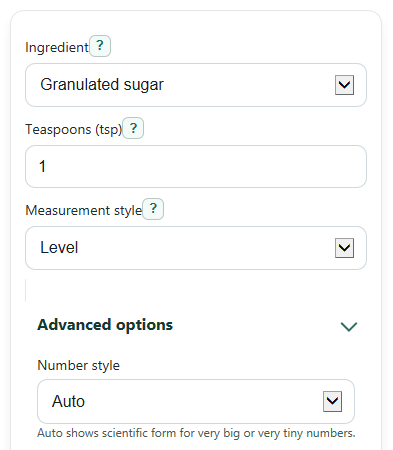
- Choose an item in Ingredient, because one teaspoon of sugar, flour, salt, or honey does not weigh the same.
- Enter your amount in Teaspoons (tsp). Decimals such as 0.25, 0.5, and 1.5 work.
- Pick Measurement style if it applies. Use level for a flat spoon, or choose lightly packed, packed, or heaping when that better matches how you measured.
- Click Calculate to see Grams, Typical range, Grams per teaspoon, and Teaspoons in milliliters.
- Sanity-check the result by looking at Typical range and Note. If your number seems off for a baking recipe, try level instead of packed or heaping.
Definitions
Ingredient: The food you are converting. Each ingredient has its own grams-per-teaspoon value.
Measurement style: How full the spoon was, such as level, lightly packed, packed, or heaping.
Grams per teaspoon: How much 1 teaspoon of the chosen ingredient weighs, in grams.
Typical range: A small estimated low-to-high span that shows normal kitchen variation from filling and texture.
Teaspoons in milliliters: The same volume shown in metric units. This calculator uses the US teaspoon.
Density: How much mass fits into a certain space. This is why the same spoonful can weigh differently for different ingredients.
Common mistakes and quick fixes
Mistake: Using the same Teaspoons (tsp) value for every Ingredient and expecting the same Grams .
Fix: Always choose the correct Ingredient first, because teaspoons measure volume and grams measure weight.
Mistake: Leaving Teaspoons (tsp) blank and expecting it to act like zero.
Fix: Enter a real number in Teaspoons (tsp) . If you mean none, type 0.
Mistake: Picking Measurement style as packed or heaping when your spoon was actually level.
Fix: Match Measurement style to how you filled the spoon. For most recipe testing, level is the safest choice.
Mistake: Reading Typical range like an exact answer.
Fix: Use Grams as the estimate and Typical range as a small cushion for real kitchen variation.
Mistake: Confusing Teaspoons in milliliters with Grams for thick or dry ingredients.
Fix: Treat Teaspoons in milliliters as volume only. Use Grams for weight.
Mistake: Ignoring the Note when a baking recipe needs precision.
Fix: Read the Note . If accuracy matters, weigh the ingredient directly instead of relying only on spoons.
Limitations & Key Assumptions / Boundary Conditions
- The result is an estimate based on the selected ingredient and spoon-fill style, not a lab measurement.
- This tool only supports the listed ingredients. If your ingredient is different, the conversion may not match.
- For liquids such as water, spoon-fill style does not meaningfully change the calculation, so the tool treats them as level.
- Texture, clumping, moisture, brand, temperature, and how tightly you pack a spoon can change the real weight.
- The calculator uses the US teaspoon, which is 4.92892159375 mL, not the rounded 5 mL food-labeling teaspoon.
- Typical range is a practical kitchen guide, not a formal confidence interval.
- Negative teaspoon values are not physically meaningful here, so they should be corrected before calculating.
Methodology
How the converter works
The calculator first changes Teaspoons (tsp) into milliliters, then uses an ingredient-specific weight factor to estimate Grams. For dry ingredients, it can adjust that factor based on Measurement style. For liquids, the style is treated as level so hidden or irrelevant choices do not change the answer.
mL = tsp * 4.92892159375
g = tsp * g_per_tsp_style
g_per_tsp_style = g_per_tsp_level * style_multiplier
range_low = g * (1 - range_pct)
range_high = g * (1 + range_pct)
Ingredient factors and style adjustment
Each supported ingredient has a stored level-teaspoon weight in grams. Example values used by the calculator include 4.2 g per teaspoon for granulated sugar and 2.6 g per teaspoon for all-purpose flour. Style multipliers are then applied where useful:
level = 1.0, lightly packed = 1.08, packed = 1.12, and heaping = 1.25. Ingredient weight references for baking ingredients are commonly built from kitchen weight charts [2].
Worked mini-example
Suppose you choose All-purpose flour, enter 2 in Teaspoons (tsp), and keep Measurement style at level.
g_per_tsp_style = 2.6 * 1.0 = 2.6 g/tsp
g = 2 * 2.6 = 5.2 g
mL = 2 * 4.92892159375 = 9.8578431875 mL
So the main result is 5.2 g, and the metric volume is about 9.86 mL.
Assumptions used
The converter uses the US teaspoon definition and ingredient-specific grams-per-teaspoon values. It also shows a practical Typical range to reflect normal kitchen variation rather than pretending every spoonful is exact. Real results can differ if the ingredient is compacted, sifted, clumpy, damp, or measured with a differently filled spoon.