
Convert yards to miles or miles to yards fast, including simple fractions like 1/2, using the exact 1 mile = 1,760 yards relationship.
Table of contents
How to use our Yards to Miles Converter
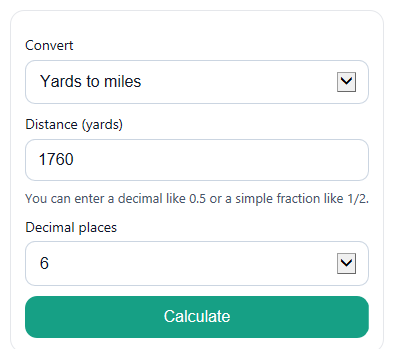
- Choose Convert to pick whether you are starting with yards or miles.
- Enter your value in Distance. You can use a decimal like 0.5 or a simple fraction like 1/2.
- Pick Decimal places to control how many digits appear in the main result.
- Click Calculate to see Converted distance, Conversion factor used, the formula, and common examples.
- Sanity-check the answer by comparing it with Exact unit relationship and Common examples; for example, 1,760 yards should equal 1 mile and 440 yards should equal 0.25 mile.
Definitions
Yard (yd): A US customary length unit. There are 1,760 yards in 1 mile.
Mile (mi): A longer distance unit used in the US. In this converter, mile means the statute mile.
Convert: The direction of the calculation, either yards to miles or miles to yards.
Distance: The starting value you type. It can be a decimal like 2.5 or a simple fraction like 1/2.
Decimal places: How many digits appear after the decimal point in the displayed result.
Conversion factor used: The amount of target unit for 1 source unit, such as 1 yard = 0.000568... miles.
Exact unit relationship: The base fact behind the converter: 1 mile = 1,760 yards.
Common mistakes and quick fixes
Mistake: Leaving Distance blank and expecting a result.
Fix: Enter a number such as 1760, 2.5, or a simple fraction like 1/2 in Distance .
Mistake: Typing an invalid fraction in Distance , such as 1//2 or 3/0.
Fix: Use one slash only, and make sure the bottom number is not zero, such as 1/2 or 3/4.
Mistake: Picking the wrong direction in Convert and reading the answer in the wrong unit.
Fix: Check Convert first, then confirm the unit shown in Converted distance .
Mistake: Thinking Decimal places changes the real math.
Fix: Decimal places only changes how the result is shown. The converter still uses the exact 1 mile = 1,760 yards ratio.
Mistake: Reading Conversion factor used as the final answer.
Fix: Use Converted distance for your actual result. Conversion factor used is just the amount for 1 starting unit.
Mistake: Being surprised by a negative Converted distance .
Fix: A negative value means a signed difference or opposite direction. If you want physical path length, enter a positive Distance .
Limitations & Key Assumptions / Boundary Conditions
- This converter uses the exact statute mile relationship: 1 mile = 1,760 yards.
- It accepts plain numbers and simple fractions like 1/2, but not mixed numbers like 1 1/2 unless you convert them to 1.5 or an improper fraction first.
- Decimal places changes display only. Internally, the calculation uses the exact ratio.
- Negative values are allowed as signed math values, but they usually represent a difference or direction, not a physical traveled path.
- Very large values are formatted for readability, but copied rounded results may differ slightly from full-precision values.
- This page converts only between yards and statute miles. It does not switch to feet, meters, or kilometers.
Methodology
Core method
This converter uses one exact unit relationship:
1 statute mile = 1,760 yards [1]. From that, the two directions are direct reverses of each other.
miles = yards / 1760
yards = miles * 1760
1 yard = 1/1760 miles = 0.000568181818... miles
How the result is shown
The calculator first converts your typed Distance into a number. It accepts decimals and simple fractions. After the exact conversion is done, the displayed Converted distance and Conversion factor used are rounded to the selected Decimal places. The rounding does not change the underlying math.
Mini example
If Convert is set to yards to miles and Distance is 440, divide 440 by 1,760.
440 / 1760 = 0.25
So the Converted distance is 0.25 mile. If Convert is set to miles to yards and Distance is 2.5, multiply by 1,760.
2.5 * 1760 = 4400
So the Converted distance is 4,400 yards.
Input handling
A value like 1/2 is parsed as numerator divided by denominator, so 1/2 becomes 0.5 before the unit conversion. Invalid entries such as blank text, multiple slashes, division by zero, NaN, or Infinity are blocked and should be corrected before calculation.
Assumptions used
This method assumes the standard US statute mile and standard yard definitions used in common measurement references [1]. Results can look slightly different from other pages only because of rounding choices, not because the base conversion changes.