
Enter inches or feet and inches to find the matching length in meters, including decimal and fractional measurements.
Advanced options
Calculated with the exact factor 0.0254 meter per inch.
For feet-and-inches input, this is feet times 12 plus the remaining inches.
Table of contents
How to use our Inches to Meters Converter
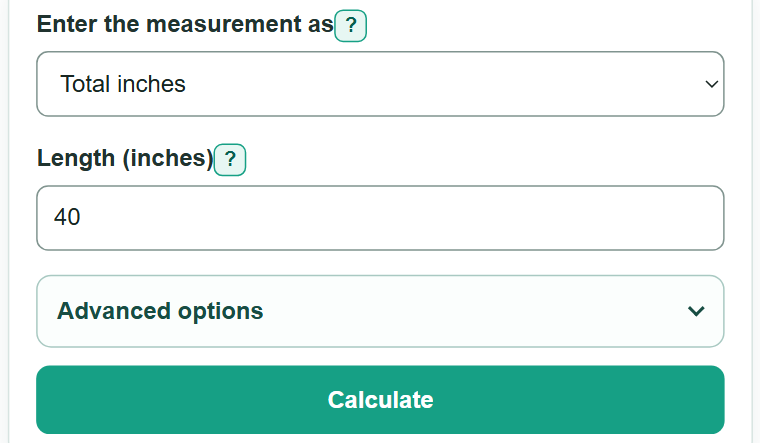
- Choose "Total inches" for a measurement already written in inches, or choose "Feet and inches" for a measurement such as 5 ft 9 in.
- Enter the measurement from your ruler, tape measure, specification, drawing, or worksheet. Total inches can be a decimal, a fraction such as 3/4, or a mixed fraction such as 5 3/8.
- Click "Calculate" to see "Length in meters." If you used feet and inches, also check "Total inches used" to make sure the two parts were combined as expected.
- Open "Advanced options" only if you need a different number of displayed decimal places. More displayed digits do not make the original measurement more precise.
Definitions
Inch (in): A customary unit of length. One inch is exactly 0.0254 meter.
Meter (m): The SI base unit of length.
Feet and inches: A two-part customary measurement. One foot equals exactly 12 inches.
Mixed fraction: A whole number plus a fraction. For example, 5 3/8 inches equals 5.375 inches.
Total inches used: The full inch value used in the conversion. For feet and inches, it is feet times 12 plus the remaining inches.
Common mistakes and quick fixes
Mistake: Entering 5.9 for a measurement written as 5 ft 9 in.
Fix: Choose "Feet and inches," enter 5 in "Length (feet)," and enter 9 in "Remaining length (inches)."
Mistake: Typing a tape-measure fraction as separate numbers.
Fix: In "Length (inches)," enter one mixed fraction, such as 5 3/8.
Mistake: Entering 12 or more for the remaining-inch part.
Fix: Add 1 to the feet value and keep "Remaining length (inches)" from 0 up to, but not including, 12.
Mistake: Using a malformed comma, such as 1,00.
Fix: Use commas only for thousands grouping, such as 1,000, or enter 1000 without a comma.
Mistake: Converting a nominal pipe or lumber label as though it were a measured dimension.
Fix: Use the actual listed or measured dimension when your project needs the physical length or width.
Limitations & Key Assumptions / Boundary Conditions
- This converter is for nonnegative physical lengths. Negative entries are rejected.
- In "Feet and inches," feet must be a whole number, and remaining inches must be from 0 up to, but not including, 12.
- A blank feet or remaining-inches field counts as zero only when the other field has a value. If both are blank, there is no measurement to convert.
- The decimal-place setting rounds only the displayed values; the calculation keeps the unrounded conversion value.
- Nominal trade sizes, including some pipe and lumber labels, may differ from the actual physical dimension.
Methodology
Conversion method
The converter first expresses the entry as total inches. It then multiplies total inches by the exact conversion factor of 0.0254 meter per inch.
total inches = entered inches
total inches = feet * 12 + remaining inches
meters = total inches * 0.0254
Worked example
For 5 ft 9 in, total inches is 5 * 12 + 9 = 69 in. Then 69 * 0.0254 = 1.7526 m.
Input and rounding rules
Total inches may be entered as a decimal, scientific notation, a slash fraction, or a mixed fraction. A fraction cannot have a bottom number of zero. The calculator converts before rounding the displayed meter value and total-inch value.