
Enter a Kelvin temperature to find its matching temperature in degrees Celsius, including valid readings below freezing.
Table of contents
How to use our Kelvin to Celsius Converter
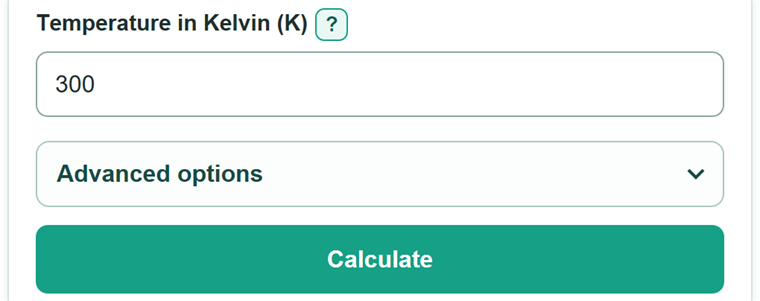
- Enter one complete temperature reading in "Temperature in Kelvin (K)," such as 300, 273.15, or 273.15 K.
- Open "Advanced options" only if you need decimal or scientific notation for a worksheet, lab record, or technical document.
- Select Calculate to see the converted "Temperature in Celsius" value.
- Check the answer against a reference point: 273.15 K equals 0 deg C, and a valid value below 273.15 K gives a negative Celsius temperature.
Definitions
Kelvin (K): The SI base unit for thermodynamic temperature. A complete Kelvin temperature cannot be below 0 K.
Degrees Celsius (deg C): A temperature scale in which 0 deg C is equal to 273.15 K.
Complete temperature reading: A temperature with a defined zero point, such as 300 K. Converting it to Celsius requires the 273.15 offset.
Temperature change: The difference between two temperatures. A change of 1 K is the same size as a change of 1 deg C.
Scientific notation: A compact way to write very large or very small numbers, such as 2.5e-7.
Common mistakes and quick fixes
Mistake: Adding 273.15 to the Kelvin reading.
Fix: Check Temperature in Kelvin (K) and then recalculate. Subtract 273.15 to convert a complete Kelvin temperature to degrees Celsius.
Mistake: Entering a value below 0 K.
Fix: Check Temperature in Kelvin (K) and then recalculate. Enter 0 K or a higher complete temperature reading. Kelvin temperatures cannot be below 0 K.
Mistake: Typing a range such as "273 to 300 K."
Fix: Check Temperature in Kelvin (K) and then recalculate. Enter one temperature at a time, such as 273.15 or 273.15 K.
Mistake: Treating a negative Celsius answer as an error.
Fix: Check Temperature in Kelvin (K) and then recalculate. A negative Celsius value is valid for Kelvin readings from 0 K up to, but not including, 273.15 K.
Mistake: Using a temperature change as though it were a complete temperature.
Fix: Check Temperature in Kelvin (K) and then recalculate. Do not subtract 273.15 from a temperature change. A change of 1 K has the same size as a change of 1 deg C.
Limitations & Key Assumptions / Boundary Conditions
- This converter is for complete thermodynamic temperature readings in K, not temperature changes.
- Values below 0 K are rejected because they are outside the thermodynamic Kelvin scale.
- The calculation uses the exact 273.15-degree offset, but displayed digits cannot make the source measurement more precise.
- Automatic format uses scientific notation for very large results and nonzero results very close to zero.
- Input is limited to 15 significant digits because ordinary JavaScript number handling cannot reliably preserve more entered precision.
Methodology
Conversion rule
Subtract 273.15 from a complete Kelvin reading to get degrees Celsius. This relationship follows the defined Kelvin and Celsius temperature scales.
Temperature in Celsius (deg C) = Temperature in Kelvin (K) - 273.15
Worked example
For 300 K, subtract 273.15 from 300. The temperature is 26.85 deg C.
300 K - 273.15 = 26.85 deg C
At the lower valid boundary, 0 K converts to -273.15 deg C. The offset is used only for complete temperature readings; it is not used for a temperature change.