
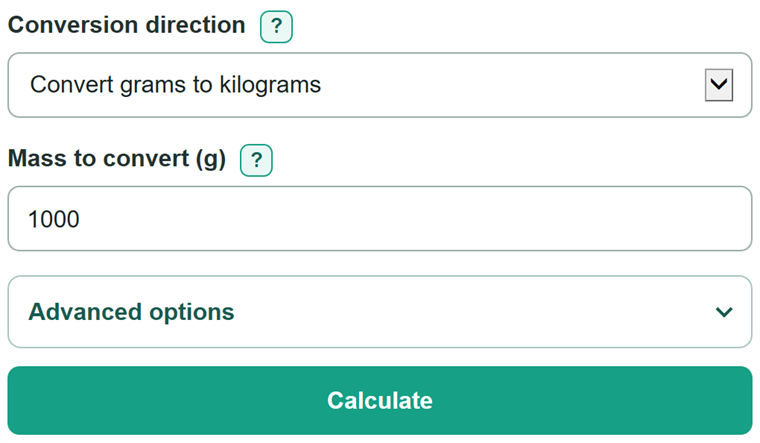
Enter grams to find the equivalent kilograms, or switch directions to convert kilograms into grams.
Advanced options
Table of contents
How to use our Grams to Kilograms Converter
- Choose the direction that starts with the unit printed on your scale, label, worksheet, or record.
- Enter the mass as a zero or positive number. You may include a matching g or kg suffix, such as 500 g or 0.5 kg.
- Open Advanced options and choose a decimal-place setting only when your worksheet or report requires a rounded answer.
- Click Calculate to see the converted mass and a direction check.
- Check the size of the answer: converting a nonzero value from grams to kilograms makes the number smaller, while converting from kilograms to grams makes it larger.
Definitions
Gram (g): A metric unit used to measure mass.
Kilogram (kg): A metric unit of mass equal to 1,000 grams.
Conversion direction: The starting unit and the unit you want after conversion.
Decimal places: Digits shown to the right of a decimal point. This setting rounds the displayed number only.
Exact conversion: A conversion based on a fixed unit relationship, so changing from grams to kilograms does not add measurement uncertainty.
Common mistakes and quick fixes
Mistake: Multiplying by 1,000 when converting grams to kilograms.
Fix: Divide the number of grams by 1,000.
Mistake: Dividing by 1,000 when converting kilograms to grams.
Fix: Multiply the number of kilograms by 1,000.
Mistake: Typing 2 kg while grams-to-kilograms is selected.
Fix: Type g in grams mode, or change the direction to kilograms to grams.
Mistake: Using a malformed comma, such as 1,00.
Fix: Use commas only in groups of three digits, such as 1,000 or 12,500.5.
Mistake: Treating grams as the same as milliliters or cups.
Fix: Use this tool for mass only. A mass-to-volume conversion also needs the density of the material.
Limitations & Key Assumptions / Boundary Conditions
- Enter zero or a positive mass. Negative mass values are outside this converter's input range.
- The grams-to-kilograms relationship is exact, but a selected decimal-place setting can round the displayed answer.
- A typed g or kg suffix must match the selected conversion direction.
- Grams measure mass. Converting grams to cups, tablespoons, or milliliters requires the density of the specific material.
- The converted value can be exact even when the original scale, label, or measurement was rounded or uncertain.
Methodology
Conversion method
One kilogram equals exactly 1,000 grams.
kilograms = grams / 1,000
grams = kilograms * 1,000
Worked example
For 12.5 g, divide by 1,000.
12.5 g / 1,000 = 0.0125 kg
For 0.001 kg, multiply by 1,000.
0.001 kg * 1,000 = 1 g
The calculator converts the entered value before applying any selected display rounding. Automatic formatting keeps small nonzero answers visible.