
Convert fluid ounces to milliliters and choose the right U.
Table of contents
How to use our Fluid Ounces to mL Converter
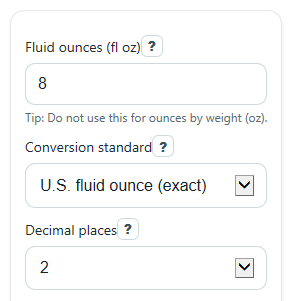
- Enter your amount in Fluid ounces. Use volume only, not weight.
- Choose Conversion standard: U.S. fluid ounce (exact), Imperial fluid ounce (exact), or Food label round number.
- If needed, pick Decimal places to control how many digits appear in the answer.
- Click Calculate to see Milliliters, the Conversion used, and the Selected standard.
- Do a quick sanity check: if you switch only the Conversion standard, the result should change slightly between U.S. and Imperial, and food-label mode should give a rounder value.
Definitions
Fluid ounce (fl oz): A unit of volume, not weight.
Milliliter (mL): A metric unit of volume.
U.S. fluid ounce: The U.S. volume standard used in many American recipes, drinks, and containers.
Imperial fluid ounce: A different volume standard used in the British Imperial system, so it is not the same size as a U.S. fluid ounce.
Food label round number: A simplified conversion that uses 1 fl oz = 30 mL for labeling-style rounding.
Conversion used: The number of milliliters per fluid ounce applied in the calculation.
Decimal places: How many digits appear after the decimal point in the displayed result.
Common mistakes and quick fixes
Mistake: Entering weight ounces instead of volume in Fluid ounces .
Fix: Use this tool only for fluid ounces. If your package shows weight oz, do not enter that number here.
Mistake: Leaving Conversion standard on the wrong option.
Fix: Check whether you need U.S. fluid ounce, Imperial fluid ounce, or food-label rounding before you calculate.
Mistake: Typing a negative number in Fluid ounces .
Fix: Enter 0 or more. Use 0 if you want to test the setup.
Mistake: Thinking Conversion used should always be 30 mL per fl oz.
Fix: That round number is only for the food-label option. Exact U.S. and Imperial values are different.
Mistake: Copying too many or too few digits from Milliliters .
Fix: Adjust Decimal places to match how exact you need the result to be.
Mistake: Ignoring the Quick note when food-label mode is selected.
Fix: Read the note so you know when the result is a rounded labeling value instead of an exact conversion.
Limitations & Key Assumptions / Boundary Conditions
- This converter works only from fluid ounces to milliliters. It does not convert weight ounces.
- You must choose the correct Conversion standard. U.S. and Imperial fluid ounces are different sizes, so the same input can give different results.
- The food-label option uses a rounded convention of 30 mL per fl oz, so it is useful for labeling-style values but not for exact measurement work.
- Displayed results depend on the selected Decimal places, so rounded output may hide tiny differences.
- Negative values are not allowed in this tool. Enter 0 or more in Fluid ounces.
- Very precise lab, manufacturing, or legal use may require additional rules beyond this simple unit conversion.
Methodology
How the converter works
The calculator multiplies the entered Fluid ounces by a milliliter-per-fluid-ounce factor based on the selected standard. The main output is Milliliters, and the page also shows the exact factor in Conversion used.
Formulas
mL = fl oz x 29.5735295625
mL = fl oz x 28.4130625
mL = fl oz x 30
Use the first formula for U.S. fluid ounces, the second for Imperial fluid ounces, and the third only for food-label style rounding. The exact U.S. and Imperial factors come from NIST conversion tables [1].
Worked example
If Fluid ounces is 8 and Conversion standard is U.S. fluid ounce (exact), multiply 8 by 29.5735295625.
8 x 29.5735295625 = 236.5882365
If Decimal places is 2, the displayed Milliliters value becomes 236.59 mL.
If you switch the same 8 fl oz to Imperial, the result becomes smaller because the Imperial conversion factor is 28.4130625 mL per fl oz.
Assumptions and limits
This tool assumes your input is a volume in fluid ounces, not a mass in ounces by weight. It also assumes the chosen standard matches the container, recipe, or labeling system you are using. Food-label mode is a rounded convention, so it can differ from exact physical conversion.