
Enter your hourly pay and work schedule to estimate your annual gross pay before taxes and deductions.
Table of contents
How to use our Hourly to Annual Calculator
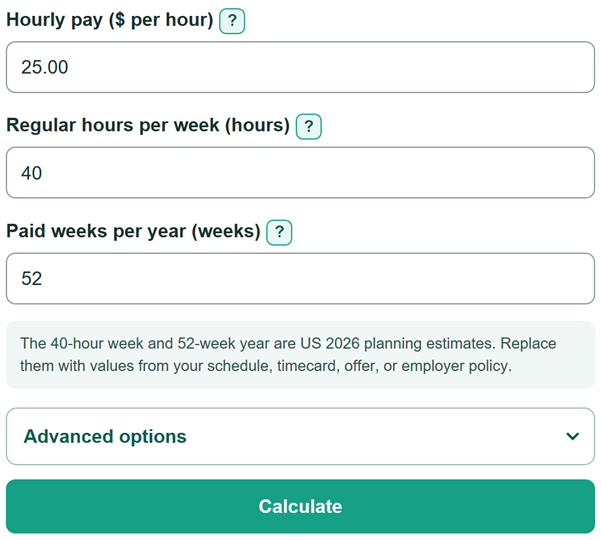
- Enter your base hourly pay from a job posting, offer letter, pay stub, or payroll system.
- Enter your regular hours per week and paid weeks per year. The starting values of 40 hours and 52 weeks are planning estimates, so replace them if your schedule differs.
- Open Advanced options if you regularly receive premium overtime pay, then enter overtime hours and the multiplier your employer uses.
- Click Calculate, then compare the gross pay for one paid week with a typical pay week before using the annual estimate to compare jobs or budgets.
Definitions
Hourly pay: Base pay for one hour of work before any overtime multiplier.
Regular hours per week: Hours paid at the base hourly rate during a typical paid week.
Paid weeks per year: Weeks in which you expect to receive pay. Unpaid leave or seasonal time off can reduce this number.
Overtime pay multiplier: The number multiplied by the base hourly rate for overtime hours. A multiplier of 1.5 means time-and-a-half. Federal overtime rules generally require at least time-and-a-half after 40 hours in a workweek for covered, nonexempt employees, with exemptions and other rules applying. [1]
Gross pay: Pay before taxes, insurance premiums, retirement contributions, and other deductions.
Biweekly pay: An average amount for a two-week period. This calculator divides annual gross pay by 26.
Common mistakes and quick fixes
Mistake: Treating annual gross pay as take-home pay.
Fix: Gross pay is before taxes, insurance, retirement deductions, and other payroll deductions.
Mistake: Leaving 52 paid weeks after planning unpaid leave or seasonal breaks.
Fix: Enter the weeks you expect to receive pay. For two unpaid weeks, enter 50.
Mistake: Adding premium overtime hours to regular hours at the base rate.
Fix: Put base-rate hours in Regular hours per week and premium-paid hours in Overtime hours per week.
Mistake: Including a bonus, tips, commission, or employer benefits in hourly pay.
Fix: Enter only your base hourly rate. Those other forms of compensation are outside this estimate.
Mistake: Typing commas in an unusual pattern, such as 2,50.00.
Fix: Use a plain number such as 250.00 or standard thousands grouping such as 2,500.00.
Limitations & Key Assumptions / Boundary Conditions
- This is an estimate of gross pay, not take-home pay. It excludes taxes, payroll deductions, insurance, retirement contributions, bonuses, tips, commissions, and employer benefits.
- The 40-hour and 52-week starting values are US planning estimates. Use your actual schedule, timecards, contract, and employer leave policy when possible.
- Overtime is included only when you enter recurring overtime hours. The calculator does not determine whether a worker or job is legally eligible for overtime pay.
- The overtime multiplier starts at 1.5, but an employer policy, union agreement, contract, state rule, or pay arrangement may use a different rate.
- Monthly and biweekly amounts are annual averages. Individual paychecks can differ because of payroll dates, unpaid holidays, changing schedules, or irregular overtime.
- Regular and overtime hours together cannot exceed 168 hours in one week.
Methodology
Calculation method
The calculator finds regular annual pay from the base hourly rate, regular weekly hours, and paid weeks. If overtime hours are entered, it calculates overtime pay separately at the selected multiplier and adds it to regular pay.
annual regular pay = hourly pay × regular hours per week × paid weeks per year
annual overtime pay = hourly pay × overtime multiplier × overtime hours per week × paid weeks per year
annual gross pay = annual regular pay + annual overtime pay
Blank overtime hours count as zero. A blank overtime multiplier uses 1.5. Average monthly gross pay is annual gross pay divided by 12, and average biweekly gross pay is annual gross pay divided by 26.
average monthly gross pay = annual gross pay / 12
average biweekly gross pay = annual gross pay / 26
Worked example
At $25 per hour for 40 regular hours each week and 52 paid weeks, regular annual pay is $52,000. Adding 5 overtime hours per week at 1.5 times the base rate adds $9,750, for estimated annual gross pay of $61,750.
$25 × 40 × 52 = $52,000
$25 × 1.5 × 5 × 52 = $9,750
$52,000 + $9,750 = $61,750