
Enter centimeters to find the exact decimal inches and a rounded tape-measure reading in inches or feet and inches.
Advanced options
Table of contents
How to use our Centimeters to Inches Converter
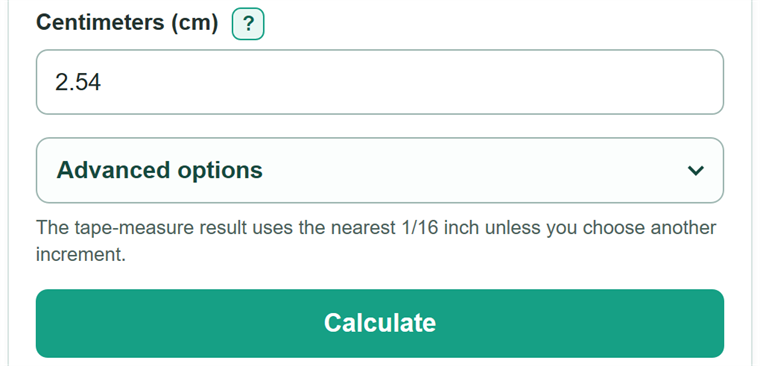
- Enter the length from your listing, ruler, pattern, or drawing in Centimeters (cm). You can enter 240, 240 cm, or a grouped value such as 2,540.
- Select Calculate to see the decimal-inch conversion.
- Open Advanced options if you need a tape-measure reading, then choose the smallest fraction your tape measure or drawing uses.
- Use the rounded inches and feet-and-inches reading for practical marking or comparison. Keep the decimal-inch answer for work that needs the unrounded conversion.
- Sanity-check the direction: centimeters are divided by 2.54, so 100 cm should be a little more than 39 inches.
Definitions
Centimeter (cm): A metric unit of length. This is the value entered into the converter.
Inch (in): A US customary unit of length. One inch equals exactly 2.54 centimeters. [1]
Decimal inches: An inch measurement written with a decimal, such as 39.3701 in.
Fractional inch: Part of an inch written as a fraction, such as 3/8 in. This matches the marks on many tape measures.
Feet and inches: A length written as whole feet plus the inches left over. One foot equals 12 inches.
Rounding change: The signed difference between the rounded tape-measure length and the unrounded decimal-inch value. A positive number means the measurement rounded up.
Common mistakes and quick fixes
Mistake: Multiplying centimeters by 2.54 to get inches.
Fix: Check Centimeters and then recalculate. Divide centimeters by 2.54. Multiplication converts inches to centimeters.
Mistake: Entering a range such as 10-12 cm.
Fix: Check Centimeters and then recalculate. Calculate one measurement at a time, such as 10 cm or 12 cm.
Mistake: Typing 1,01 when you mean 1.01 cm.
Fix: Check Centimeters and then recalculate. Use a decimal point for decimals. Use commas only for thousands, such as 1,000.5.
Mistake: Treating the tape-measure length as the exact conversion.
Fix: Check Centimeters and then recalculate. Use the decimal-inch result for the unrounded value. The fraction is rounded to the increment you selected.
Mistake: Reading the remaining inches without the feet value.
Fix: Check Centimeters and then recalculate. Combine both parts. For example, 7 feet and 10 1/2 remaining inches means 7 ft 10 1/2 in.
Limitations & Key Assumptions / Boundary Conditions
- Enter only a nonnegative physical length. Negative centimeters are not supported.
- The decimal conversion uses the exact relationship of 2.54 cm per inch, but the tape-measure reading is an approximation rounded to the selected fraction.
- A coarse increment such as 1/2 in can differ more from the decimal result than a finer increment such as 1/32 in.
- The calculator rounds before splitting the length into feet and inches, so a value that rounds to 12 in becomes 1 ft 0 in.
- A very small nonzero length may display as 0 at a low decimal-place setting. Extra detail is needed to distinguish it from an exact zero.
Methodology
Conversion
One inch is exactly 2.54 centimeters, so the calculator divides the entered centimeter value by 2.54. It keeps the unrounded value for the fraction and feet-and-inches calculations. [1]
inches = centimeters / 2.54
Tape-measure rounding
The selected denominator sets the nearest fraction. For example, 16 means the result is rounded to the nearest 1/16 in. The calculator rounds total inches first, then splits that amount into whole feet and remaining inches. This lets a rounded 12-inch remainder carry into the next foot.
rounded inches = round(decimal inches x denominator) / denominator
whole feet = floor(rounded inches / 12)
remaining inches = rounded inches - (whole feet x 12)
Worked example
For 100 cm, 100 / 2.54 = 39.370078... in. Rounded to the nearest 1/16 in, this becomes 39 3/8 in, or 3 ft 3 3/8 in. The rounded value is about 0.0049 in higher than the unrounded value.