
Paste text or enter a word count and your reading speed to estimate your silent reading time.
Table of contents
How to use our Reading Time Calculator
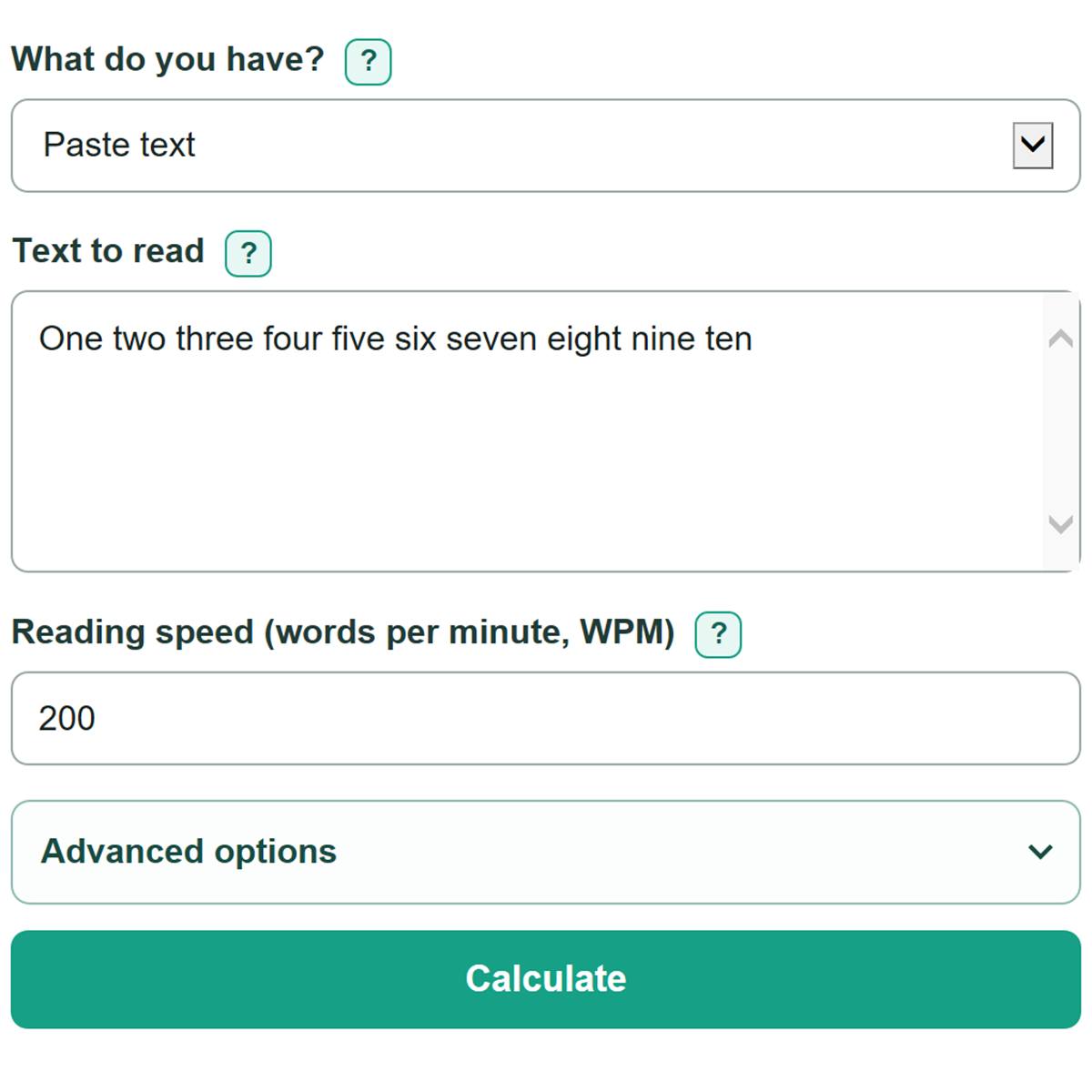
- Choose whether you have text to paste or a known word total.
- Paste the text into Text to read, or enter the total in Word count (words).
- Enter a positive Reading speed (words per minute, WPM) that fits the reader and material.
- Use Advanced options if you want to test both a slower and faster pace, then select Calculate.
- Check Word count used before planning from the estimated reading time, especially for pasted text with unusual spacing or punctuation.
Definitions
Word count: The number of words used in the estimate. For pasted text, the calculator counts nonempty groups separated by spaces, tabs, or line breaks.
Words per minute (WPM): The number of words the reader is expected to read in one minute.
Estimated reading time: The duration calculated from the word count and the main reading speed.
Slow pace: An optional lower WPM that calculates the longer end of a planning range.
Fast pace: An optional higher WPM that calculates the shorter end of a planning range.
Common mistakes and quick fixes
Mistake: Typing a known number, such as 1,200, into Text to read.
Fix: Choose Enter word count and enter the number in Word count (words).
Mistake: Writing a word count with misplaced commas, such as 1,20.
Fix: Check What do you have? and then recalculate. Use plain digits or standard thousands commas, such as 1200 or 1,200.
Mistake: Entering a decimal word total.
Fix: Check What do you have? and then recalculate. Enter a whole number of at least 1 word.
Mistake: Leaving Reading speed blank or entering 0.
Fix: Check What do you have? and then recalculate. Enter a reading speed greater than 0 WPM.
Mistake: Filling in only a slow pace or only a fast pace.
Fix: Check What do you have? and then recalculate. Enter both pace values to calculate a range, or leave both blank.
Mistake: Setting the slow pace above the main speed or the fast pace below it.
Fix: Check What do you have? and then recalculate. Keep Slow pace at or below the main reading speed and Fast pace at or above it.
Limitations & Key Assumptions / Boundary Conditions
- The result is a silent-reading estimate, not a guaranteed completion time.
- Text difficulty, unfamiliar words, note-taking, rereading, interruptions, and the reader's familiarity with the topic can change actual time.
- Pasted text is counted as whitespace-separated tokens. A punctuation-only token counts, so the total may differ from a word processor that uses different counting rules.
- Do not use this silent-reading estimate to time a speech, narration, read-aloud, or audiobook.
- A pace range appears only when both optional pace fields are filled in and the slow pace is at or below the main pace while the fast pace is at or above it.
Methodology
Calculation
The calculator uses the active input route. For pasted text, it trims the text and counts nonempty groups separated by whitespace. For a known total, it uses the whole number entered in Word count (words).
word count = number of trimmed, whitespace-separated text tokens
reading time in seconds = word count / reading speed in WPM * 60
The displayed duration rounds to the nearest whole second and is then shown in hours, minutes, and seconds. A positive result that rounds below one second is shown as less than 1 second.
Optional pace range
When both optional pace fields have values, the calculator divides the word count by the fast pace for the shortest time and by the slow pace for the longest time. The slow pace must be at or below the main pace, and the fast pace must be at or above it.
shortest time in seconds = word count / fast pace in WPM * 60
longest time in seconds = word count / slow pace in WPM * 60
Worked example
For 1,200 words at 240 WPM, 1,200 / 240 = 5 minutes, or 300 seconds. With a slow pace of 180 WPM and a fast pace of 300 WPM, the range is 4 minutes to 6 minutes 40 seconds.
Reading context
This method measures silent-reading time from a user-chosen pace. Silent reading and spoken articulation are different measures; a study of adults reading short texts found no correlation between articulation speed and silent reading rate. [1]