
Enter your gross annual salary and work schedule to find its gross hourly equivalent before taxes and deductions.
Table of contents
How to use our Salary to Hourly Calculator
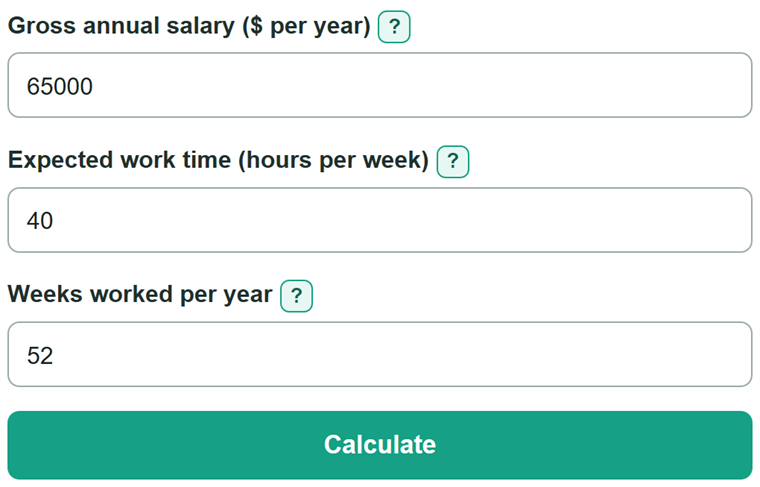
- Enter your Gross annual salary ($ per year) from your job offer, agreement, or pay record before taxes and deductions.
- Enter Expected work time (hours per week) from your usual schedule, including regularly expected extra hours.
- Enter Weeks worked per year. Keep 52 if paid time off is included in the annual salary; use fewer weeks for unpaid time off, seasonal work, or a shorter contract.
- Click Calculate to see your gross hourly equivalent and the yearly work hours used to calculate it.
- Check the annual-hours result before using the rate to compare pay: 40 hours per week for 52 weeks equals 2,080 hours, and more annual hours should produce a lower hourly equivalent for the same salary.
Definitions
Gross annual salary: Yearly pay before taxes, insurance, retirement contributions, and other deductions.
Gross hourly equivalent: Gross annual salary divided by the work hours represented by that salary.
Expected work time per year: Expected hours per week multiplied by weeks worked per year. Forty hours per week for 52 weeks equals 2,080 hours.
Biweekly: Every two weeks. A full year has 26 biweekly pay periods.
Semimonthly: Twice per month. A full year has 24 semimonthly pay periods.
Common mistakes and quick fixes
Mistake: Entering take-home pay instead of gross annual salary.
Fix: Check Gross annual salary ($ per year) and then recalculate. Enter pay before taxes, insurance, retirement contributions, and other deductions.
Mistake: Using 40 hours per week when the job regularly takes more or fewer hours.
Fix: Check Gross annual salary ($ per year) and then recalculate. Use the hours you realistically expect to work in a typical week.
Mistake: Subtracting paid vacation weeks from a salary that already includes paid time off.
Fix: Check Gross annual salary ($ per year) and then recalculate. Keep 52 weeks when paid time off is included. Reduce weeks only for unpaid time off, seasonal work, or a shorter paid contract.
Mistake: Treating the gross hourly equivalent as take-home hourly pay.
Fix: Check Gross annual salary ($ per year) and then recalculate. This result is before deductions. Use a pay stub or tax estimate to examine take-home pay.
Mistake: Treating biweekly and semimonthly pay as the same schedule.
Fix: Check Gross annual salary ($ per year) and then recalculate. Biweekly means every two weeks, or 26 pay periods per year. Semimonthly means twice each month, or 24 pay periods per year.
Limitations & Key Assumptions / Boundary Conditions
- The result is gross pay only. It does not estimate taxes, withholding, insurance, retirement contributions, or take-home pay.
- Bonuses, commissions, equity, benefits, employer contributions, and overtime premiums are not included.
- The calculator uses your entered schedule. A 40-hour week for 52 weeks creates a 2,080-hour planning basis, but actual work time can differ.
- Paid time off normally remains part of annual salary. Use fewer weeks only if the salary comparison truly covers unpaid time off, seasonal work, or a shorter contract.
- An employer or government payroll system may use another divisor. US federal civilian payroll uses a 2,087-hour divisor rather than 2,080 hours [1].
- A salary amount by itself does not determine overtime eligibility or exemption status [2].
Methodology
Calculation method
The calculator first finds expected work time for the year. It then divides gross annual salary by those hours. It uses unrounded values while calculating and rounds displayed dollar amounts to cents.
annual work hours = expected hours per week x weeks worked per year
gross hourly equivalent = gross annual salary / annual work hours
Worked example
A $65,000 annual salary with 40 expected hours per week and 52 weeks worked has 2,080 annual work hours. Dividing $65,000 by 2,080 gives $31.25 per hour.
Pay-period amounts
The weekly, biweekly, semimonthly, and monthly amounts split the annual salary into calendar pay periods. They do not change when work hours or weeks change.
weekly gross pay = gross annual salary / 52
biweekly gross pay = gross annual salary / 26
semimonthly gross pay = gross annual salary / 24
monthly gross pay = gross annual salary / 12
For the $65,000 example, the calendar equivalents are $1,250.00 per week, $2,500.00 every two weeks, $2,708.33 twice per month, and $5,416.67 per month.