
Convert between counting units like pair, dozen, score, gross, and great gross, and see the exact item count too.
Advanced options
Table of contents
How to use our Quantity Converter
- Enter your starting number in Amount.
- Choose the unit you have under Convert from, then choose the unit you want under Convert to.
- If you want more or fewer digits, set Decimal places (0 to 10).
- Click Calculate to see Converted amount, Single items, the Closest named quantity, and All equivalent quantities.
- Sanity-check the answer by looking at Single items; for example, if you enter 24 dozen, the single-item total should be 288.
Definitions
Amount: The number you enter before converting. It can be a whole number or a decimal.
Convert from: The counting unit your starting amount uses.
Convert to: The counting unit you want for the main answer.
Single items: The same quantity written as individual items. This is the base count used for all conversions.
Pair: A group of 2 items.
Half dozen: A group of 6 items.
Dozen: A group of 12 items.[1]
Baker's dozen: A group of 13 items.[2]
Score: A group of 20 items.[3]
Gross: A group of 144 items, or 12 dozen.[4]
Great gross: A group of 1,728 items, or 12 gross.[5]
Closest named quantity: The supported counting name whose item total is nearest to your Single items value.
Common mistakes and quick fixes
Mistake: Leaving Amount blank and expecting it to act like 0.
Fix: Enter a number in Amount . Use 0 only when you really mean no items.
Mistake: Typing a negative number in Amount .
Fix: Use an Amount that is 0 or greater, because this converter counts quantities of items.
Mistake: Picking the wrong starting unit in Convert from , such as choosing Unit when your amount is in dozens.
Fix: Match Convert from to the unit your original number is written in before you calculate.
Mistake: Reading Converted amount as if it must always be a whole number.
Fix: If Converted amount has decimals, it means you have part of that named quantity, which is normal in conversion math.
Mistake: Treating Closest named quantity as the exact answer.
Fix: Use Converted amount for the exact conversion and use Closest named quantity only as a quick plain-English note.
Mistake: Ignoring All equivalent quantities when comparing units.
Fix: Check All equivalent quantities to compare pair, dozen, score, gross, and the other supported units without re-entering your values.
Limitations & Key Assumptions / Boundary Conditions
- This converter only works with the supported counting units: unit, pair, half dozen, dozen, baker's dozen, score, gross, and great gross.
- Results are mathematical conversions. A decimal answer means part of a named quantity, even if people would not normally say it that way in conversation.
- Closest named quantity is an interpretation aid, not an exact replacement for Converted amount.
- If two named quantities are equally close, the calculator uses the smaller named unit.
- Displayed values may be rounded based on Decimal places (0 to 10), even though the internal conversion uses full precision.
- Very unusual historical or trade counting names beyond the listed units are not included.
Methodology
How the calculation works
The converter first changes your entry into single items, then changes that item count into the output unit.
base_units = input_value * unit_size[from_unit]
converted_value = base_units / unit_size[to_unit]
Supported unit sizes are:
unit = 1, pair = 2, half dozen = 6, dozen = 12[1], baker's dozen = 13[2], score = 20[3], gross = 144[4], and great gross = 1,728[5].
Closest named quantity
To create the plain-English note, the calculator compares your total single items with each supported named quantity and picks the one with the smallest difference.
difference_i = abs(base_units - unit_size[i])
If two names are equally close, it chooses the smaller unit so the note stays simpler.
Mini example
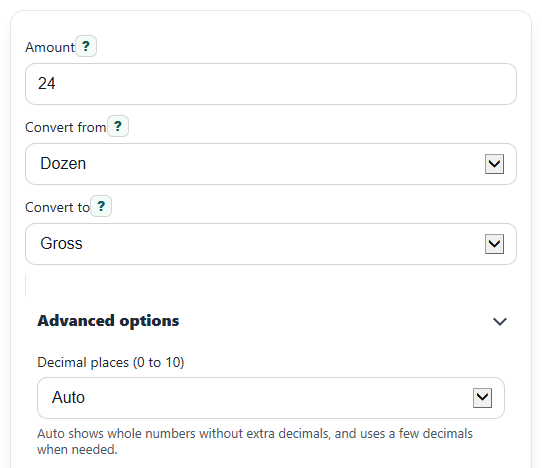
Suppose you enter 24 for Amount, choose Dozen for Convert from, and choose Gross for Convert to.
base_units = 24 * 12 = 288
converted_value = 288 / 144 = 2
So the main answer is 2 gross, and the same quantity is 288 single items.
Rounding and display
The calculator keeps full precision during conversion and rounds only for display, using your chosen Decimal places (0 to 10). This helps with repeating decimals like score to dozen conversions.
Assumptions and limits
This method assumes the entered amount is a valid non-negative count and that each named unit always has its standard fixed size. It does not estimate packaging, pricing, or real-world selling conventions.