
Enter an event's date, local time, and named locations to find the matching date and time at your destination.
Advanced options
Table of contents
How to use our Time Zones Converter
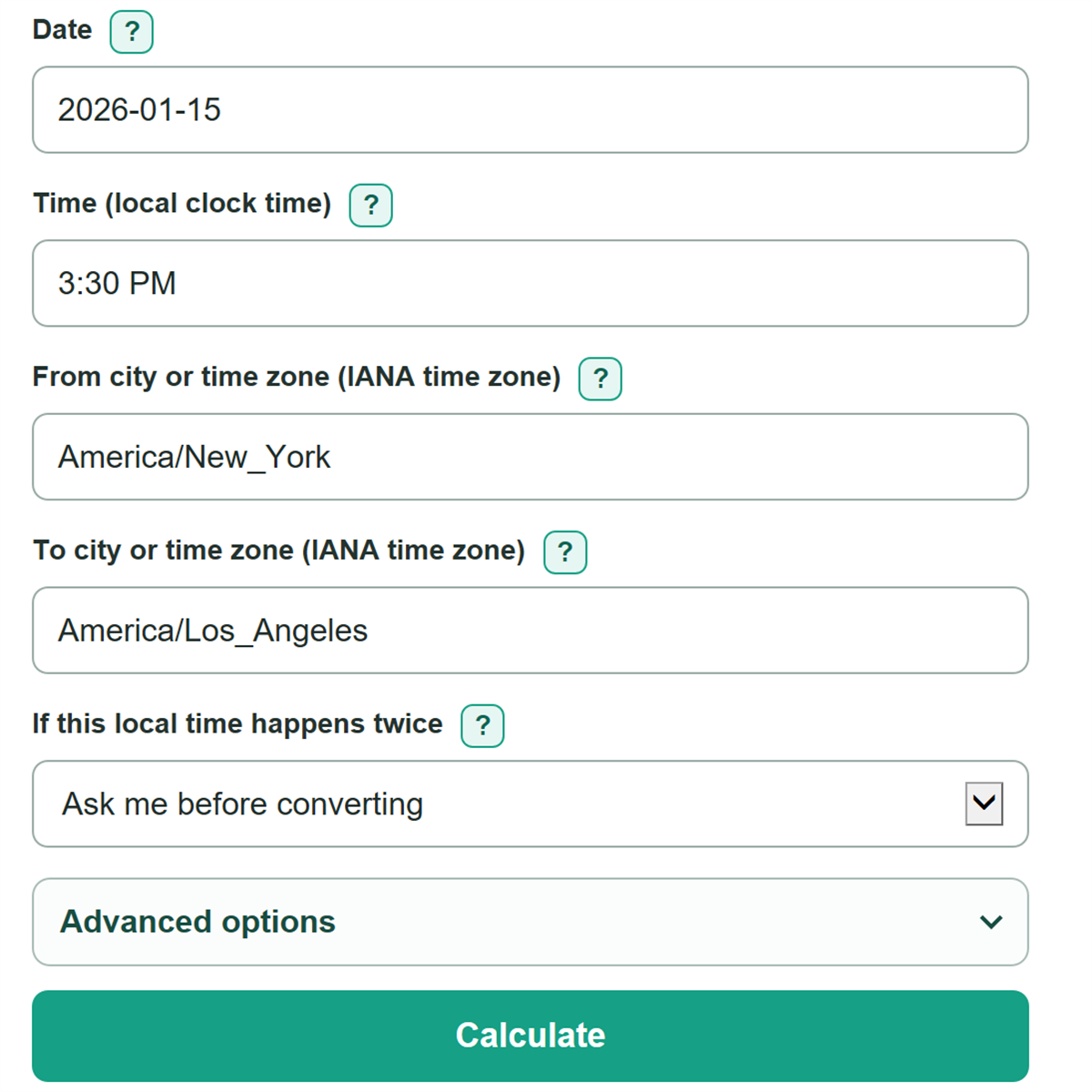
- Enter the event's Date and Time exactly as scheduled in the source location. Add AM or PM, or use a two-digit 24-hour time such as 15:30.
- Choose the event location in From city or time zone, then choose the place you want to check in To city or time zone.
- Keep If this local time happens twice set to Ask me unless the calculator says the time is repeated after clocks move back.
- Click Calculate and check the full destination date, not only the clock time. The destination can be on the previous day or next day.
Definitions
IANA time zone: A named regional time rule, such as America/New_York or Asia/Tokyo. It includes the area's UTC offset and any seasonal clock changes.
UTC: The worldwide reference time used to identify one exact moment.
UTC offset: How far a local clock is ahead of or behind UTC, written like UTC-05:00 or UTC+09:00. Some places have an offset of 30 or 45 minutes.
Repeated local time: A clock time that occurs twice when clocks move back, such as 1:30 AM appearing once before and once after the change.
Destination clock difference: The destination UTC offset minus the source UTC offset at the event instant. A positive value means the destination clock is ahead.
Common mistakes and quick fixes
Mistake: Entering 3:30 without AM or PM.
Fix: Check Date and then recalculate. Enter 3:30 PM, or use 15:30 for 24-hour time.
Mistake: Choosing a fixed UTC offset instead of the event's location.
Fix: Check Date and then recalculate. Choose a named city or IANA time zone so the date-specific seasonal clock rule is used.
Mistake: Entering the destination date when the event is scheduled in the source location.
Fix: Check Date and then recalculate. Enter the date where the event starts, then read the converted destination date.
Mistake: Ignoring a message that the source time happens twice.
Fix: Check Date and then recalculate. Confirm whether the event is before or after clocks move back, then choose the first or second occurrence.
Mistake: Treating Destination clock difference as time remaining until the event.
Fix: It compares local clocks. Use Time in the destination for the matching date and time.
Limitations & Key Assumptions / Boundary Conditions
- The conversion depends on the named zones, date, and local time entered. Your browser must support the selected IANA time zones.
- A source local time skipped when clocks move forward has no matching instant, so the calculator cannot convert it.
- A source local time repeated when clocks move back needs a first or second occurrence choice because each occurrence is a different instant.
- Future government changes to time-zone or seasonal clock rules may not appear until the browser or operating system time-zone data is updated.
- The clock difference compares the two local clocks at the event instant. It is not a countdown or travel duration.
Methodology
Calculation method
The calculator resolves the entered source date and local clock time using the named source zone's installed time-zone rules. It keeps only instants that format back to the exact date and time entered. No match means the time was skipped, while two matches mean the time was repeated and needs a choice.
source_epoch_ms = IANA_resolve(date, time, from_zone, repeated_time_choice)
That resolved instant is formatted in the destination zone. The instant does not change; only its local date and clock display change.
destination_local_datetime_epoch_ms = source_epoch_ms
The calculator finds each zone's UTC offset at that instant, then subtracts the source offset from the destination offset. It compares the formatted local calendar dates separately to determine whether the destination is on the same, previous, or next day.
time_difference_minutes = destination_utc_offset_minutes - source_utc_offset_minutes
calendar_day_change = destination_local_day_index - source_local_day_index
Worked example
On January 15, 2026, 3:30 PM in America/New_York converts to 12:30 PM in America/Los_Angeles. New York is UTC-05:00 and Los Angeles is UTC-08:00 at that instant. The destination clock difference is -180 minutes, and both locations are on the same calendar day.