
Convert a torque value to N*m, lb-ft, or lb-in, or calculate torque, force, or lever-arm length from measurements you know.
Advanced options
Table of contents
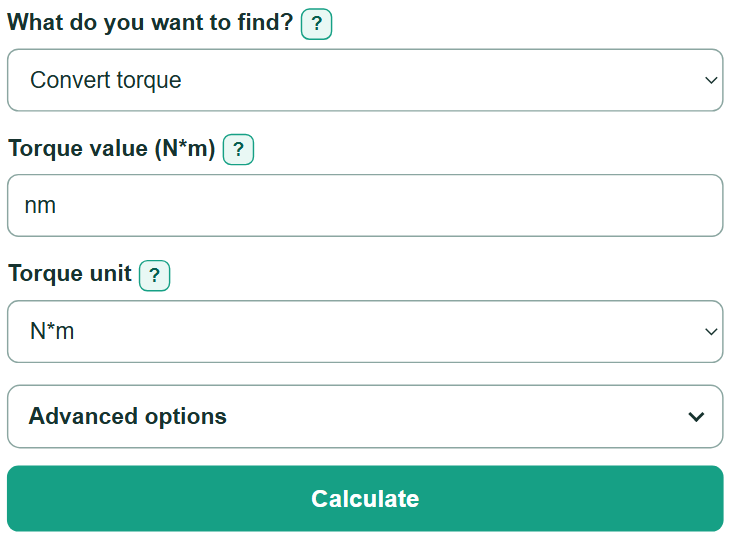
How to use our Newton Meter Calculator
- Choose the task under "What do you want to find?".
- For conversion, enter the torque number and choose the unit printed beside it in your manual, drawing, or torque wrench setting.
- For a torque equation task, enter the known force or lever-arm length and choose the matching units.
- Use "Advanced options" to change the force angle if it is not 90 degrees; a blank angle uses the perpendicular-force assumption of 90 degrees.
- Select "Calculate", then check that the leading answer has the unit you need and that the entered angle matches how the force is actually applied.
Definitions
Torque: A turning effect around a pivot or rotation axis. This calculator reports its magnitude, not clockwise or counterclockwise direction.
Newton-meter (N*m): The SI unit of torque. One N*m is produced by a one-newton force applied one meter from a pivot at a right angle.
lb-ft: Pound-force feet, a torque unit used in many US vehicle and tool specifications. It may also be written ft-lb or lbf*ft.
Lever arm: The distance from the pivot to the point where the force is applied.
Perpendicular force: The part of a force acting at a right angle to the lever arm. This is the part that creates torque.
Angle between force and lever arm: The smaller angle between the lever arm and the force direction. A 90-degree angle gives the greatest torque for the same force and length.
Pound-force (lbf): A unit of force, not mass. One lbf equals about 4.44822 N.
Common mistakes and quick fixes
Mistake: Entering a wrench setting in N*m while "Torque unit" is set to lb-ft.
Fix: Choose the unit printed beside the source number before calculating. Changing the unit changes what the entered number means.
Mistake: Treating lb-ft as pounds of mass.
Fix: Use lb-ft for torque and lbf for force. Pounds of mass are not a force value.
Mistake: Measuring from the end of a handle instead of from the pivot.
Fix: Measure from the rotation axis to the exact point where the force is applied.
Mistake: Leaving the angle at 90 degrees when the force is pushed along the handle.
Fix: Enter the smaller angle between the force direction and lever arm. An angled force produces less torque than a perpendicular force.
Mistake: Typing a comma as a decimal mark, such as 1,5.
Fix: Use a decimal point for fractions, such as 1.5. Use commas only as thousands separators, such as 1,000.
Limitations & Key Assumptions / Boundary Conditions
- The calculator uses torque magnitude only. It does not calculate clockwise or counterclockwise direction, vector components, or net torque from multiple forces.
- The entered angle must be greater than 0 and less than 180 degrees. At 0 or 180 degrees, the perpendicular force component is zero.
- Use the pivot-to-force distance, not the full handle length unless the force is applied exactly at the handle end.
- Friction, bending, flexing, off-center loading, and tool calibration can make real applied torque differ from this ideal calculation.
- N*m has the same physical dimensions as a joule, but this calculator uses N*m as torque, not energy.
- Displayed values are rounded to the selected decimal places while calculations use unrounded values.
Methodology
Calculation method
The calculator converts torque to N*m, force to newtons, and lever-arm length to meters before solving. It then uses the part of the force that is perpendicular to the lever arm.
τ (torque in N*m) = F (force in N) * r (lever-arm length in m) * sin(θ)
θ is the angle between the force direction and lever arm. At 90 degrees, sin(θ) is 1, so the full force contributes to torque. [1]
Finding force or length
For "Find required force" and "Find lever arm", the calculator rearranges the same equation. A zero force or zero lever arm cannot be used in the matching inverse calculation because it would require division by zero.
F (force in N) = τ / (r * sin(θ))
r (lever-arm length in m) = τ / (F * sin(θ))
Unit conversions
The torque conversions use 1 lb-ft = 1.3558179483314004 N*m and 1 lb-in = 0.1129848290276167 N*m. The force and length conversions include 1 lbf = 4.4482216152605 N and 1 in = 0.0254 m.
lb-ft = N*m / 1.3558179483314004
Worked example
A 100 N force applied 0.5 m from a pivot at 90 degrees produces 50 N*m. That converts to about 36.878 lb-ft and 442.537 lb-in when three decimal places are selected.
τ = 100 * 0.5 * sin(90 degrees) = 50 N*m