
Convert US fluid ounces to US cups, or turn weighed ingredient ounces into cups using that ingredient's weight per cup.
Table of contents
How to use our Oz to Cups Converter
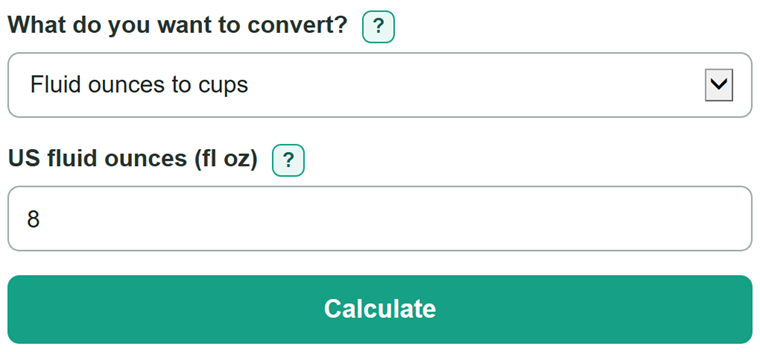
- Choose "Fluid ounces to cups" for an amount labeled fl oz, "Cups to fluid ounces" for a US cup amount, or "Ounces by weight to cups" for an amount measured on a scale.
- Enter the amount from the recipe, measuring cup, package, or scale in the field that appears.
- For "Ounces by weight to cups," enter the ounces in 1 US cup for the same ingredient and preparation, such as sifted or packed.
- Click "Calculate" to see the converted amount plus equivalent milliliters and US tablespoons.
- Check "How this conversion was chosen" before measuring. It should say volume for fl oz or cups, and ingredient weight for an amount from a scale.
Definitions
US fluid ounce (fl oz): A US unit of volume. Eight US fluid ounces equal 1 US cup.
US cup: A US volume measure equal to 8 US fluid ounces, 16 US tablespoons, and 236.5882365 mL.
Ounce by weight (oz): A unit of weight shown by a kitchen scale or a package net-weight label. It is different from a fluid ounce.
Ounces per cup: The weight of 1 US cup of a specific ingredient in its stated form. This is needed to convert ingredient weight into cups.
Milliliter (mL): A metric unit of volume. The calculator shows the milliliters equivalent of the converted US cup volume.
Common mistakes and quick fixes
Mistake: Dividing every amount labeled oz by 8.
Fix: Divide by 8 only for US fluid ounces (fl oz), which measure volume. Choose "Ounces by weight to cups" for ounces from a scale.
Mistake: Using an ounces-per-cup value for a different form of an ingredient.
Fix: Match the ingredient and preparation. A cup of packed, sifted, chopped, or whole food can have a different weight.
Mistake: Treating another country's cup as a US cup.
Fix: Use this converter only for US cups. Keep the original cup standard if a recipe specifies metric, Australian, or UK cups.
Mistake: Typing a decimal with a comma, such as 1,5.
Fix: Use a decimal point for decimals, such as 1.5. Use commas only as thousands separators, such as 1,000.
Mistake: Entering zero for "Ingredient weight in 1 US cup (oz)."
Fix: Enter a positive weight from a package or recipe reference for that ingredient. Division by zero is undefined.
Limitations & Key Assumptions / Boundary Conditions
- The 8-to-1 rule applies only to US fluid ounces and US cups, which are volume measures.
- Weight ounces need an ingredient-specific ounces-per-cup value; there is no single weight-ounce-to-cup rule.
- The weight-based answer depends on the entered ingredient reference. Packing, chopping, sifting, moisture, and settling can change an ingredient's weight per cup.
- This converter uses US cups only and does not convert metric, Australian, or UK cup standards.
- Zero is valid for an amount being converted. Negative amounts, malformed numbers, and zero ounces per cup are not valid inputs.
Methodology
Calculation method
For liquid volume, the calculator uses 8 US fluid ounces per US cup. It converts the resulting US cup amount to milliliters and US tablespoons using fixed US volume relationships.
US cups = US fluid ounces / 8
US fluid ounces = US cups x 8
milliliters = US cups x 236.5882365
US tablespoons = US cups x 16
Weight conversion
An amount from a scale is weight, not volume. The calculator divides the ingredient weight by the weight of 1 US cup that you enter for that same ingredient and preparation.
US cups = ingredient weight (oz) / ingredient weight of 1 US cup (oz)
Worked example
For liquid volume, 12 fl oz divided by 8 equals 1.5 US cups. For ingredient weight, 6 oz divided by 4.25 oz per US cup equals about 1.4118 US cups.