
Enter a molecular formula or atom counts to calculate degree of unsaturation and see the possible total of rings and pi bonds.
Table of contents
How to use our Degree of Unsaturation Calculator
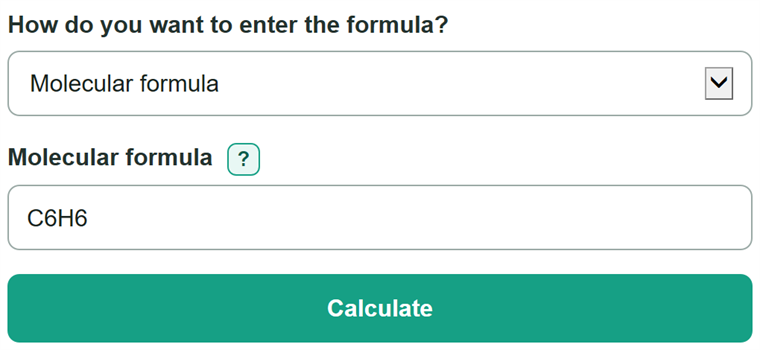
- Choose Molecular formula if you can copy a formula such as C8H10N4O2, or choose Separate atom counts if you already know the carbon, hydrogen, nitrogen, and total halogen counts.
- Enter the formula with correct capitalization, or enter whole-number atom counts. For manual entry, combine all F, Cl, Br, and I atoms into the halogen field.
- Click Calculate to see the degree of unsaturation first, followed by the atom counts and substituted calculation.
- Sanity-check the atom summary against the formula you copied, especially the nitrogen count and total halogen count. Oxygen and sulfur should appear in the summary but do not change the calculation.
- Interpret a whole nonnegative answer as the total rings and pi-bond equivalents. Do not round a fractional or negative answer; check the formula or chemical model instead.
Definitions
Degree of unsaturation (DoU): The total number of rings and pi-bond equivalents indicated by a molecular formula in the neutral closed-shell model.
Index of hydrogen deficiency (IHD): Another name for degree of unsaturation.
Double-bond equivalents (DBE): Another name for degree of unsaturation. One ring or double bond is 1 DBE; one triple bond is 2 DBE.
Halogens (X): Fluorine, chlorine, bromine, and iodine. Their combined count is written as X in the calculation.
Pi bond: A bond found in addition to a sigma bond. A double bond has one pi bond, and a triple bond has two pi bonds.
Saturated hydrogen count: The hydrogen count predicted for a formula with no rings or pi bonds under this model.
Common mistakes and quick fixes
Mistake: Missing nitrogen while copying the formula.
Fix: Include every N atom. Each nitrogen raises the matching saturated hydrogen count by 1.
Mistake: Leaving out chlorine, bromine, fluorine, or iodine.
Fix: Add all F, Cl, Br, and I atoms into one total halogen count. Each halogen takes the place of one hydrogen in this calculation.
Mistake: Including oxygen or sulfur in the calculation as if each were a hydrogen.
Fix: Keep O and S in a formula entry so the atom check can show them, but do not add them to the DoU equation.
Mistake: Rounding a result such as 0.5 to 1.
Fix: Leave the fractional value unchanged. It often means the formula has a typo or does not fit the neutral closed-shell model.
Mistake: Entering grouped notation such as C6H5(OH).
Fix: Expand it to a flat formula first, such as C6H6O. Parentheses, dots, charges, and isotope notation are not supported.
Limitations & Key Assumptions / Boundary Conditions
- The calculation is intended for neutral, closed-shell organic formulas containing C, H, N, O, S, F, Cl, Br, and I.
- A whole nonnegative DoU limits possible structures, but it cannot identify one structure or show which units are rings, double bonds, or triple bonds.
- Oxygen and sulfur are included in the atom summary but do not change the conventional DoU equation.
- Parentheses, brackets, hydrate dots, leading coefficients, charges, radicals, isotopes, decimal subscripts, and unsupported elements need a different treatment.
- A fractional or negative result is kept as a diagnostic. It is not an ordinary count of rings and pi bonds for this model.
Methodology
Calculation
The calculator uses carbon (C), hydrogen (H), nitrogen (N), and total halogens (X). X is the combined number of F, Cl, Br, and I atoms. Oxygen and sulfur are read for the atom check but are not part of this conventional equation.
Hsat = 2C + 2 + N - X
Hsat is the hydrogen count for the matching saturated formula. The degree of unsaturation compares that count with the hydrogen atoms actually present.
DoU = (Hsat - H) / 2
DoU = (2C + 2 + N - H - X) / 2
Worked example
For C6H6, C is 6, H is 6, N is 0, and X is 0. The saturated hydrogen count is 14, so the calculation is:
(2 x 6 + 2 + 0 - 6 - 0) / 2 = 4
The DoU is 4. Those four units can be divided among rings and pi bonds in more than one way, so the formula does not prove a single structure.
Reading the answer
A result of 0 means no rings or pi bonds under this formula model. Each ring or double bond adds 1 unit, and each triple bond adds 2 units. A fractional or negative result is displayed without rounding because the entered formula needs review or falls outside the model used here.