
Enter a starting amount or activity, elapsed time, and half-life to calculate what remains or solve for another radioactive decay value.
Quantity
Time
Table of contents
How to use our Radioactive Decay Calculator
- Choose the value you need under "What do you want to find?"
- For an amount problem, enter the known initial or remaining amount and choose the unit used for both values.
- For an activity problem, enter the known activity values in the same activity unit. Activity is not radiation dose.
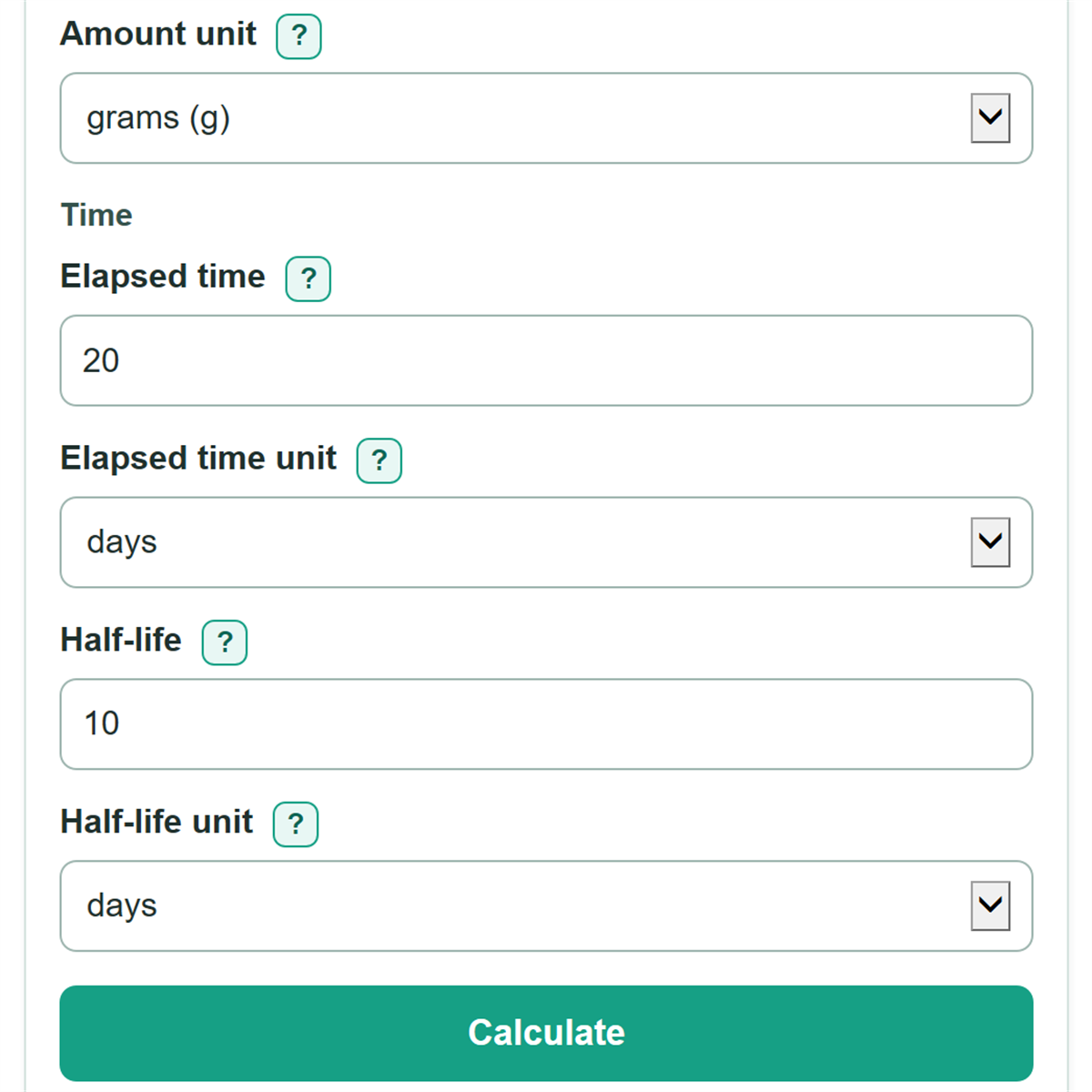
- Enter the known elapsed time and half-life, then choose the unit printed with each time value.
- Select "Calculate" and check the result against the half-lives elapsed. For example, after 2 half-lives, 25 percent should remain.
Definitions
Half-life: The time for the expected number of undecayed nuclei, or their activity, to fall to one half of its starting value.
Initial amount: The material quantity at the start of the time interval, such as grams, moles, or atoms.
Remaining amount: The material quantity left after decay during the entered elapsed time.
Activity: The rate of radioactive nuclear transformations. Becquerel (Bq) and curie (Ci) are activity units; activity is different from absorbed dose and dose equivalent. [1] [2]
Elapsed half-lives: Elapsed time divided by half-life after both times are converted to the same time basis.
Percent remaining: The part of the starting amount or activity that remains, written as a percent. One half-life leaves 50 percent; two half-lives leave 25 percent.
Common mistakes and quick fixes
Mistake: Using different units for the initial and remaining amounts.
Fix: Check What do you want to find? and then recalculate. Choose one amount unit and convert one value first if needed, so both amount values use that unit.
Mistake: Treating elapsed time in days as though a half-life stated in years were also in days.
Fix: Check What do you want to find? and then recalculate. Select the printed unit for each value. The calculator converts the times to a shared basis.
Mistake: Entering a remaining amount or activity larger than its initial value while finding elapsed time.
Fix: Check What do you want to find? and then recalculate. For forward radioactive decay, the target must be less than or equal to the starting value.
Mistake: Using Gy, Sv, rad, or rem as an activity unit.
Fix: Check What do you want to find? and then recalculate. Choose Bq, Ci, or a listed prefix such as mCi or uCi. Dose units measure a different quantity.
Mistake: Entering 0 for half-life.
Fix: Check What do you want to find? and then recalculate. Enter a positive half-life from the problem or a reference that matches the exact isotope and nuclear state.
Limitations & Key Assumptions / Boundary Conditions
- The calculation assumes one radioactive substance with a constant half-life and ordinary exponential decay.
- It describes the expected behavior of a large population of atoms; the decay time of one individual atom is random.
- Initial and remaining amounts must be the same kind of quantity and use the same selected amount unit.
- Initial and remaining activity values must use the same selected activity unit. The calculator keeps that unit and does not convert between activity units.
- Activity is not absorbed dose or dose equivalent. This calculator does not estimate exposure, shielding, dose, or health risk.
- A year is converted as 365.25 days. Results can differ from a source that uses a different year convention.
- For very long intervals, the calculated value can be too small for ordinary decimal display, so a displayed zero can mean an extremely small positive value.
Methodology
Decay calculation
The calculator converts elapsed time and half-life to seconds before comparing them. It then finds the number of half-lives that passed and applies the resulting fraction to the starting amount or activity.
n (elapsed half-lives) = t (elapsed time) / T (half-life)
f (fraction remaining) = 2-n
N (remaining value) = N0 (initial value) x f
percent remaining = 100 x f
Solving for a missing value
For elapsed time or half-life, the calculator first finds elapsed half-lives from the ratio of the initial value to the lower remaining value. For an initial amount, it divides the remaining amount by the fraction remaining.
n = ln(N0 / N) / ln(2)
t (elapsed time) = n x T
T (half-life) = t / n
N0 (initial amount) = N (remaining amount) / f
Worked example
Start with 100 g, use a half-life of 10 days, and let 20 days pass. Two half-lives have passed, so the fraction remaining is 0.25. The remaining amount is 25 g, and 25 percent remains.