
Enter moles or measured gas conditions to find the ideal gas volume at the STP reference your problem requires.
Table of contents
How to use our STP Calculator
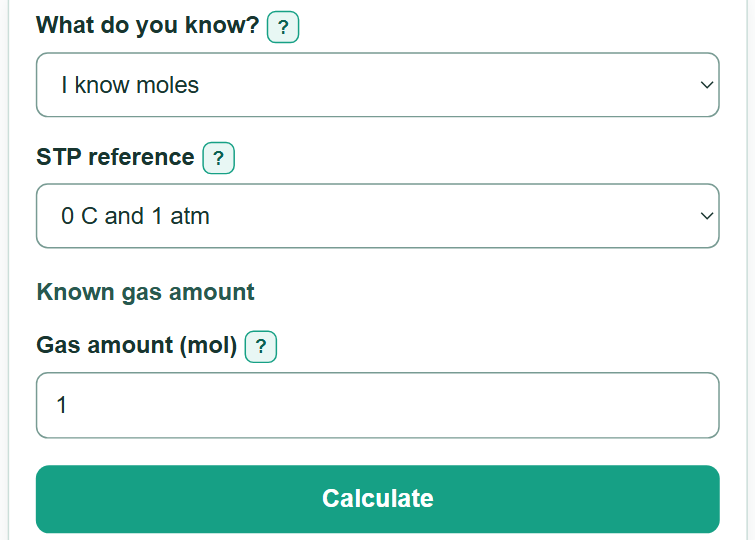
- Choose "What do you know?" to match the information in your problem: "I know moles" or "I measured volume, temperature, and pressure."
- Choose the required "STP reference." Check your assignment, textbook, lab instructions, or report because 0 C and 1 atm is different from 0 C and 100 kPa.
- For "I know moles," enter the value in "Gas amount (mol)." A value of 0 is allowed.
- For "I measured volume, temperature, and pressure," choose each source unit first. Then enter "Measured gas volume," "Measured gas temperature," and "Absolute gas pressure."
- Use absolute pressure, not gauge pressure. Temperature may be entered in C, K, or F.
- Select "Calculate." Read "Gas volume at selected STP" first, then check that "Selected STP reference" matches the condition your problem requests.
- Use "Gas amount used" as a check. It matches the entered amount on the moles path and is calculated from the measured conditions on the other path.
Definitions
STP: Standard temperature and pressure, a named reference condition used to report gas properties. This calculator supports 0 C and 1 atm, and 0 C and 100 kPa.
Absolute pressure: Pressure measured relative to a perfect vacuum. Gas-law calculations require absolute pressure, not gauge pressure.
Mole (mol): A unit for amount of substance. The ideal gas law uses n for the number of moles.
Ideal gas law: A relationship among pressure, volume, gas amount, and absolute temperature for an ideal gas. [1]
Molar volume: The volume occupied by one mole of gas at a stated temperature and pressure. It changes when the selected STP pressure changes.
Common mistakes and quick fixes
Mistake: Assuming STP always means 0 C and 1 atm.
Fix: Check the problem instructions, then select either "0 C and 1 atm" or "0 C and 100 kPa." These references have different molar volumes.
Mistake: Using a Celsius or Fahrenheit value directly in a gas-law temperature ratio.
Fix: Select the temperature unit printed with the measurement. The calculator converts C and F to Kelvin before calculating.
Mistake: Entering gauge pressure as "Absolute gas pressure."
Fix: Convert gauge pressure to absolute pressure first by adding the applicable atmospheric pressure.
Mistake: Changing a unit after entering a number and expecting the number to convert.
Fix: The unit selectors reinterpret the current number. Select the correct unit, then re-enter the original measurement.
Limitations & Key Assumptions / Boundary Conditions
- The calculation assumes ideal-gas behavior and a constant amount of gas between the measured state and the selected STP reference.
- Measured pressure must be absolute and greater than zero. Measured temperature must be above 0 K.
- Gas collected over water may need a water-vapor-pressure correction before you enter the dry-gas pressure.
- Leaks, chemical reactions, condensation, phase changes, and nonideal behavior at high pressure can make a real result differ from this estimate.
- STP is a reference convention, not one universal condition. Use the temperature and pressure pair required by the assignment or report.
Methodology
Calculation method
For "I know moles," the calculator applies the ideal gas law at the temperature and pressure of the selected STP reference.
V = nRT/P
V is volume in liters, n is gas amount in moles, R is 8.31446261815324 kPa L/(mol K), T is absolute temperature in Kelvin, and P is absolute pressure in kPa. The ideal gas law relates these quantities. [1]
For "I measured volume, temperature, and pressure," the calculator converts volume to liters, temperature to Kelvin, and pressure to kPa. It calculates the gas amount with the ideal gas law, then calculates that amount's volume at the selected STP reference. This is equivalent to the constant-amount gas-law ratio.
V2 = V1 × (P1/P2) × (T2/T1)
State 1 is the measured condition and state 2 is the selected STP condition. V is volume, P is absolute pressure, and T is absolute temperature in Kelvin.
Worked example
A 10 L sample at 25 C and 1 atm converted to 0 C and 1 atm has the same pressure in both states, so the pressure ratio is 1.
V2 = 10 × (273.15/298.15) = 9.161495891 L
The calculator uses 273.15 K for 0 C and 101.325 kPa for 1 atm.