
Enter a balanced reaction and its current amounts to calculate Qc or Qp, then compare it with K to find the direction toward equilibrium.
Advanced options
Table of contents
How to use our Reaction Quotient Calculator
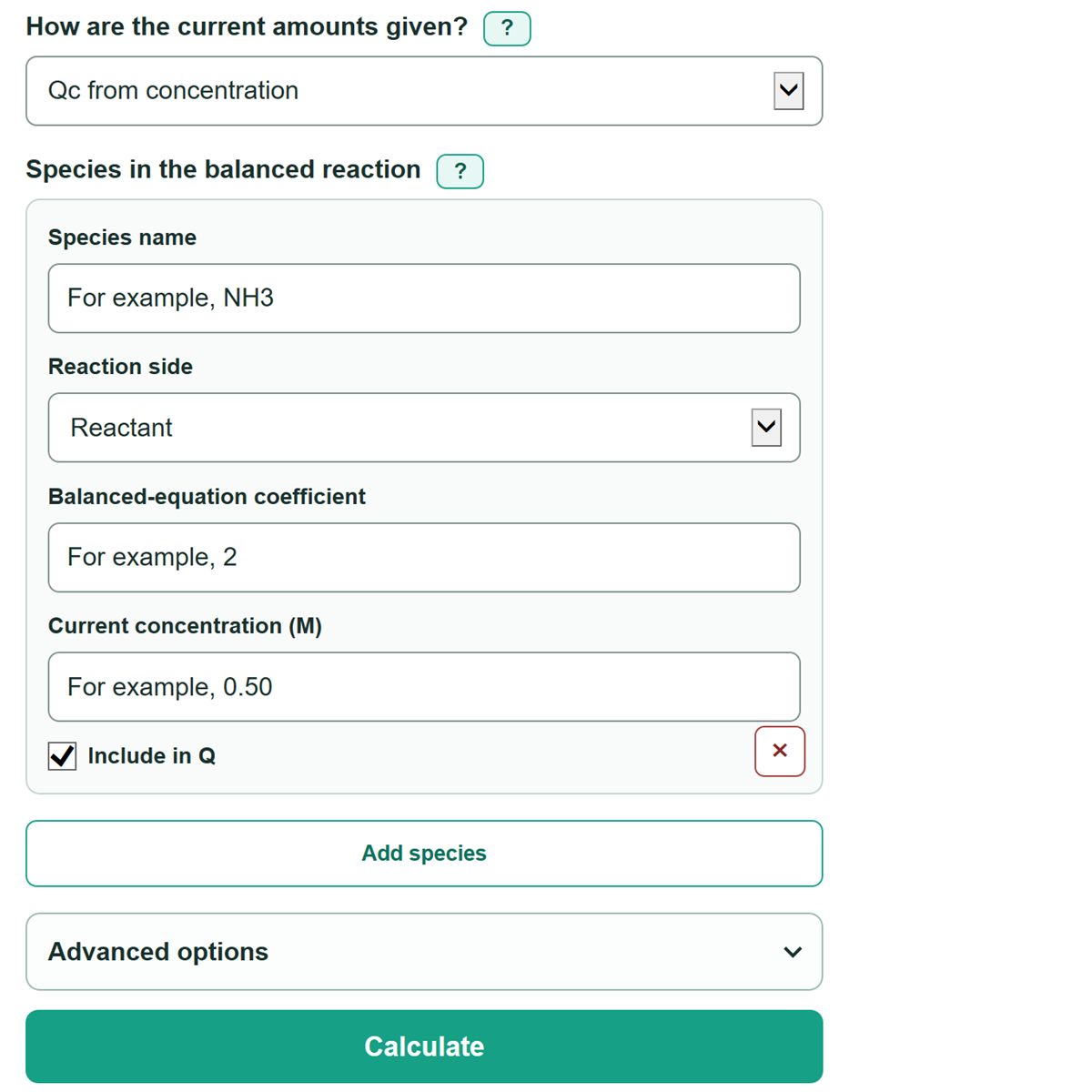
- Choose "Qc from concentration", "Qp from partial pressure", or "Qc from moles and volume" based on the quantities in your problem.
- For every species in the balanced reaction, enter its name, choose reactant or product, enter the coefficient written before its formula, and enter its current amount.
- Exclude pure solids, pure liquids, and the solvent in a dilute solution when your course treats them as omitted from the equilibrium expression.
- For "Qc from moles and volume", enter the shared vessel volume in liters. In "Advanced options", enter K only if it matches the selected Q form, reaction, and temperature.
- Select "Calculate" and check the displayed Q expression: products must be in the numerator, reactants in the denominator, and balanced coefficients as exponents.
Definitions
Reaction quotient (Q): A number calculated from the current mixture using the same products-over-reactants pattern as an equilibrium expression. It describes the current mixture, not reaction speed. [1]
Qc: Reaction quotient calculated from molar concentrations, usually shown with square brackets such as [A].
Qp: Reaction quotient calculated from partial pressures of gases.
Equilibrium constant (K): The value of the matching equilibrium expression at a particular temperature. Compare Qc with Kc and Qp with Kp.
Balanced-equation coefficient: The number before a chemical formula in a balanced equation. It becomes an exponent in Q.
Molarity (M): Concentration in moles per liter, calculated by dividing moles by liters.
Scientific notation: A compact number form such as 1.0e-3, meaning 1.0 times 10 raised to the power of -3.
Common mistakes and quick fixes
Mistake: Using a subscript in a formula, such as the 2 in H2, as the coefficient.
Fix: Enter the number before the formula in the balanced equation. Use 1 when no number is written.
Mistake: Selecting reactant for a product, or product for a reactant.
Fix: Products belong in the numerator and reactants belong in the denominator. Check the Q expression used before relying on Q.
Mistake: Mixing concentrations and partial pressures in one calculation.
Fix: Use "Qc from concentration" only with molar concentrations and "Qp from partial pressure" only with partial pressures.
Mistake: Entering moles as if they were molarity.
Fix: Select "Qc from moles and volume" and enter the one shared vessel volume so each amount is converted to M.
Mistake: Including a pure solid, pure liquid, or dilute-solution solvent in Q.
Fix: Exclude that row when your introductory equilibrium expression omits its term.
Mistake: Comparing Qc with Kp, or Qp with Kc.
Fix: Enter K only when it is for the same reaction, temperature, and expression form as Q.
Limitations & Key Assumptions / Boundary Conditions
- This calculator uses the introductory concentration or partial-pressure form of Q. In nonideal mixtures, activities can differ from raw concentrations or pressures.
- Compare Q with K only when both use the same balanced reaction, expression form, and temperature.
- The direction statement predicts net change toward equilibrium. It does not predict reaction speed or final equilibrium concentrations.
- In the moles-and-volume path, every entered amount must describe the same mixture volume. Each concentration is calculated as moles divided by that shared volume.
- Pure solids, pure liquids, and a dilute-solution solvent are excluded in this introductory treatment. Follow course instructions if a problem states a different convention.
- If an included reactant term is zero, Q is undefined because the denominator is zero. If a product term is zero while all reactant terms are positive, Q can equal zero.
Methodology
Calculation
The calculator multiplies included product terms in the numerator and included reactant terms in the denominator. Each coefficient from the balanced equation becomes an exponent. Qc uses molar concentrations, and Qp uses partial pressures. [1]
Q = product-side terms / reactant-side terms, each raised to its coefficient
Moles and volume
With "Qc from moles and volume", each included amount is converted to molarity before Qc is calculated. The calculator shows those generated concentrations so the conversion can be checked.
concentration (M) = amount (mol) / shared volume (L)
Comparing Q and K
For a positive matching K, Q less than K means net change is forward toward products. Q greater than K means net change is reverse toward reactants. Matching values mean the mixture is at equilibrium within a small numerical tolerance.
Q / K = reaction quotient / equilibrium constant
Worked example
For N2 + 3H2 <=> 2NH3, let [N2] = 0.5 M, [H2] = 0.2 M, and [NH3] = 0.1 M. The product term is 0.1 squared, and the reactant term is 0.5 times 0.2 cubed, so Qc = 2.5.
Qc = [NH3]^2 / ([N2] [H2]^3) = 0.1^2 / (0.5 * 0.2^3) = 2.5
The base-10 logarithm is shown only when Q is positive. For example, log10(Q) = 2 means Q = 100, while log10(Q) = -2 means Q = 0.01.
log10(Q) = LOG10(Q)