
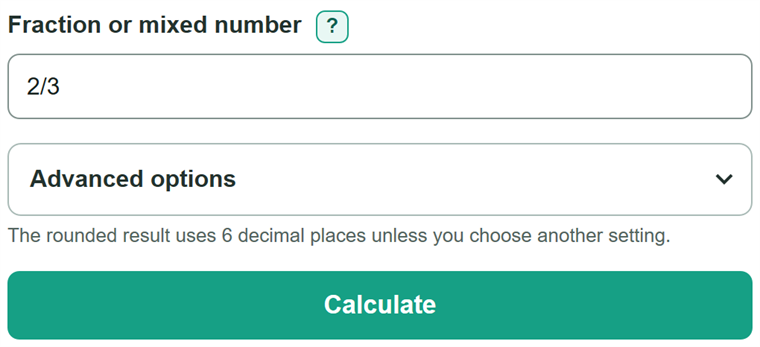
Enter a fraction or mixed number to see its exact decimal, including repeating digits, plus a rounded decimal when needed.
Advanced options
The rounded result uses 6 decimal places unless you choose another setting.
This is the exact decimal. Parentheses mark the shortest block of digits that repeats forever.
This is an approximation at the selected number of decimal places.
A terminating decimal ends. A repeating decimal has a digit block that continues forever.
Table of contents
How to use our Fraction to Decimal Calculator
- Enter a whole number, fraction such as 3/8, improper fraction such as 11/4, finite decimal, or mixed number such as 2 3/4 in "Fraction or mixed number."
- For a negative mixed number, put the minus sign before the whole value, as in -2 3/4.
- If you need a certain rounding level, open "Advanced options" and choose "Rounded decimal places." Then select "Calculate."
- Read "Decimal equivalent" for the exact answer. Parentheses show the shortest digit group that repeats forever.
- Sanity-check a terminating answer by multiplying its decimal value by the denominator. It should give the numerator. For a repeating answer, use the exact fraction for later work instead of the rounded decimal.
Definitions
Fraction: A number written with a numerator over a denominator, such as 3/8.
Numerator: The number above the fraction bar. In 3/8, it is 3.
Denominator: The number below the fraction bar. In 3/8, it is 8. It cannot be zero.
Mixed number: A whole number and a fraction written together, such as 2 3/4.
Terminating decimal: A decimal that ends, such as 0.375.
Repeating decimal: A decimal with one or more digits that continue forever. In 0.1(6), the 6 repeats, so the value is 0.16666...
Rounded decimal: An approximate decimal written to a selected number of places after the decimal point.
Common mistakes and quick fixes
Mistake: Entering a denominator of 0, such as 5/0.
Fix: Change the denominator. Division by zero is undefined, so it has no decimal equivalent.
Mistake: Reading 0.(6) as 0.6 only.
Fix: The parentheses mean the 6 repeats forever. The exact value is 0.6666..., not 0.6.
Mistake: Entering -2 3/4 when you mean negative 2 plus 3/4.
Fix: -2 3/4 means negative two and three fourths, or -2.75. For negative 2 plus 3/4, enter -2 + 3/4 is not supported; enter -1 1/4 instead.
Mistake: Treating a rounded decimal as the exact value in later calculations.
Fix: Keep the fraction or exact repeating decimal until the final rounding step.
Mistake: Typing an incomplete fraction such as 3//8 or 2 3/.
Fix: Use one slash and include both numbers around it, such as 3/8 or 2 3/4.
Limitations & Key Assumptions / Boundary Conditions
- The calculator accepts whole numbers, finite decimals, fractions, improper fractions, and mixed numbers made with integer components.
- A denominator of 0 is undefined, so the calculator does not show a decimal answer.
- To keep exact repeating-decimal output responsive, the denominator's absolute value must be from 1 to 10,000. Larger denominators are rejected.
- Each whole-number, numerator, and denominator component can contain up to 100 digits.
- The rounded display supports 0 through 15 decimal places. Use the exact terminating or repeating form when more detail is needed.
- A rounded decimal is an approximation and can differ from the exact value, especially when digits repeat.
Methodology
Exact decimal conversion
The calculator reads the entry as an exact fraction. For a mixed number, the sign applies to the complete value, so -2 3/4 is -(2 + 3/4). It reduces the fraction before dividing. During long division, a remainder of zero means the decimal ends. If a remainder occurs again, the digits since its first appearance are the shortest repeating block.
decimal equivalent = exact numerator divided by exact denominator
Rounded decimal
The rounded value comes from the exact fraction, not from a shortened decimal display. It rounds to the selected number of places. When a value is exactly halfway between two choices, it rounds away from zero.
rounded decimal = round(exact numerator divided by exact denominator, decimal places)
Decimal type
After reduction, a fraction terminates only if its denominator has no prime factors other than 2 and 5. Otherwise, its decimal repeats.
terminating if the reduced denominator has only factors 2 and 5
Worked example
For 2/3, long division gives 0.6666... and the same remainder returns after the first 6. The exact display is 0.(6). At six decimal places, the rounded decimal is 0.666667.