
Use this reconstitution calculator to find concentration, dose draw amount, or the diluent volume needed for a target mix strength.
Advanced options
How to use our Reconstitution Calculator
- Choose What do you want to find? so the calculator knows whether to solve for Draw amount (mL), Final concentration, or Diluent to add (mL).
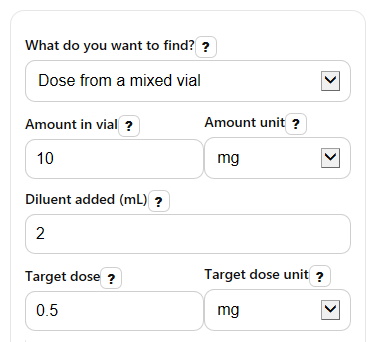
- Enter Amount in vial and pick the matching Amount unit, then fill in the mode-specific field: Diluent added (mL), Target dose with Target dose unit, or Target concentration with Target concentration unit.
- If you want a syringe-scale readout, open Advanced options and turn on Show insulin syringe units, then choose Syringe size (mL). You can also change Result decimals there.
- Click Calculate and read the first result card as your main answer, then use Final concentration and Approximate number of target doses to understand what the mix means in practice.
- Sanity-check the output: a larger Diluent added (mL) should make Final concentration lower, and a larger Target dose should make Draw amount (mL) higher. If that pattern does not fit, recheck your units.
Definitions
Amount in vial: The total drug amount in the powder before mixing, entered in mg or mcg.
Diluent added (mL): The liquid volume added to the vial to make the final solution.
Final concentration: How much drug is in each 1 mL after mixing, shown as mg/mL and mcg/mL.
Target dose: The amount wanted for one dose, in mg or mcg.
Draw amount (mL): The volume of mixed solution needed to deliver the Target dose.
Target concentration: The mix strength you want to end up with when solving for Diluent to add (mL).
U-100 syringe: An insulin syringe scale where 1 mL equals 100 units, so 1 unit equals 0.01 mL.
Approximate number of target doses: The ideal vial total divided by the Target dose, before losses from dead space or waste.
Common mistakes and quick fixes
Mistake: Entering Amount in vial as 10 but leaving Amount unit on mcg when the vial label is 10 mg.
Fix: Match Amount unit to the vial label before calculating Final concentration or Draw amount (mL).
Mistake: Typing Target dose in mcg but leaving Target dose unit on mg.
Fix: Change Target dose unit so it matches the number you entered, or convert the number first.
Mistake: Using Diluent added (mL) in the Diluent to add for a target concentration mode and expecting it to affect the answer.
Fix: In that mode, enter Target concentration and Target concentration unit instead, then read Diluent to add (mL).
Mistake: Reading Draw amount on a U-100 syringe as mL without turning on Show insulin syringe units.
Fix: Enable Show insulin syringe units only if you want the U-100 scale conversion in units as well as Draw amount (mL).
Mistake: Ignoring a very tiny Draw amount (mL), such as less than 0.01 mL.
Fix: Check the Note output and consider whether the mix is too concentrated for accurate measuring.
Mistake: Seeing Approximate number of target doses and treating it as exact usable doses.
Fix: Use Approximate number of target doses as an ideal math estimate, not a guarantee after wastage or dead space.
Limitations & Key Assumptions / Boundary Conditions
- The calculator uses basic reconstitution math and assumes the entered Amount in vial is fully dissolved in the final mixture.
- It treats Diluent added (mL) as the working final liquid volume for the calculation. In real products, powder displacement or label-specific directions can make the actual final volume differ.
- Approximate number of target doses is an ideal count and does not subtract waste, syringe dead space, priming, or leftover liquid.
- Optional U-100 syringe output is only a scale conversion from mL to units. It does not confirm that a given syringe type is appropriate for a specific substance or use.
- Very small Draw amount (mL) values can be hard to measure accurately even when the math is correct.
- If Draw amount (mL) is larger than the chosen Syringe size (mL), the calculator still shows the math result but flags it with a note.
- This tool is educational and calculation-focused. Product-specific preparation steps, stability limits, and administration instructions can differ from one vial to another.
Methodology
Core math
The calculator first converts mass units so the numbers match. It uses 1 mg = 1000 mcg.
C = M / V
Here, C is Final concentration, M is the total Amount in vial, and V is Diluent added (mL).
Vdraw = D / C
In dose mode, Vdraw is Draw amount (mL), D is Target dose, and C is the mixed concentration.
V = M / Ctarget
In target-concentration mode, V is Diluent to add (mL), M is the total vial amount, and Ctarget is the Target concentration.
units = Vdraw x 100
If U-100 syringe output is turned on, the calculator converts mL to insulin syringe units using 100 units per 1 mL.
N = M / D
Approximate number of target doses is the vial total divided by the Target dose after unit matching.
Worked mini-example
Suppose Amount in vial is 10 mg, Diluent added (mL) is 2, and Target dose is 0.5 mg.
Final concentration = 10 mg / 2 mL = 5 mg/mL
Draw amount = 0.5 mg / 5 mg/mL = 0.1 mL
Approximate number of target doses = 10 mg / 0.5 mg = 20
If U-100 output is enabled, 0.1 mL becomes 10 units.
How the calculator handles units and notes
If you mix mg with mcg inputs, the calculator converts them before dividing or comparing. That prevents unit mismatch errors.
It shows a note when Draw amount (mL) is very small, when the Target dose is larger than the total vial amount, or when the draw volume is bigger than the selected Syringe size (mL).
Assumptions used
The math follows the standard mass-volume-concentration relationship used in reconstitution calculations [1]. Real vial instructions can differ because of product-specific final-volume rules, displacement, or preparation steps.