
Calculate the activity coefficient for an aqueous ion or binary liquid component and check whether the selected model fits your conditions.
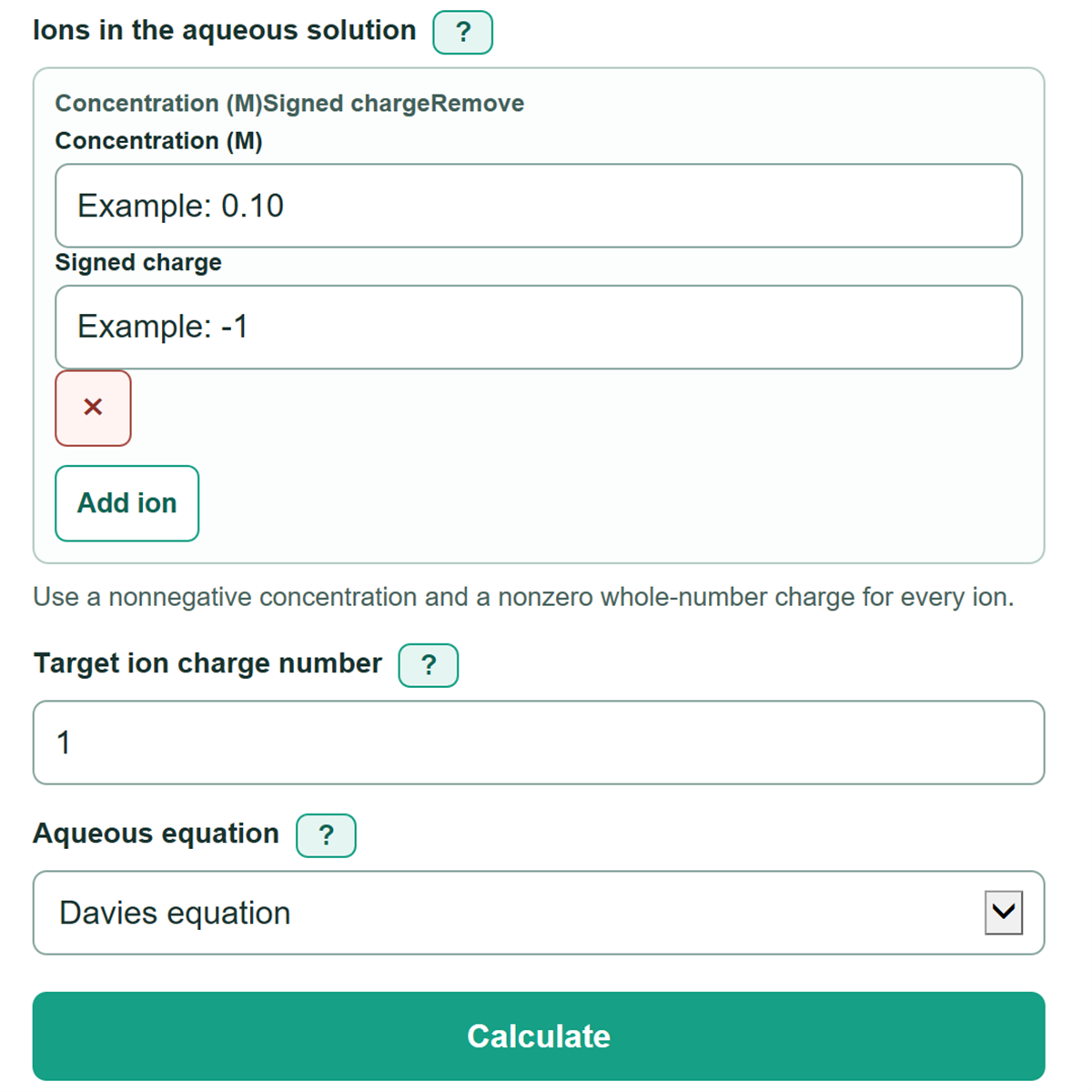
Use a nonnegative concentration and a nonzero whole-number charge for every ion.
Table of contents
How to use our Activity Coefficient Calculator
- Choose "Aqueous electrolyte" for dissolved ions in water or "Binary liquid mixture" for two liquid components.
- For an aqueous solution, add every dissolved ion with its concentration in M and signed charge, then enter the signed charge of the ion you are studying.
- Choose the required aqueous equation, or, for a binary mixture, enter component 1 mole fraction and the fitted "Margules interaction parameter A" for the same component order and conditions.
- Select "Calculate." Check the equation name, charge check, and applicability message before using the coefficient in later work.
Definitions
Activity coefficient (γ): A dimensionless correction that relates a component's activity to its concentration-based or composition-based reference value. An ideal-reference value is 1.
Ionic strength (I): A concentration measure that weights each dissolved ion by the square of its charge.
Davies equation: An aqueous-electrolyte equation that estimates an ion activity coefficient from ionic strength.
Limiting Debye-Huckel equation: A dilute-solution equation for ion activity coefficients at very low ionic strength.
Mole fraction (x): The moles of one component divided by total moles in a mixture. In a binary mixture, x1 + x2 = 1.
Margules interaction parameter (A): A dimensionless fitted number used by the one-parameter Margules model for one binary liquid pair under stated conditions.
Common mistakes and quick fixes
Mistake: Entering the salt concentration for every ion after dissociation.
Fix: Enter each ion concentration separately. For fully dissociated 0.10 M NaCl, enter 0.10 M Na+ and 0.10 M Cl-.
Mistake: Leaving out a counterion or using the wrong charge sign.
Fix: Add every dissolved ion and use its signed charge. If the charge check fails, review counterions, concentrations, and signs.
Mistake: Treating ionic strength as the sum of ion concentrations.
Fix: Ionic strength uses concentration times charge squared. A 2+ or 2- ion has four times the charge-squared factor of a 1+ or 1- ion at the same concentration.
Mistake: Using the limiting Debye-Huckel equation at moderate ionic strength.
Fix: Use it only in the displayed low-strength range. Use the Davies equation only when it is appropriate for your method and its displayed range.
Mistake: Reusing a Margules parameter for a different temperature, component pair, or component order.
Fix: Use a parameter fitted for the exact binary system and conditions in your calculation.
Limitations & Key Assumptions / Boundary Conditions
- The aqueous calculations use the 25 C water constant A = 0.509 and use molarity as an approximation for the concentration basis. Different temperatures, solvents, and concentration conventions can produce different coefficients.
- The limiting Debye-Huckel result is marked within range only when ionic strength is 0.01 M or less. The Davies result is marked within range only when ionic strength is 0.5 M or less.
- A passing charge check shows only that the entered positive and negative charge concentrations balance within the calculator tolerance. It cannot confirm that every species, complex, or chemical reaction was included.
- The binary calculation uses only the one-parameter Margules model. Its parameter must be fitted for the same two components, component order, temperature, pressure basis, and composition convention.
- At mole fractions of 0 or 1, the Margules equations are mathematically defined, but the fitted-data range and real pure-component behavior still need separate review.
Methodology
Aqueous electrolyte calculation
The calculator finds ionic strength from every listed ion. Concentration is entered in molarity, M, and charge is a signed whole number.
I = 0.5 × Σ(cizi2)
It also compares the signed charge-concentration total with the total absolute charge concentration. A failed charge check blocks the calculation because it often means a counterion is missing or an ion entry is incorrect.
For the limiting Debye-Huckel equation, the calculator uses the 25 C water constant 0.509. [1]
γ = 10-0.509z2√I
For the Davies equation, it uses the same constant and the 0.3 ionic-strength term.
γ = 10-0.509z2(√I/(1 + √I) - 0.3I)
The Davies form is used for a broader ionic-strength range than the limiting law, while still requiring a range check. [2]
Binary liquid calculation
For a binary mixture, the calculator derives component 2 mole fraction from the entered component 1 mole fraction. It then applies the fitted one-parameter Margules interaction parameter A.
x2 = 1 - x1
γ1 = exp(Ax22); γ2 = exp(Ax12)
Worked aqueous example
For 0.10 M Na+ and 0.10 M Cl-, both charges have magnitude 1, so I = 0.5(0.10 × 12 + 0.10 × 12) = 0.10 M. Using the Davies equation for a target ion with charge +1 gives an activity coefficient of about 0.782.