
Enter your ppm concentration and molar mass to calculate molarity in mol/L, using the mg/L or mg/kg meaning shown by your source.
Table of contents
How to use our PPM to Molarity Calculator
- Check the unit next to the ppm value in your report, label, or instrument reading.
- Choose mg/L if the value is mass per liter, or mg/kg if it is mass per kilogram of solution.
- Enter the concentration and the molar mass of the dissolved substance in g/mol.
- For an mg/kg value, enter the density of that same solution in kg/L.
- Calculate, then confirm the mass concentration used matches your source: it should equal the entered ppm for an mg/L source.
Definitions
ppm: Parts per million. The unit reported with the value determines whether it describes mass per liter or mass per mass.
mg/L: Milligrams of dissolved substance per liter of solution. A ppm value reported as mg/L is already a mass concentration.
mg/kg: Milligrams of dissolved substance per kilogram of solution. For a mass-based concentration, 1 ppm equals 1 mg/kg.
Molar mass: The mass of one mole of a substance, expressed in grams per mole (g/mol).
Molarity: The amount of dissolved substance in one liter of solution, expressed in moles per liter (mol/L).
mmol/L: Millimoles per liter. One mol/L equals 1,000 mmol/L.
Solution density: The mass of the complete solution per liter, expressed here in kg/L.
Common mistakes and quick fixes
Mistake: Treating every ppm reading as mg/L.
Fix: Read the unit printed with the value. Select mg/kg when the source gives mass per mass of solution.
Mistake: Omitting density for a ppm value reported as mg/kg.
Fix: Enter the density in kg/L for the same solution, because it converts mg/kg into mg/L.
Mistake: Entering a chemical formula in the molar-mass box.
Fix: Enter the numerical molar mass in g/mol for the substance or chemical form named by the source.
Mistake: Using water density for a solution with a different composition or temperature.
Fix: Use a measured density or a reference value for the actual solution at the relevant temperature.
Mistake: Reading scientific notation as zero.
Fix: A result of 1e-8 mol/L is nonzero. It equals 0.00000001 mol/L.
Mistake: Using a comma as a decimal mark, such as 1,01.
Fix: Use a decimal point for decimals, such as 1.01. Use commas only for thousands, such as 1,000.
Limitations & Key Assumptions / Boundary Conditions
- The result is only as accurate as the entered ppm value, molar mass, and, for mg/kg sources, solution density.
- A density used for mg/kg must match the same solution and temperature because density can change with temperature and composition.
- The calculation converts the stated concentration only. It does not account for chemical reactions, incomplete dissolution, or a test method that uses a different reporting basis.
- Use the molar mass for the actual substance or chemical form reported. A salt, ion, hydrate, or mixture may not have the same molar mass as a related chemical.
- Zero ppm is valid and gives zero molarity. Negative concentration, zero molar mass, and zero or negative density cannot be used.
Methodology
Calculation method
The calculator first finds mass concentration in milligrams per liter (mg/L). If the source already reports ppm as mg/L, the entered number is used directly. If the source reports ppm as mg/kg, the calculator multiplies the entered value by solution density in kg/L.
Mass concentration (mg/L) = ppm
This applies when ppm means mg/L.
Mass concentration (mg/L) = ppm × solution density (kg/L)
This applies when ppm means mg/kg. The kg units cancel, leaving mg/L.
The calculator converts milligrams to grams, then divides by molar mass to find moles per liter.
Molarity (mol/L) = mass concentration (mg/L) / (1000 × molar mass (g/mol))
It multiplies molarity by 1,000 for the millimoles-per-liter display.
Millimolarity (mmol/L) = molarity (mol/L) × 1000
Worked example
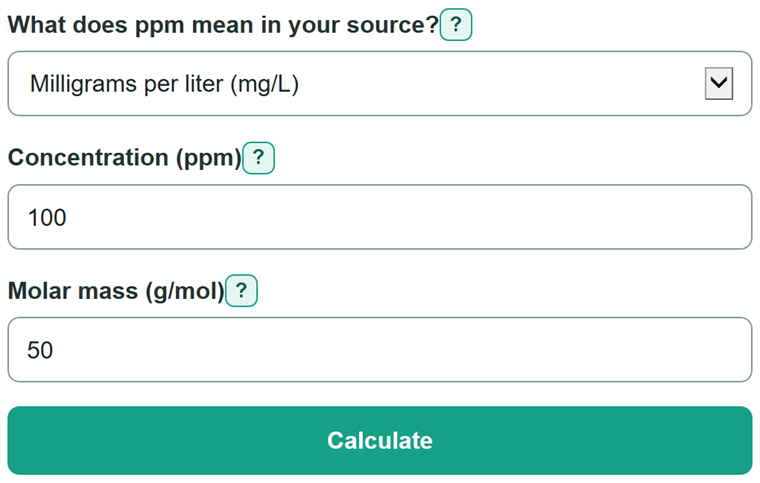
A sample reported as 100 ppm mg/L with a molar mass of 50 g/mol has a mass concentration of 100 mg/L. Dividing 100 by 1000 times 50 gives 0.002 mol/L, which is 2 mmol/L.
Choosing the ppm basis
A mass-based ppm value of 1 ppm means 1 mg/kg. It does not automatically mean 1 mg/L. The mg/kg calculation needs solution density to convert a mass-based concentration into a per-liter concentration. Very small nonzero results use scientific notation so they are not displayed as zero.