
Use this calculator to find percent ionic character from electronegativity or dipole data and quickly see what the result says about the bond.
How to use our Percent Ionic Character Calculator
- Choose a method under "What do you want to use?" Pick electronegativity if your class gives Pauling values, or pick dipole data if you have a measured dipole moment and bond length.
- Enter only the values for that method: either "First electronegativity (Pauling scale)" and "Second electronegativity (Pauling scale)," or "Electronegativity difference, Delta EN," or "Observed dipole moment (D)," "Bond length (A)," and "Separated charge amount (in elementary charges)."
- Click Calculate to get "Percent ionic character" first, then read "Bond type from this result" and "What this result means" so you know whether the answer is an electronegativity estimate or based on dipole data.
- Do a quick sanity check: if your atoms have a bigger electronegativity gap, the percent should usually be higher, and if you use the dipole method the "Observed dipole moment (D)" should usually be smaller than the "Ideal fully ionic dipole moment" for a realistic percent below 100%.
Definitions
Electronegativity: A measure of how strongly an atom pulls shared electrons in a bond. This calculator uses the Pauling scale.
Delta EN: The absolute difference between two electronegativity values. A bigger Delta EN usually means a more polar bond [1].
Percent ionic character: A percent that tells how much a bond acts like an ionic bond in the chosen model. Higher percent means more ionic character.
Dipole moment: A measure of charge separation in a bond or molecule. In this calculator, it is used as the bond dipole magnitude.
Debye (D): A common chemistry unit for dipole moment.
Bond length (A): The distance between the bonded atoms, entered here in angstroms. One angstrom is 1 x 10^-10 meter.
Separated charge amount (in elementary charges): The charge size used for the ideal fully ionic case. For many simple examples, this is 1.
Common mistakes and quick fixes
Mistake: Entering a negative value for "Electronegativity difference, Delta EN."
Fix: Enter the positive difference only. Delta EN is the size of the gap, so it should be 0 or more.
Mistake: Mixing up the two methods and typing electronegativity values into "Observed dipole moment (D)" or "Bond length (A)."
Fix: First set "What do you want to use?" to the method that matches your homework data, then fill in only the labels shown for that method.
Mistake: Using a negative "Observed dipole moment (D)."
Fix: Enter dipole magnitude, not direction. Use 0 or a positive number in Debye.
Mistake: Typing bond length in nanometers or picometers into "Bond length (A)."
Fix: Convert your value to angstroms first. This input expects A, not nm or pm.
Mistake: Entering 100 in "Percent ionic character (%)" when using reverse solve.
Fix: Use a value from 0 to less than 100. The reverse formula approaches 100% but does not solve exactly at 100.
Mistake: Treating "Bond type from this result" as a perfect real-world rule.
Fix: Read "What this result means" too. The bond-type label is a simple classroom guide, while real bonds can be more complicated.
Limitations & Key Assumptions / Boundary Conditions
- The electronegativity method gives an estimate from the Pauling-style formula, not a direct measurement.
- The dipole method depends on the entered "Observed dipole moment (D)," "Bond length (A)," and "Separated charge amount (in elementary charges)." Wrong units can change the answer a lot.
- For reverse solve, "Percent ionic character (%)" must be at least 0 and less than 100. The formula cannot invert exactly at 100%.
- The simple "Bond type from this result" is a classroom shortcut. Real bonding can be affected by structure, environment, and how the value was measured.
- If the dipole-based percent comes out above 100%, the calculator should be read as a warning that the simple ideal model and the entered data do not match well.
- This tool treats dipole moment as a magnitude, so it does not track bond direction in space.
Methodology
How the calculator works
The calculator uses one of three forward methods or one reverse method, depending on the choice under "What do you want to use?".
1) From two electronegativity values
First it finds the absolute difference between the two Pauling electronegativity values.
Delta EN = abs(chi1 - chi2)
Then it estimates percent ionic character with the Pauling-style relation.
percent ionic character = 100 x (1 - exp(-0.25 x (Delta EN^2)))
2) From electronegativity difference directly
If you already know "Electronegativity difference, Delta EN," the calculator uses the same percent formula without recomputing the difference.
percent ionic character = 100 x (1 - exp(-0.25 x (Delta EN^2)))
3) From dipole moment and bond length
First the bond length is converted from angstroms to meters.
d_m = bond length in A x 1e-10
Next the ideal fully ionic dipole moment is found in coulomb-meter using the elementary charge and the chosen charge multiple.
mu_ideal_Cm = q_multiple x 1.602176634e-19 x d_m
That value is converted to Debye so it matches "Observed dipole moment (D)".
mu_ideal_D = mu_ideal_Cm / 3.33564e-30
Finally, percent ionic character is the observed dipole divided by the ideal fully ionic dipole, times 100.
percent ionic character = 100 x mu_obs / mu_ideal_D
4) Reverse solve for electronegativity difference
If you enter "Percent ionic character (%)," the calculator solves the Pauling relation backward to find Delta EN.
Delta EN = 2 x sqrt(-ln(1 - percent ionic character/100))
This only works for values from 0 up to, but not including, 100%.
Bond-type note
The bond-type output is a simple classroom interpretation based on the size of the electronegativity gap, since larger gaps usually mean more ionic character [1]. It is best used as a quick guide, not as a strict rule for every substance.
Mini example
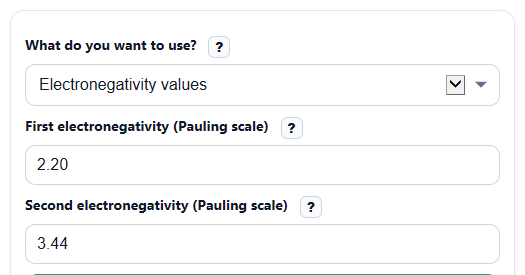
Suppose you use the electronegativity-values method with 2.20 and 3.44. The difference is 1.24, so the calculator uses that in the Pauling formula and gets about 31.91% ionic character. That means the bond has noticeable polarity but is not treated as fully ionic by this model.
For the dipole method, if "Observed dipole moment (D)" is 0.44, "Bond length (A)" is 1.61, and "Separated charge amount (in elementary charges)" is 1, the ideal fully ionic dipole is about 7.73 D. Then 100 x 0.44 / 7.73 gives about 5.7% ionic character.
Assumptions used here
The electronegativity route is an estimate based on electronegativity difference, while the dipole route is based on measured bond data and an ideal fully ionic comparison. Because those ideas are not identical, the two methods can give different answers for the same bond, and that difference is part of the chemistry rather than a calculator error.