
Enter isotope masses and abundances to calculate average atomic mass and confirm that the complete isotope mixture totals 100%.
Advanced options
Table of contents
How to use our Atomic Mass Calculator
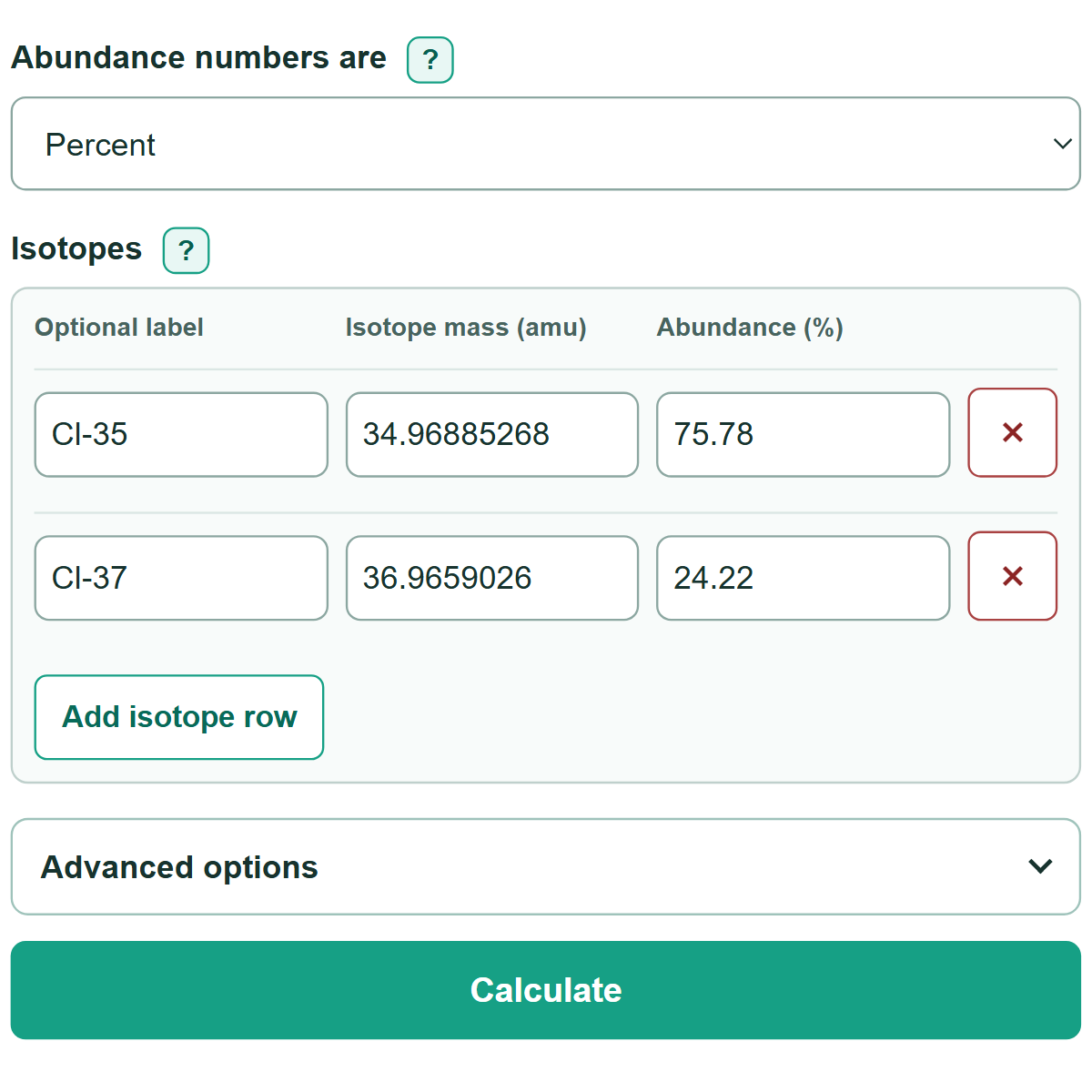
- Choose "Percent" for abundances written like 75.78, or choose "Decimal fraction" for values written like 0.7578.
- Enter at least two isotope rows. The isotope label is optional, but each row needs its precise isotope mass and matching abundance.
- Select "Calculate" to find the average atomic mass, entered abundance total, and each isotope's weighted contribution.
- Check that "Abundance check" says the entries total 100%. If not, find the missing isotope or correct the mistyped abundance before using the answer.
- Open "Advanced options" and change "Result decimal places" only if your assignment requests a different displayed rounding.
Definitions
Isotope: A form of an element with the same number of protons but a different number of neutrons.
Isotope mass (amu): The mass of one isotope, measured in atomic mass units (amu).
Natural abundance: The share of atoms in a mixture that are one isotope. It may be written as a percent, such as 75.78%, or a decimal fraction, such as 0.7578.
Weighted contribution (amu): An isotope mass multiplied by its abundance written as a decimal fraction.
Average atomic mass (amu): The sum of the weighted contributions for a complete isotope mixture. It is an average, not the mass of one individual atom.
Common mistakes and quick fixes
Mistake: Entering 75.78 while "Abundance numbers are" is set to decimal fraction.
Fix: Choose "Percent" for 75.78, or enter 0.7578 when using decimal fraction.
Mistake: Using a mass number, such as 35, instead of the precise isotope mass.
Fix: Copy the isotope mass from the problem, such as 34.96885268 amu. A label such as Cl-35 is not the precise mass.
Mistake: Leaving out an isotope so the abundances add to less than 100%.
Fix: Include every isotope in the stated mixture, then confirm that all abundances add to exactly 100%.
Mistake: Matching an isotope mass with the abundance for a different isotope.
Fix: Check each row against the worksheet or table. The mass and abundance in one row must describe the same isotope.
Mistake: Rounding each weighted contribution before adding them.
Fix: Enter the source values as given. Round the final displayed average only, unless the assignment gives different instructions.
Limitations & Key Assumptions / Boundary Conditions
- The result uses only the isotope masses and abundances entered. The calculator does not look up an element or fill in missing isotope data.
- All rows must describe one complete mixture. Their abundances must total exactly 100%, and the calculator does not rescale an incomplete total.
- An isotope label is a note only. The calculator cannot determine a precise isotope mass from a label such as Mg-24.
- The displayed value can differ from a periodic-table atomic weight because a source may use different isotope compositions, rounding rules, or a standard atomic-weight interval.
- A zero-abundance row is valid and contributes zero to the average, but every isotope mass must be greater than zero.
Methodology
Weighted-average calculation
Average atomic mass is found by multiplying each isotope mass by its abundance as a decimal fraction, then adding the contributions. This is the usual weighted-average method for isotope-abundance problems. [1]
average atomic mass = sum of (isotope mass x decimal abundance)
With "Percent" selected, the calculator divides every abundance by 100 before multiplying. With "Decimal fraction" selected, it uses the entered abundance directly.
decimal abundance = percent abundance / 100
Abundance check
Before showing an answer, the calculator adds all entered abundances on a percent basis. The total must equal 100%. This check catches incomplete mixtures and many percent-versus-fraction entry errors.
entered abundance total = sum of percent abundances
entered abundance total = 100 x sum of decimal-fraction abundances
Mini-example
Suppose two isotopes have masses of 34.96885268 amu and 36.9659026 amu, with abundances of 75.78% and 24.22%. The decimal abundances are 0.7578 and 0.2422.
average atomic mass = (34.96885268 x 0.7578) + (36.9659026 x 0.2422) = 35.452538170624 amu
Rounded to four decimal places, the average atomic mass is 35.4525 amu.
Calculation choices
At least two complete isotope rows are required. Every isotope mass must be a finite number greater than zero. Percent abundances must be from 0 through 100, and decimal-fraction abundances must be from 0 through 1. Isotope labels do not affect the arithmetic.