
Estimate corn yield per acre from ear and kernel counts, then see whole-field bushels and an optional adjustment to 15.5% grain moisture.
Advanced options
How to use our Corn Yield Calculator
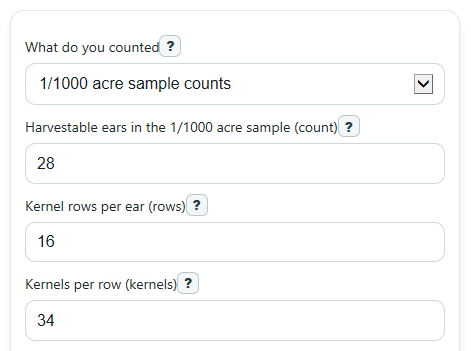
- Choose your count method in What do you counted: use Harvestable ears in the 1/1000 acre sample (count) if you sampled a small area, or use Plants per acre (plants/acre) plus Average ears per plant (ears/plant) if you already know stand and ear set.
- Enter Kernel rows per ear (rows) and Kernels per row (kernels) from several representative ears, then enter Field size (acres) to convert the per-acre estimate into whole-field bushels.
- If you want a different grain-fill assumption, open Advanced options and choose Kernel fill assumption. Add Grain moisture at harvest (%) only if you want the dry-bushel result at 15.5% moisture.
- Click Calculate, then check whether Average kernels per ear and Harvestable ears per acre used in the estimate match what you saw in the field before trusting Estimated yield.
- If the numbers look unusually low or high, sample more spots in the field and rerun the calculator with fresh averages instead of relying on one location.
Definitions
1/1000 acre sample: A small measured area where you count harvestable ears, then multiply by 1000 to estimate ears per acre.
Harvestable ears: Ears likely to be picked by the combine and contribute to grain yield.
Kernel rows per ear: The number of rows that run around an ear. Count several ears and use an average.
Kernels per row: The number of kernels in one full row on an ear. This works with kernel rows to estimate total kernels on each ear.
Average kernels per ear: The calculator multiplies kernel rows per ear by kernels per row to estimate kernels on one ear.
Kernel fill assumption: The kernels-per-bushel value used to turn kernel counts into bushels. More kernels per bushel means smaller kernels and a lower yield estimate for the same ear counts [2].
Estimated yield: The result in bushels per acre, written as bu/acre.
Dry-equivalent bushels at 15.5% moisture: A bushel estimate adjusted to the standard corn moisture basis of 15.5% so you can compare wet grain with a dry standard.
Common mistakes and quick fixes
Mistake: Entering every plant in Harvestable ears in the 1/1000 acre sample (count) even when some plants are barren or badly damaged.
Fix: Count only ears likely to make it into the combine so Harvestable ears per acre used in the estimate is realistic.
Mistake: Using both sampling methods at once by entering Harvestable ears in the 1/1000 acre sample (count) and expecting Plants per acre (plants/acre) to affect the answer too.
Fix: The calculator uses only the active method from What do you counted , so pick the right mode and ignore the hidden method.
Mistake: Counting kernels on one unusually big or small ear and typing that into Kernel rows per ear (rows) and Kernels per row (kernels) .
Fix: Average several representative ears so Average kernels per ear is not skewed by one outlier.
Mistake: Leaving the default Kernel fill assumption when field stress suggests smaller kernels, then treating Estimated yield as certain.
Fix: Try more than one kernel-fill option in Advanced to see how much the result changes.
Mistake: Typing the wrong area into Field size (acres) and then focusing only on Estimated total bushels for the field .
Fix: Recheck acreage first, because the whole-field total is just Estimated yield multiplied by field size.
Mistake: Entering wet grain in Grain moisture at harvest (%) but comparing Estimated total bushels for the field directly with market dry-bushel figures.
Fix: Use Dry-equivalent total bushels at 15.5% moisture when you want a standard dry basis for comparison.
Limitations & Key Assumptions / Boundary Conditions
- This is an in-field estimate, not a guaranteed harvest result. Final yield can change with late-season stress, kernel depth, disease, lodging, and harvest loss.
- The calculator assumes the ears and kernel counts you enter are representative of the field. Uneven soils or variable stands can make one sample misleading.
- Kernel fill assumption strongly affects the answer. Choosing 80000, 90000, or 100000 kernels per bushel can shift the estimate a lot, especially in stressed crops.
- Dry-equivalent total bushels at 15.5% moisture is shown only when Grain moisture at harvest (%) is entered and valid. It is a moisture-basis conversion, not a full commercial shrink or dock calculation.
- The calculator uses only the active entry method. In sample mode it ignores Plants per acre (plants/acre) and Average ears per plant (ears/plant); in per-acre mode it ignores Harvestable ears in the 1/1000 acre sample (count).
- Very low or very high results can be mathematically valid, but they often mean the counts were taken from a non-representative spot or entered with the wrong units.
Methodology
How the calculator works
The calculator follows the common ear-and-kernel corn yield estimate. First it estimates kernels on each ear, then it estimates harvestable ears per acre, and finally it converts total kernels per acre into bushels per acre using the selected kernels-per-bushel assumption [1][2].
kernels_per_ear = rows_per_ear x kernels_per_row
ears_per_acre = ears_sample x 1000
ears_per_acre = plants_per_acre x ears_per_plant
yield_bu_ac = (ears_per_acre x kernels_per_ear) / kernels_per_bushel
total_bushels_field_moisture = yield_bu_ac x field_size_acres
dry_bushels_15_5 = total_bushels_field_moisture x ((100 - grain_moisture) / (100 - 15.5))
Mode logic
If you choose the 1/1000 acre sample method, the calculator uses only Harvestable ears in the 1/1000 acre sample (count) and scales it to acres by multiplying by 1000. If you choose the per-acre method, it uses Plants per acre (plants/acre) times Average ears per plant (ears/plant). Hidden inputs do not affect the result.
Worked example
Suppose you count 28 harvestable ears in a 1/1000 acre sample, average 16 kernel rows per ear, and 34 kernels per row. With the average fill setting of 90000 kernels per bushel and a field size of 80 acres:
kernels_per_ear = 16 x 34 = 544
ears_per_acre = 28 x 1000 = 28000
yield_bu_ac = (28000 x 544) / 90000 = 169.24 bu/acre
total_bushels_field_moisture = 169.24 x 80 = 13539.56 bu
If harvest moisture is 18%, the dry-equivalent total becomes about 13138.38 bushels at the standard 15.5% moisture basis.
How to interpret the main outputs
Estimated yield is the main per-acre answer. Estimated total bushels for the field turns that into whole-field production. Dry-equivalent total bushels at 15.5% moisture helps you compare wet grain to a standard dry basis. Average kernels per ear and Harvestable ears per acre used in the estimate are check values that help you catch counting mistakes before acting on the yield estimate.
Assumptions used here
The method assumes your ear counts represent the field and that the chosen kernels-per-bushel setting matches actual grain fill. Extension guides commonly show that results can vary noticeably from final harvested yield because kernel weight, late stress, and field variability are not fully known at sampling time [1][3][4].