
Use your dog's chest, neck, and weight to estimate a safe starting harness size and spot between-size or shape-fit issues.
Advanced options
How to use our Dog Harness Size Calculator
- Choose Units, then enter Chest girth, Neck girth, and Dog weight using the same unit system.
- Measure Chest girth around the widest part of the chest, usually just behind the front legs, and measure Neck girth at the base of the neck where the harness sits.
- If needed, open Advanced options and set Harness style, Fit preference, and Coat thickness to improve tie-break advice near size edges.
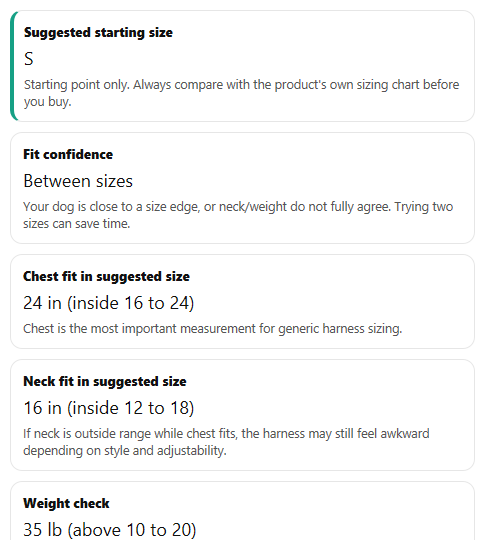
- Click Calculate, then read Suggested starting size first and use Fit confidence, Chest fit in suggested size, and Try this if the fit is borderline to decide whether to try one size or compare two.
- Sanity-check the result by making sure Chest fit in suggested size is inside range; if chest is outside range or Fit confidence says size conflict, compare the product's own chart before buying.
Definitions
Chest girth: The distance around the widest part of your dog's chest, usually just behind the front legs. This is the main measurement used to choose size.
Neck girth: The distance around the base of the neck where the harness rests, not where a collar usually sits.
Dog weight: Your dog's current body weight. It is a backup check, not the main sizing measurement.
Suggested starting size: The first generic size to try based on chest-first matching.
Fit confidence: A plain-language rating that tells you whether the measurements point cleanly to one size, sit near a size edge, or conflict with each other.
Between sizes: A case where the chest measurement lands very close to a size boundary or exactly on a shared boundary, so two sizes may both be worth trying.
Size conflict: A case where chest points to one size but Neck girth points to a different size band, which can happen with unusual body shape or less adjustable harness styles.
Common mistakes and quick fixes
Mistake: Measuring Chest girth too far forward near the neck instead of around the widest part of the chest.
Fix: Re-measure Chest girth just behind the front legs and calculate again, because chest is the main size-picking measurement.
Mistake: Entering Neck girth where the collar sits instead of at the base of the neck where the harness sits.
Fix: Measure Neck girth lower at the neck base, then recheck Neck fit in suggested size .
Mistake: Mixing units, like inches for Chest girth but kilograms for Dog weight while Units is set to inches and pounds.
Fix: Make sure all values match the selected Units setting before you calculate.
Mistake: Letting Dog weight override the tape-measure numbers in your own decision.
Fix: Use Weight check as a backup only, and trust Chest fit in suggested size first.
Mistake: Ignoring a borderline result and buying only the Suggested starting size without checking the tie-break note.
Fix: Read Fit confidence and Try this if the fit is borderline to see whether trying a second size is smarter.
Mistake: Using a fluffy dog's tape measurement without thinking about fur bulk.
Fix: In Coat thickness , choose the thick-coat option so the borderline advice can lean a little roomier when needed.
Limitations & Key Assumptions / Boundary Conditions
- This tool gives a generic starting size only. Real harness brands and models can run smaller, larger, wider, or less adjustable.
- Chest is treated as the binding measurement. If a product chart says to size by a different measurement, follow that product chart.
- The generic chart uses broad overlapping ranges on purpose, so the result is a fit estimate, not a guarantee.
- Weight is used only as a support check. Dogs with the same weight can have very different chest and neck measurements.
- Style notes change the caution text, not the underlying size chart. A front-clip, step-in, or Y-front harness may still fit differently even in the same labeled size.
- Very thick coats, deep chests, narrow shoulders, puppies, senior dogs, and dogs with medical or mobility needs may need a more adjustable or specialty harness.
- If Chest girth is below the smallest range or above the largest range, the calculator can only show the nearest generic size and a caution, not a reliable fit.
Methodology
How the calculator picks a size
The calculator uses a chest-first method because chest girth is the main harness sizing measurement used in common charts, with neck used as extra support [1].
Candidates = all sizes where chest_min <= chest <= chest_max
If more than one size contains the chest measurement, the tie-break follows Fit preference. Balanced and snugger start with the smaller matching size, while roomier starts with the larger matching size.
If multiple candidates: roomier -> larger size; balanced or snugger -> smaller size
If chest is outside every chest range, the tool flags the result as unsupported and shows the nearest generic size by distance to the closest chest-range edge.
How fit confidence is set
After a starting size is chosen by chest, the calculator checks whether Neck girth and Dog weight also fall inside that same size's neck and weight bands.
support_score = I(neck_in_range) + I(weight_in_range)
Here, I(...) means 1 when the statement is true and 0 when it is false. A higher support score means the chest-based choice is better supported.
The calculator also measures how close the chest value is to the nearest edge of the chosen chest band. Small edge distance means the dog is near a boundary and may be between sizes.
edge_distance = min(chest - chest_min, chest_max - chest)
borderline if edge_distance / (chest_max - chest_min) < t
t = 0.15 balanced, 0.22 roomier, 0.10 snugger
If Coat thickness is set to a very fluffy or thick coat, the borderline rule is treated a little more cautiously so the advice can lean roomier when the dog is near an edge.
If chest fits one size but neck clearly falls only in a different size band, the calculator sets Fit confidence to size conflict instead of pretending the fit is clean.
If support score is 0, a clean chest match is downgraded from good match to between sizes.
Generic chart used
The calculator compares your measurements to this generic everyday harness chart in inches and pounds, then converts units when needed: XS neck 10-14, chest 14-18, weight 5-10; S neck 12-18, chest 16-24, weight 10-20; M neck 16-22, chest 22-30, weight 20-40; L neck 18-26, chest 28-38, weight 40-70; XL neck 22-32, chest 36-50, weight 70-110.
cm = in x 2.54
lb = kg x 2.20462262185
Mini example
Suppose a dog has Chest girth 24 in, Neck girth 17 in, and Dog weight 19 lb with balanced preference. A 24 in chest fits both S and M because S is 16-24 and M is 22-30, so balanced picks the smaller matching size first: S.
candidates = S, M
balanced -> choose S
For S, the chest edge distance is the smaller of 24 - 16 = 8 and 24 - 24 = 0, so edge distance is 0. That is right on the boundary, so the result is between sizes, not a strong single-size match. Neck 17 in and weight 19 lb still support S, but the boundary alone keeps confidence lower.
Assumptions built into the math
The calculator assumes the selected chart is a broad generic everyday harness chart, not a brand-specific fit map. It also assumes measurements are taken snug to the body without adding extra finger space during measuring, since adjustability and comfort are handled later by trying the real product.