
Roll virtual dice, see every die and the combined total, then check your exact chance of meeting a target.
Advanced options
Table of contents
How to use our Dice Roller Calculator
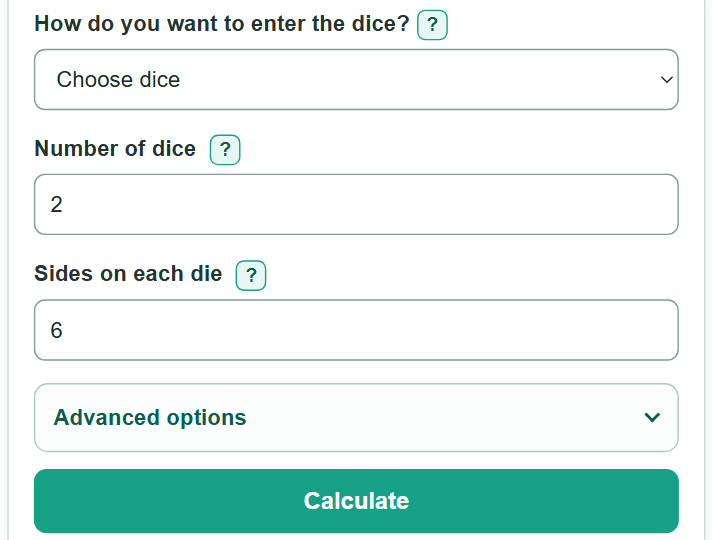
- Choose "Choose dice" to enter separate values, or choose "Use dice notation" to enter an expression such as 2d6+3.
- Enter the number of dice and sides for the builder, or copy the dice expression from your game rule or character sheet.
- Open "Advanced options" if you need a flat modifier, want to check a target chance, or need a repeatable roll code.
- Click "Calculate" to generate a roll and view the rolled total, individual dice, possible range, and expected average.
- Sanity-check the roll by confirming that the rolled total is between the displayed lowest and highest possible totals.
Definitions
Dice notation (NdS): A short dice description. N is the number of dice and S is the number of sides, so 2d6 means two six-sided dice.
Flat modifier: A signed number added or subtracted once after the dice are totaled. In 2d6+3, the modifier is +3.
Target total: The final total a game rule asks you to meet, stay at or below, or hit exactly. It includes any flat modifier.
Exact target chance: The number of favorable outcomes divided by the number of all equally likely outcomes, written as a reduced fraction.
Expected average: The long-run average total across many rolls. It does not predict the next roll.
Repeatable roll code: A whole-number code that recreates the same dice sequence for an example or test.
Common mistakes and quick fixes
Mistake: Reading 2d6 as the number twenty-six.
Fix: Read 2d6 as two six-sided dice. Add the two rolled values.
Mistake: Applying a flat modifier to every die.
Fix: "Add or subtract after rolling (points)" is applied once after all dice are added.
Mistake: Entering a die shape instead of its face count.
Fix: Enter 6 for a d6 or 20 for a d20. The field needs the number of sides.
Mistake: Treating target chance as a prediction of the roll already shown.
Fix: Target chance counts every possible outcome. It does not change or explain the displayed random roll.
Mistake: Using a repeatable roll code for a roll that must be unpredictable.
Fix: Leave "Repeatable roll code" blank for a new browser-generated roll. A code recreates the same sequence.
Mistake: Entering keep, drop, or exploding-die codes.
Fix: Use dice terms such as 2d6 or 1d20+1d4, with an optional final whole-number modifier.
Limitations & Key Assumptions / Boundary Conditions
- Each die is treated as fair and independent, with every face equally likely.
- The calculator accepts up to 100 dice and up to 1,000 sides on each die.
- Dice notation accepts dice terms joined by plus signs and an optional final whole-number modifier. It does not support keep, drop, reroll, exploding dice, multiplication, division, decimals, or ranges.
- Target odds are exact for the entered dice model, but game rules involving advantage, critical hits, special faces, or rerolls can change the real chance.
- A blank repeatable roll code uses browser cryptographic randomness when available. A supplied code is predictable and intended only for repeatable examples.
- A target outside the possible range is valid. Its exact chance can be 0% or 100%.
Methodology
Roll calculation
The calculator builds the active dice list from the separate fields or the dice notation. It generates one whole value from 1 through the side count for every die, adds those values, then applies one flat modifier.
rolled total = sum of individual die values + flat modifier
For example, 2d6+3 has two six-sided dice and one modifier. If the dice show 2 and 2, the rolled total is 2 + 2 + 3 = 7.
Range and average
The lowest total uses a 1 on every die. The highest total uses the largest face on every die. The expected average adds the average of each fair die, then applies the modifier once.
lowest possible total = number of dice + flat modifier
highest possible total = sum of all die side counts + flat modifier
average of one S-sided die = (S + 1) / 2
For 2d6+3, the possible range is 5 through 15 and the expected average is 10 points.
Target chance
When a target check is selected, the calculator counts every equally likely dice outcome that meets the chosen condition. It uses the full distribution of possible totals, not a simulation and not the random roll displayed above.
target chance percent = 100 x favorable outcomes / total outcomes
exact target chance = favorable outcomes / total outcomes, reduced
For 2d6+3, rolling at least 8 means the two dice must total at least 5. Thirty of 36 possible dice outcomes work, so the chance is 30/36, reduced to 5/6, or 83.33%.
Repeatable rolls
A blank roll code requests fresh browser cryptographic random values. With a roll code, the calculator advances a 32-bit repeatable sequence once for each die, so the same code and dice setup reproduce the same individual results.