
Use this calculator to find horsepower or kilowatts, torque, or engine speed from the other two values with the right units.
How to use our Horsepower Calculator
- Choose What do you want to find? and pick Unit system so the calculator knows whether to use lb-ft and hp or N-m and kW.
- Enter the two known values in Torque, Engine speed (RPM), and Power. You can leave the value you want to find as-is because the calculator will ignore that hidden target in the math.
- Pick Decimal places if you want a rounder or more precise result, then click Calculate.
- Read the main answer first, then check Same power in the other unit and Formula used to confirm the units and equation match your problem or spec sheet.
- Do a quick sanity check: if your result sign is negative, it usually means the entered torque, power, or rotation direction uses an opposite sign convention; if the number is far larger or smaller than expected, recheck Unit system and the units entered in Torque and Power.
Definitions
Torque: Twisting force at a shaft. In this calculator it uses lb-ft in US mode or N-m in Metric mode.
Engine speed (RPM): Revolutions per minute, meaning how many full turns the shaft makes each minute.
Power: The rate of doing work. Here it is shown as horsepower in US mode or kilowatts in Metric mode.
Horsepower (hp): A US-style power unit often used for engines and motors.
Kilowatt (kW): A metric power unit. The calculator also shows the same power in this other unit for easy comparison.
Unit system: The setting that tells the calculator which equation constant and output units to use.
Formula used: The exact equation matched to your solve choice and unit system so you can verify the math.
Common mistakes and quick fixes
Mistake: Entering Torque in N-m while Unit system is set to US.
Fix: Switch Unit system to Metric or re-enter Torque in lb-ft so the formula matches your units.
Mistake: Typing horsepower into Power while Metric mode is selected.
Fix: In Metric mode, enter Power in kW, or change Unit system to US if your value is in hp.
Mistake: Using 0 for Engine speed (RPM) when trying to find Calculated torque or Calculated power .
Fix: Enter an RPM greater than 0. Back-solving those results with zero RPM would cause a divide-by-zero problem or represent zero rotating shaft power.
Mistake: Using 0 for Torque when trying to find Calculated engine speed .
Fix: Enter a nonzero Torque value. The RPM formula divides by torque, so zero torque cannot give a valid speed result.
Mistake: Confusing wheel speed or road speed with Engine speed (RPM) .
Fix: Enter shaft or engine rotational speed in Engine speed (RPM) , not vehicle speed in mph.
Mistake: Seeing an unexpected negative Calculated power or Calculated torque and assuming the calculator broke.
Fix: Check your sign convention. A negative result can mean opposite torque direction, opposite rotation direction, or power flowing the other way.
Limitations & Key Assumptions / Boundary Conditions
- This calculator is for steady rotating shaft relationships between torque, speed, and power. It does not model traction, gearing, drivetrain losses, or vehicle acceleration.
- Results depend completely on the units matching the selected Unit system. Entering N-m in US mode or hp in Metric mode will give the wrong answer.
- When solving for torque or power, Engine speed (RPM) must be greater than 0. When solving for RPM, Torque must not be 0.
- Negative values are allowed because some engineering sign conventions use negative torque, negative power, or reverse rotation. The calculator keeps that sign instead of forcing a positive answer.
- Rounded display values can differ slightly from hand calculations if you round intermediate numbers too early. The calculator uses the full constants first, then rounds the final display.
- The calculator converts only between hp and kW for the secondary power output. It does not convert to watts, PS, or electrical input power.
Methodology
How the calculator works
This calculator uses the standard rotating shaft relationship between torque, rotational speed, and power. You choose what to find, enter the other two values, and the calculator applies the matching formula for the selected unit system.
Formulas used
hp = torque_lbft x rpm / 5252.113122
kW = torque_Nm x rpm / 9549.296586
torque_lbft = hp x 5252.113122 / rpm
torque_Nm = kW x 9549.296586 / rpm
rpm = hp x 5252.113122 / torque_lbft
rpm = kW x 9549.296586 / torque_Nm
kW = hp x 0.745699872
hp = kW / 0.745699872
What the constants mean
The US constant 5252.113122 is the shortcut used when torque is in pound-feet and speed is in RPM. The metric constant 9549.296586 is the matching shortcut when torque is in newton-meters and power is in kilowatts. These constants keep you from converting RPM to radians per second by hand every time.
Mini example
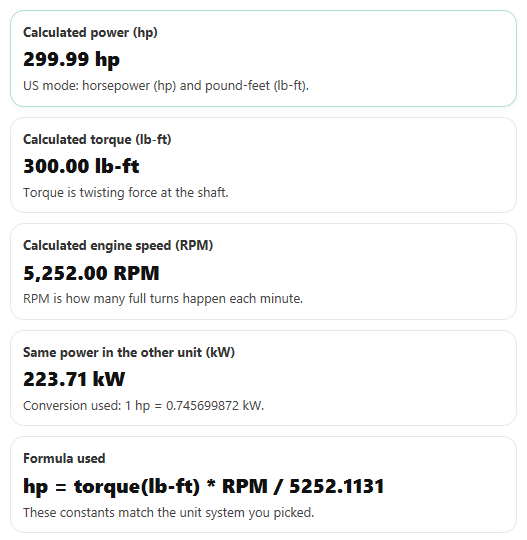
If you choose US mode and want to find power from 300 lb-ft at 5252 RPM, the calculator computes:
hp = 300 x 5252 / 5252.113122 = 299.99 hp
It then converts that power to kilowatts for the secondary output:
kW = 299.99 x 0.745699872 = 223.71 kW
If instead you choose Metric mode and enter 200 N-m at 3000 RPM, the calculator computes:
kW = 200 x 3000 / 9549.296586 = 62.84 kW
How to interpret the result
A larger power result means more work is being delivered per unit of time. A larger torque result means more twisting force. A larger RPM result means the shaft must spin faster to match the same power and torque relationship.
Assumptions used
This is an ideal math relationship for rotating shafts. It does not include transmission losses, measurement error, transient engine behavior, or test-standard corrections, so real dyno or certification values can differ from the simple calculated result.