
Enter an appliance's power, measured energy, or label kWh and your electricity price to estimate monthly use and cost.
Table of contents
How to use our Electricity Calculator
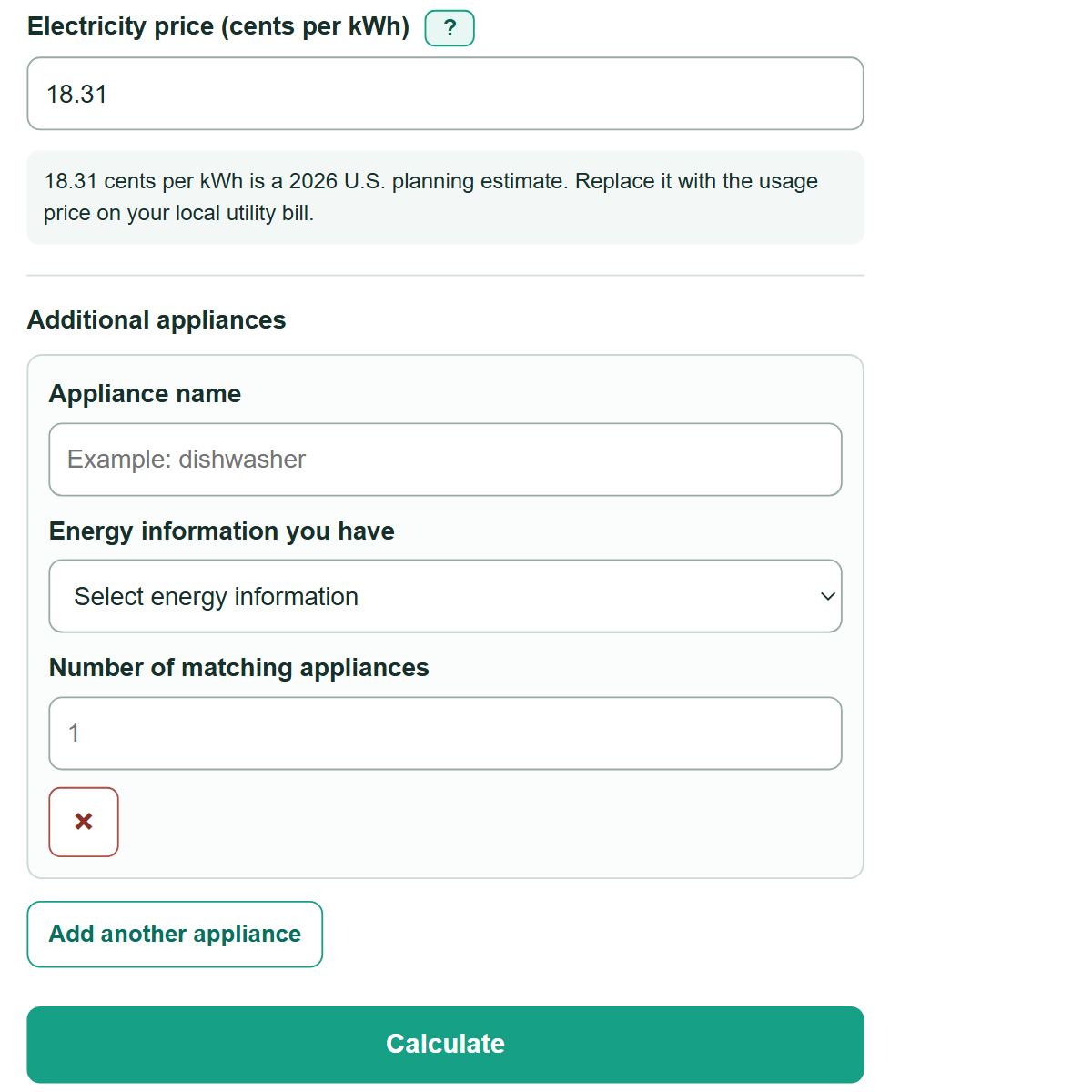
- Choose the information you have in "Energy information you have": watts and daily use, measured kWh per use, or yearly kWh from a label.
- Enter an appliance name, the source values shown for that choice, and the "Number of matching appliances."
- Check "Electricity price (cents per kWh)" against the usage-based charge on your utility bill, then select "Calculate."
- Read "Estimated electricity cost per month" first. Then use the monthly kWh and appliance breakdown to compare items. If the estimate seems too high or low, check the runtime, use frequency, quantity, and price.
Definitions
Watt (W): A unit of power. It tells how fast an appliance uses energy while it is drawing power.
Kilowatt-hour (kWh): A unit of energy used on electricity bills. One kWh equals 1,000 watts used for one hour.
Measured energy per use: The kWh recorded for one complete appliance event, such as one dishwasher cycle.
Usage-based electricity price: The charge per kWh used to estimate the energy portion of a bill. It does not include fixed customer charges.
Monthly average: A yearly energy or cost estimate divided by 12. It is not a forecast for one specific calendar month.
Common mistakes and quick fixes
Mistake: Entering watts as though they are kWh.
Fix: Use "Appliance power (W)" only with "Time used each day (hours)." Watts are power, while kWh are energy used over time.
Mistake: Using nameplate watts for an appliance that cycles on and off.
Fix: If possible, select "Measured kWh per use" and enter the energy from one complete measured event.
Mistake: Putting a fixed customer charge into "Electricity price (cents per kWh)."
Fix: Enter the usage-based price per kWh only. Fixed charges are not included in this estimate.
Mistake: Entering a label's yearly dollar estimate as yearly kWh.
Fix: Under "Yearly kWh from a label," copy the number labeled kWh, not the label's estimated cost.
Mistake: Combining appliances with different use patterns as matching appliances.
Fix: Use "Number of matching appliances" only for identical items with the same estimated use. Add another appliance for a different item or schedule.
Limitations & Key Assumptions / Boundary Conditions
- The estimate includes usage-based energy charges only. It excludes fixed customer charges, taxes, demand charges, credits, and other bill items.
- It applies one electricity price to every kWh. Time-of-use, tiered, seasonal, and real-time pricing can change actual charges.
- Watts-and-time estimates assume the entered watts apply throughout the entered running time. Appliances that cycle on and off may use less energy than a nameplate-watt estimate suggests.
- Daily-use entries use 365 days per year, and per-use entries use 52 weeks per year. Actual routines and calendar months vary.
- Matching appliances are assumed to have the same energy use. Add separate appliances when their wattage, runtime, measured use, or yearly kWh differs.
Methodology
Calculation method
The calculator estimates yearly electricity use for each appliance, adds included appliances, and then calculates monthly averages and usage-based cost.
yearly kWh from watts = (watts / 1000) * hours per day * 365 * quantity
yearly kWh from measured use = kWh per use * uses per week * 52 * quantity
yearly kWh from label = yearly label kWh * quantity
combined yearly kWh = primary appliance yearly kWh + added appliance yearly kWh
monthly kWh = combined yearly kWh / 12
yearly cost = combined yearly kWh * cents per kWh / 100
monthly cost = yearly cost / 12
Worked example
A 1,000 W space heater used 2 hours per day uses an estimated (1,000 / 1,000) * 2 * 365 = 730 kWh per year. Its monthly average is 730 / 12 = 60.8 kWh. At 18.31 cents per kWh, its estimated monthly usage-based cost is 730 * 18.31 / 100 / 12 = $11.14.
Rate used
The starting price of 18.31 cents per kWh is a 2026 U.S. residential planning estimate from EIA. Replace it with the usage-based price from your utility bill. [1] A utility rate can vary by time or other pricing rules, so one price per kWh may not match the charge on a bill. [2]