
Enter density and volume to calculate mass, or choose a different known pair to find mass, density, or volume in your needed unit.
Table of contents
How to use our Mass Calculator
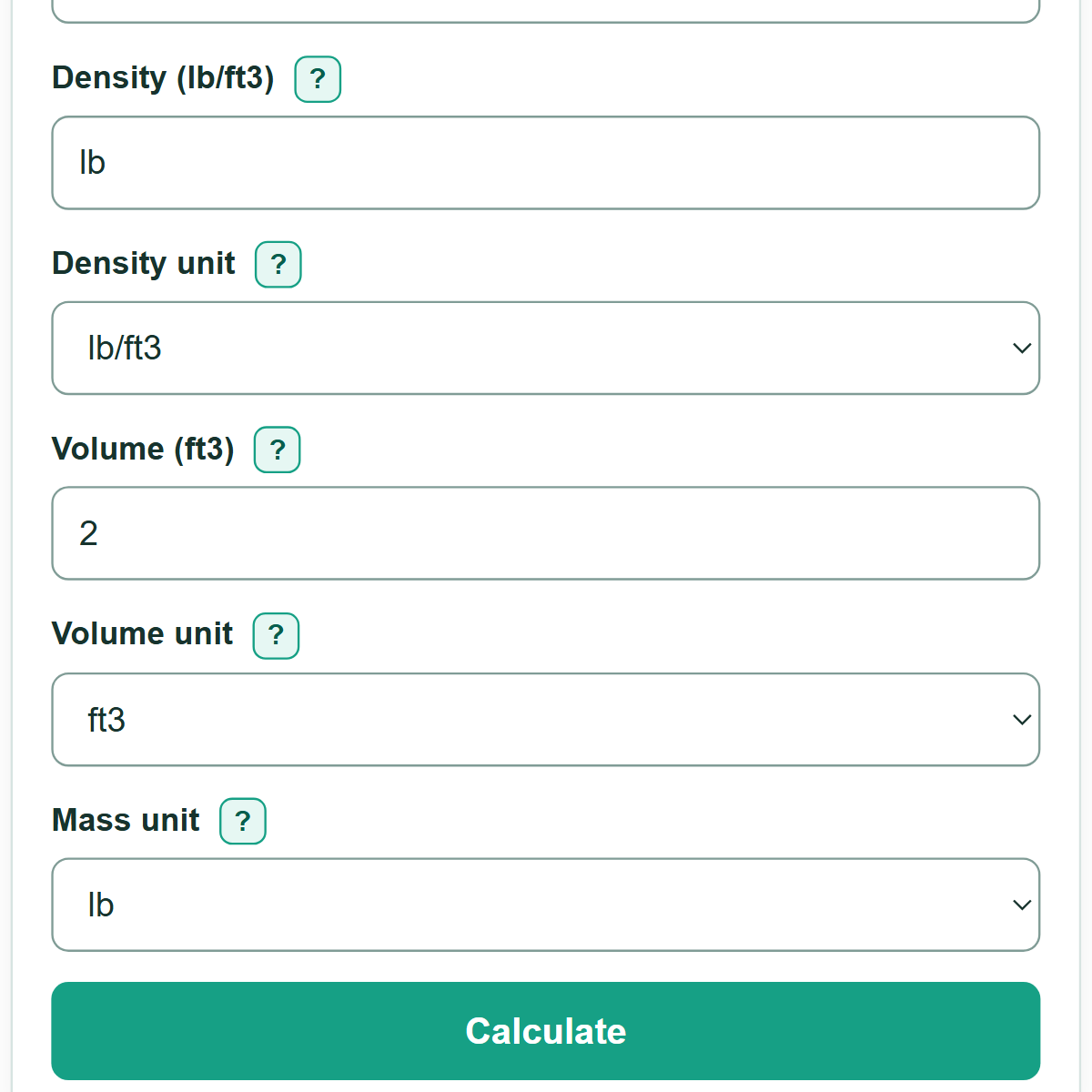
- Choose your task in "What do you want to calculate?" so the calculator shows only the values needed.
- Enter each known value and select the same unit shown in your problem, measurement, data sheet, or lab record.
- For a mass answer, choose the unit you want for the calculated mass, then select "Calculate".
- Check that "Formula used" matches your known quantities and that the answer unit matches the unit you intended.
Definitions
Mass: The amount of matter in an object. This calculator uses kilograms (kg), grams (g), and pounds (lb, meaning pound-mass).
Density: Mass per unit of volume. For example, kg/m3 means kilograms in each cubic meter.
Volume: The three-dimensional space occupied by material. This calculator accepts ft3, in3, m3, L, and cm3.
Force: A push or pull measured here in newtons (N) or pounds-force (lbf). Pound-force is different from pound-mass.
Acceleration: The rate at which velocity changes, measured here in m/s2 or ft/s2.
Newton's second law: Net force equals mass times acceleration, so mass can be found by dividing net force by acceleration. [2]
Common mistakes and quick fixes
Mistake: Entering weight into the Mass field.
Fix: Enter mass in lb, kg, or g. Use the force path only when you have force and acceleration.
Mistake: Selecting a density unit that does not match the source value.
Fix: Match "Density unit" to the unit printed beside the density before calculating.
Mistake: Using outside dimensions as material volume for a hollow object.
Fix: Use the volume occupied by the material, not the empty space inside or around it.
Mistake: Using zero volume to find density or zero density to find volume.
Fix: Enter a value greater than zero for the quantity being divided by.
Mistake: Typing a decimal with a comma, such as 1,01.
Fix: Use a decimal point for decimals. Use commas only for thousands separators, such as 1,000.
Limitations & Key Assumptions / Boundary Conditions
- Use density for the actual material and condition. A hollow, porous, mixed, loose, heated, cooled, or pressurized object may not match a reference density.
- The density-based calculations treat the entered density as uniform enough for the purpose. A density calculated from a mixed object is an average density.
- The force method requires compatible force and acceleration magnitudes. It does not determine direction or decide whether the entered force is the net force.
- Zero density or zero volume gives a valid zero mass in the density-volume path, but zero cannot be a divisor when finding volume or density.
- Source rounding, measurement error, and an incorrect unit choice can change the calculated answer.
Methodology
Calculation method
The calculator converts the active inputs to kilograms, cubic meters, newtons, and meters per second squared before calculating. It then converts the answer to the unit selected for that quantity. US customary conversion factors for pounds, feet, inches, cubic units, and pound-force follow NIST guidance. [1]
mass = density x volume
density = mass / volume
volume = mass / density
mass = force / acceleration
Worked example
With a density of 62.4 lb/ft3 and a volume of 2 ft3, mass is 62.4 x 2 = 124.8 lb. With a net force of 98.0665 N and an acceleration of 9.80665 m/s2, mass is 98.0665 / 9.80665 = 10 kg. The second calculation rearranges Newton's second law. [2]
Unit conversion
The calculator uses 1 g/cm3 = 1,000 kg/m3, 1 L = 0.001 m3, and 1 lb = 0.45359237 kg. When you change a unit selector, a valid entered value is converted so it keeps the same physical amount.