
Choose your wastewater record type to calculate average daily flow in gal/day and, if needed, pollutant load in pounds per day.
Advanced options
Table of contents
How to use our Wastewater Calculator
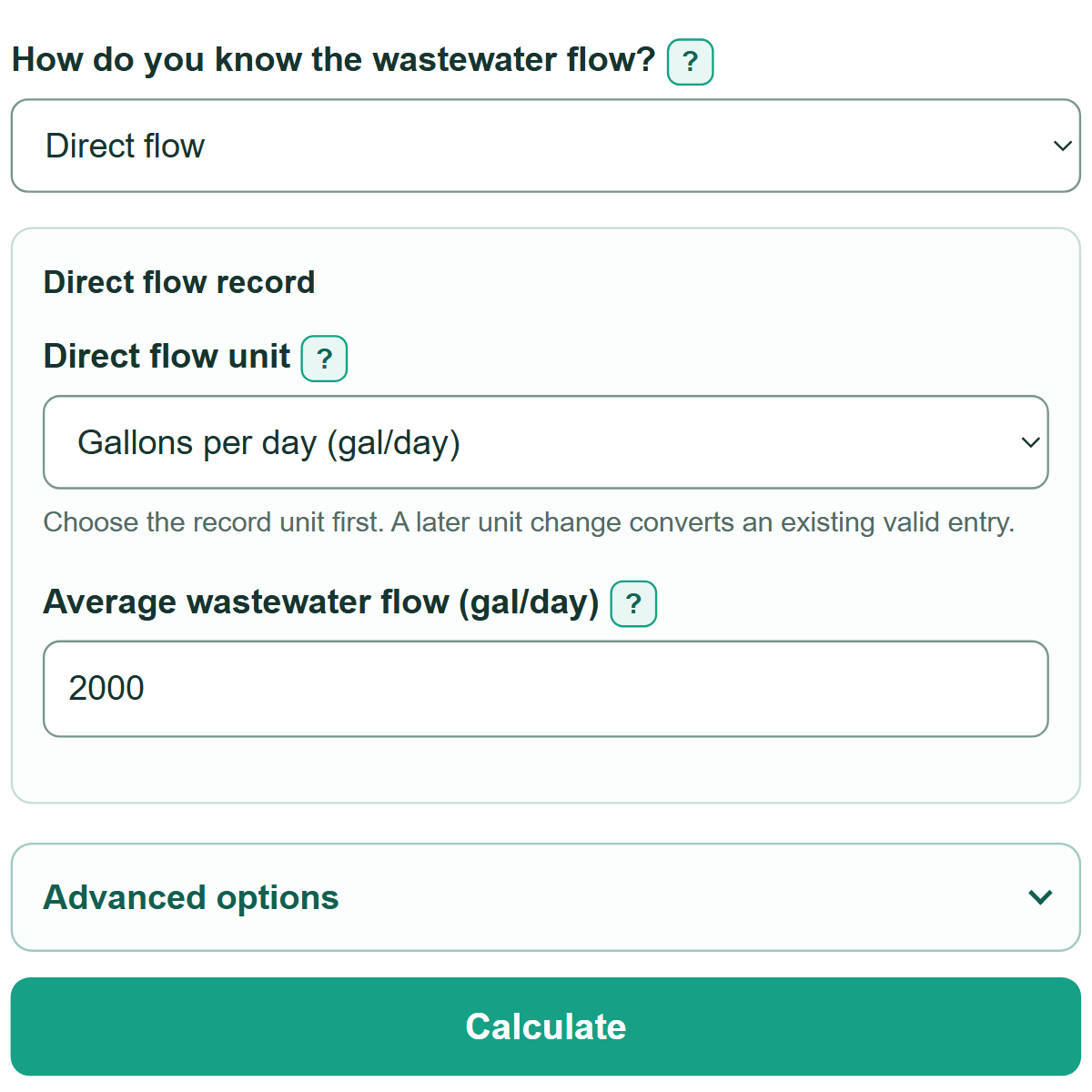
- Choose how you know the wastewater flow: "Direct flow," "Flow meter readings," "Cycle counter," or "Elapsed-time meter."
- For "Direct flow," choose the unit printed in your record before entering the average flow. If you change units after entering a correct value, the calculator converts the number to preserve the same flow.
- For a record-based method, enter the earlier reading date as "Start date" and the later reading date as "End date." The end date must be later.
- Copy the prior and current readings from the same cumulative meter or counter. The current reading must be at least the prior reading.
- For "Cycle counter," enter the calibrated gallons delivered per cycle. For "Elapsed-time meter," enter the calibrated gallons and seconds from the same pump dose.
- Open "Advanced options" if you need pollutant loading. Enter concentration from a lab report, DMR, or operating log. Add a loading period only if you need total pounds for that period.
- Select "Calculate." "Average daily wastewater flow" is the main answer for the entered record period; the MGD value is the same flow in million gallons per day.
Definitions
Totalizing meter: A meter that keeps a running total, such as total gallons pumped or total pump run time.
MGD: Million gallons per day. One MGD equals 1,000,000 gal/day.
mg/L: Milligrams per liter, a concentration unit commonly reported by wastewater laboratories.
Pollutant load: The mass of a pollutant carried by wastewater over time, shown here as lb/day or total lb.
Calibrated volume per dose: The measured gallons delivered during one pump dose or cycle.
Common mistakes and quick fixes
Mistake: Entering gallons used during the period as though they were two cumulative flow-meter readings.
Fix: Enter the actual prior and current totalizing-meter readings. The calculator finds the difference.
Mistake: Using the same date for both readings or entering the dates backward.
Fix: Enter the earlier date as "Start date" and a later date as "End date."
Mistake: Pairing a pump dose volume with the run time from a different dose.
Fix: For "Elapsed-time meter," use gallons and seconds measured during the same calibration dose.
Mistake: Treating mg/L as pounds per day.
Fix: Enter mg/L in "Pollutant concentration (mg/L)." The calculated lb/day value is the estimated mass load.
Mistake: Typing irregular commas, such as 1,25,000.
Fix: Enter 125000 or 125,000. Each comma must separate a group of three digits.
Limitations & Key Assumptions / Boundary Conditions
- The flow result is an arithmetic average for the entered period. It does not show peak flow, hourly flow, infiltration, or future design flow.
- Meter, cycle-counter, and elapsed-time methods assume both readings came from the same cumulative device and that the device did not reset or roll over.
- Cycle and elapsed-time results depend on the calibration values entered. Pump wear, pressure changes, controller changes, or dose-setting changes can make an older calibration inaccurate.
- The pollutant-load result assumes the entered concentration and calculated average flow apply for the reported day or selected period. A single sample may not represent changing wastewater conditions.
- This calculator does not determine permit compliance, sampling requirements, treatment performance, or facility capacity.
Methodology
Flow calculation
The calculator uses only the entries for the selected flow source. Direct flow is converted to gal/day when needed. For record-based methods, it finds the volume during the record period and divides by elapsed calendar days.
record_days = end_date - start_date
meter_flow_gpd = (current_meter_gallons - prior_meter_gallons) / record_days
cycle_flow_gpd = (current_cycles - prior_cycles) * cycle_gallons_per_dose / record_days
For elapsed-time records, the calibration becomes a pump rate in gallons per hour. The calculator multiplies the run-time increase by that rate, then divides by record days.
pump_rate_gph = gallons_per_dose * 3600 / seconds_per_dose
elapsed_flow_gpd = (current_etm_hours - prior_etm_hours) * pump_rate_gph / record_days
Flow units and loading
The MGD result is calculated from the full gal/day value, not from the rounded displayed value.
flow_mgd = flow_gpd / 1000000
When concentration is supplied, daily pollutant load uses the wastewater relationship between MGD, mg/L, and pounds per day, including the 8.34 factor. [1]
daily_load_lb = flow_mgd * concentration_mg_l * 8.34
period_load_lb = daily_load_lb * loading_period_days
Worked example
A direct flow of 2,000 gal/day is 0.002 MGD. With 25 mg/L, the estimated daily load is 0.002 * 25 * 8.34 = 0.4170 lb/day. For 30 days, the estimated total is 12.51 lb.