
Enter an amount in milliliters to convert it to US or imperial fluid ounces. The calculator shows both standards so you can use the one your recipe or label expects.
Table of contents
How to use our mL to Fluid Ounces Converter
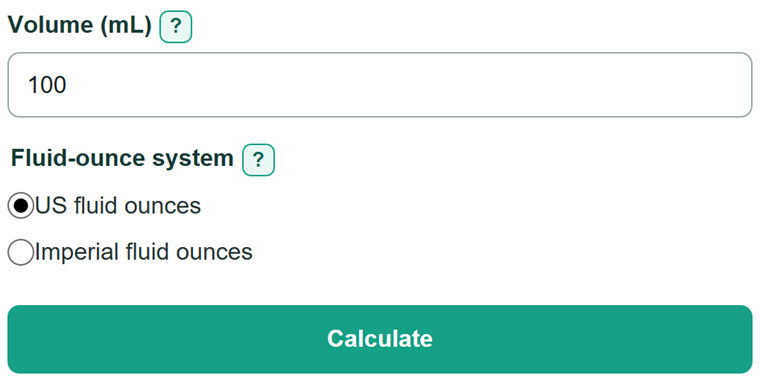
- Enter the amount from the label or recipe in Volume (mL). You can enter a decimal, such as 250.5, or a grouped number, such as 1,000.
- Choose US fluid ounces for most US recipes and labels. Choose Imperial fluid ounces only when the source specifically says imperial.
- Click Calculate to see the selected answer first, followed by both labeled equivalents.
- Sanity-check the unit beside Converted fluid ounces. At the default precision, 100 mL is about 3.4 US fl oz or 3.5 imperial fl oz, so a large difference may mean the wrong system was chosen.
Definitions
Milliliter (mL): A metric unit of volume. One thousand milliliters equal one liter.
Fluid ounce (fl oz): A unit of volume, not a unit of weight.
US fluid ounce: The US liquid-volume fluid ounce. One US fl oz equals 29.5735295625 mL.
Imperial fluid ounce: The fluid ounce used in the imperial system. One imperial fl oz equals 28.4130625 mL.
Converted fluid ounces: The main equivalent using the Fluid-ounce system you selected.
Common mistakes and quick fixes
Mistake: Entering an ounce weight from a food package in Volume.
Fix: Enter only a liquid volume in mL. Weight ounces need an ingredient density and are not converted here.
Mistake: Leaving Fluid-ounce system on US when a recipe says imperial.
Fix: Choose Imperial fluid ounces before calculating.
Mistake: Treating Equivalent US fluid ounces and Equivalent imperial fluid ounces as the same amount.
Fix: Use the result with the exact unit requested by the recipe, label, or container.
Mistake: Typing a range or formula such as 100-120 into Volume.
Fix: Enter one nonnegative mL amount at a time.
Mistake: Writing commas as 1,00 in Volume.
Fix: Use commas only for thousands, such as 1,000, and use a decimal point for decimals, such as 1.5.
Limitations & Key Assumptions / Boundary Conditions
- This is a volume-to-volume conversion only. It does not convert mL to ounces by weight.
- Use US fluid ounces for most US sources. Use imperial fluid ounces only when the original source explicitly uses imperial units.
- Displayed values are rounded for readability, even though the calculation uses the full listed conversion factors.
- Volume must be 0 mL or greater. Negative volumes, ranges, formulas, and malformed numbers are rejected.
- A label that says only "oz" may mean weight ounces, not fluid ounces. Check the original label or recipe wording before converting.
Methodology
Calculation method
The converter divides the entered Volume in mL by the exact number of milliliters in one fluid ounce for each system. It calculates both equivalents, then places the selected system first.
US fluid ounces = Volume (mL) / 29.5735295625 mL per US fl oz
Imperial fluid ounces = Volume (mL) / 28.4130625 mL per imperial fl oz
For example, 100 mL / 29.5735295625 = 3.3814022701843 US fl oz. The same 100 mL / 28.4130625 = 3.5195079727854 imperial fl oz. The converter rounds visible results to the number of decimal places you choose, while retaining full precision for its calculations. The conversion factors use NIST unit-conversion references.
Calculation boundaries
Zero is valid and converts to zero in both systems. The calculation accepts one nonnegative numeric amount, with an optional mL suffix. It does not use ingredient density, so it cannot produce a weight-ounce result from a milliliter amount.