
Convert any value in millions to thousands, see the full number with commas, and check the answer back in millions.
How to use our Million to Thousand Converter Calculator
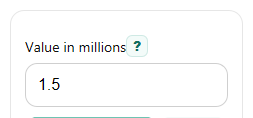
- Enter your amount in Value in millions. You can use decimals like 2.75, zero, or a negative number.
- Click Calculate to get Value in thousands, Full number, and Check back in millions.
- Read Value in thousands as the main answer. For example, 1.5 million becomes 1,500 thousand.
- Use Full number to check commas and place value, and make sure Check back in millions matches your starting amount except for small display rounding.
Definitions
Million: A number equal to 1,000,000. In this calculator, it is the unit you enter first.
Thousand: A number equal to 1,000. The main answer is shown in this unit.
Value in millions: The starting amount you type, such as 1.5 or 2.75.
Value in thousands: The converted amount after multiplying the million value by 1,000.
Full number: The same amount written as a regular number with commas, such as 2,750,000.
Check back in millions: A reverse check that converts the thousand result back to millions so you can confirm the answer.
Common mistakes and quick fixes
Mistake: Typing the full number 1,500,000 into Value in millions when you really mean 1.5 million.
Fix: Enter 1.5 in Value in millions , not 1,500,000.
Mistake: Reading Value in thousands as if it were the Full number .
Fix: Remember that Value in thousands is still written in thousands, while Full number shows the same amount as a regular number with commas.
Mistake: Forgetting that decimal inputs are allowed in Value in millions .
Fix: Enter decimals directly, such as 2.75 for 2.75 million, then check the result in Value in thousands .
Mistake: Thinking a negative result means the calculator is broken.
Fix: If Value in millions is negative, then Value in thousands , Full number , and Check back in millions should also be negative.
Mistake: Leaving Value in millions blank or entering text instead of a number.
Fix: Enter a numeric value in Value in millions , such as 0.125, 1, or 12.345.
Limitations & Key Assumptions / Boundary Conditions
- This converter uses a simple place-value rule: 1 million = 1,000 thousand. It does not handle other number words such as billion or lakh.
- Results are only as accurate as the number entered in Value in millions. If the input is mistyped, every output will reflect that mistake.
- Very large inputs can run into normal JavaScript number limits, so extremely huge values may lose precision even if the calculator avoids scientific notation in the display.
- Small display rounding can make Check back in millions look slightly different from the original entry when the true value has many decimal places.
- Negative values are allowed and treated as negative amounts or changes, which is mathematically valid but may not fit every real-world use case.
Methodology
Conversion rule
The calculator uses one core fact: one million equals one thousand thousand [1]. That means converting from millions to thousands is a straight multiplication by 1,000.
thousand_value = million_value * 1000
full_number = million_value * 1000000
reverse_check = thousand_value / 1000
How to read the outputs
Value in thousands is the main converted result. Full number writes the same amount as a standard comma-formatted number so place value is easier to check. Check back in millions converts the answer back to the starting unit to confirm the result.
Mini example
If you enter 2.75 for Value in millions, multiply 2.75 by 1,000 to get 2,750 thousand.
2.75 * 1000 = 2750
Then multiply 2.75 by 1,000,000 to get the full number 2,750,000.
2.75 * 1000000 = 2750000
For the reverse check, divide 2,750 by 1,000 and you get back to 2.75 million.
2750 / 1000 = 2.75
Assumptions and limits
This method assumes standard US place value for million and thousand. It allows decimals, zero, and negative values. To keep results readable, the display may round tiny floating-point tails, so long decimal inputs can show slight display rounding even when the underlying conversion rule is correct.