
Enter a plain microgram (mcg) amount to find its milligram (mg) equivalent, or switch directions to convert mg to mcg.
Table of contents
How to use our mcg to mg Converter
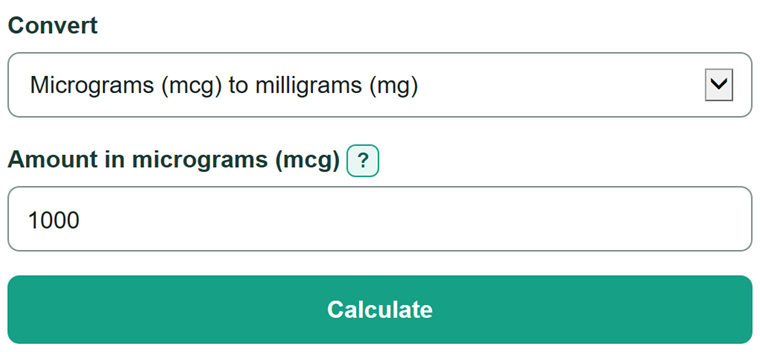
- Choose the direction that matches the unit beside the amount you copied.
- Enter the plain amount in the visible field. You can type mcg or ug after a microgram amount, or mg after a milligram amount.
- Select Calculate to see the same mass in the other unit.
- Sanity-check the size of the number: mcg to mg should make the number 1,000 times smaller, while mg to mcg should make it 1,000 times larger.
- If the original label says IU, DFE, or NE, keep that label detail and use the nutrient-specific rule instead of this plain mass conversion.
Definitions
Microgram (mcg): A metric mass unit equal to one thousandth of a milligram.
Milligram (mg): A metric mass unit equal to 1,000 micrograms.
ug: A typed alternate notation for microgram. This converter treats ug as mcg.
IU: International unit, a measure of activity for a specific substance rather than a universal mass unit.
DFE: Dietary folate equivalents, a folate label unit that includes a qualifier.
NE: Niacin equivalents, a niacin label unit that includes a qualifier.
Common mistakes and quick fixes
Mistake: Selecting a direction that does not match the copied unit.
Fix: Check Convert and then recalculate. Use mcg to mg only when the original amount is marked mcg or ug. Use mg to mcg when it is marked mg.
Mistake: Multiplying a microgram amount by 1,000.
Fix: Check Convert and then recalculate. Divide mcg by 1,000. For example, 125 mcg equals 0.125 mg.
Mistake: Leaving out the zero before a decimal result below 1 mg.
Fix: Check Convert and then recalculate. Write 0.125 mg, not.125 mg, so the decimal point is easier to read.
Mistake: Entering an amount marked IU.
Fix: Check Convert and then recalculate. IU needs a conversion rule for the specific nutrient or substance. Do not use the fixed mcg-to-mg factor.
Mistake: Dropping DFE or NE from a nutrition or supplement label.
Fix: Check Convert and then recalculate. Keep the qualifier with the label amount and use the nutrient-specific rule for that label unit.
Mistake: Typing a comma as a decimal, such as 1,00.
Fix: Check Convert and then recalculate. Use a period for decimals, such as 1.00. Use commas only for thousands, such as 1,000.
Limitations & Key Assumptions / Boundary Conditions
- This converter applies only to plain mass amounts marked mcg, ug, or mg. It does not determine a safe or appropriate medication, supplement, or nutrient amount.
- IU has no universal mcg-to-mg conversion because the relationship depends on the specific nutrient or substance.
- Do not remove qualifiers such as DFE or NE from a nutrition or supplement label. They may require nutrient-specific conversion rules.[1]
- The active amount must be a nonnegative, finite decimal with no more than 15 significant digits. Zero is valid.
- The result changes units only. It does not account for serving size, concentration, dose schedule, or differences between substances.
Methodology
Conversion rule
The metric relationship is exact: 1 mg equals 1,000 mcg. To change mcg to mg, divide by 1,000. To change mg to mcg, multiply by 1,000.
mg = mcg / 1000
mcg = mg * 1000
Worked example
For 125 mcg, divide 125 by 1,000: 125 / 1,000 = 0.125. The equivalent is 0.125 mg. The zero before the decimal shows the amount is less than 1 mg.
Label boundaries
The calculator accepts only plain mcg, ug, and mg amounts. IU and qualified nutrition-label units such as DFE and NE can use nutrient-specific conversion rules, so they should not be treated as bare mass units.[1]