
Estimate what each Instant Pot cook costs in electricity, then see the expected cost per week, month, and year.
Your estimated running cost
Table of contents
How to use our Instant Pot Running Cost Calculator
- Choose "Model from watts and time" if you have the appliance label and recipe timer, or choose "Use measured kWh per cook" if a smart plug measured a full cooking session.
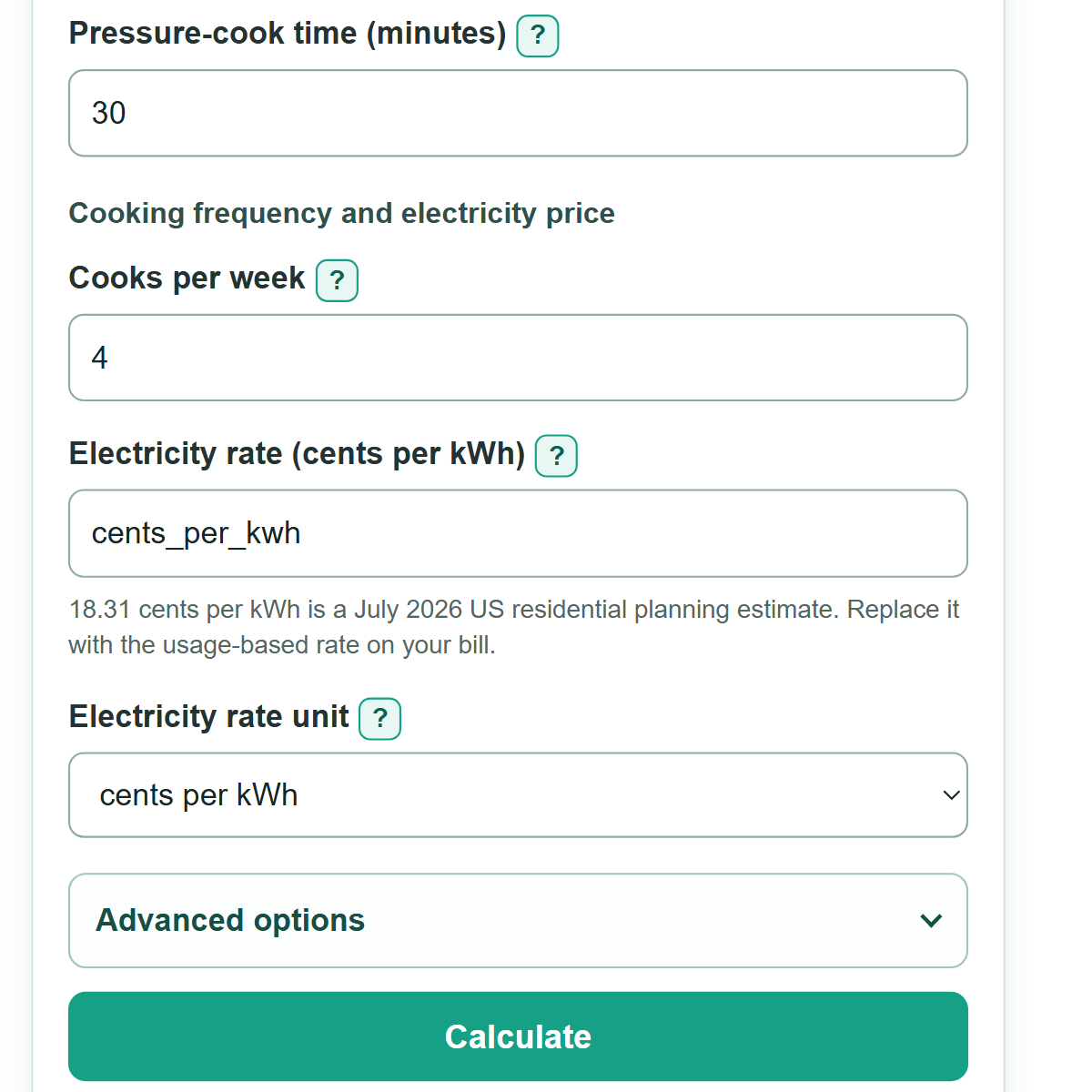
- For "Model from watts and time," enter "Instant Pot wattage (W)" from the appliance label and "Pressure-cook time (minutes)" from the recipe timer after pressure is reached.
- For "Use measured kWh per cook," enter the complete-session reading in "Measured energy per cook (kWh)." Do not also add modeled phase details.
- Enter "Cooks per week" as completed cooking sessions or batches, not servings.
- Choose "Electricity rate unit" to match your bill, then enter the usage-based price in "Electricity rate." Include per-kWh supply and delivery charges, but leave out fixed monthly fees.
- Open "Advanced options" to include time to reach pressure, Keep Warm time, or meter-based average watts for either active phase.
- Select "Calculate." Start with "Estimated electricity cost per cook," then check the recurring costs. If the result seems high, confirm that the rate unit and cooking time match your bill and recipe.
Definitions
Watt (W): A measure of electrical power, meaning how quickly an appliance uses energy.
Kilowatt-hour (kWh): A measure of electrical energy used over time. Electric bills commonly charge by the kWh. [3]
Usage-based electricity rate: The price per kWh that changes when you use more electricity. It can include supply and delivery charges that are listed per kWh.
Average power: The average watts used during a cooking phase. It can be lower than label wattage when the heating element turns on and off.
Keep Warm: The powered holding phase after cooking. Its energy is included only if you enter a Keep Warm time.
Common mistakes and quick fixes
Mistake: Entering a dollar rate while "Electricity rate unit" is set to cents per kWh.
Fix: Match the unit on the bill. For example, enter 18.31 for cents per kWh or 0.1831 for $ per kWh.
Mistake: Using recipe pressure-cook minutes as though they include time to reach pressure.
Fix: Add the measured preheat period in "Time to reach pressure (minutes)" when you want that energy included.
Mistake: Assuming label wattage is the average power for every cooking phase.
Fix: Use the basic model for a rough estimate, or enter meter-based values in "Average power while pressure cooking (W)" and "Average Keep Warm power (W)."
Mistake: Adding a fixed customer, meter, or connection fee to the electricity rate.
Fix: Enter only charges that rise with each kWh used. Fixed monthly fees do not change because of one additional cook.
Mistake: Counting servings as cooks per week.
Fix: Count each completed Instant Pot session or batch once, even if it makes several servings.
Limitations & Key Assumptions / Boundary Conditions
- The modeled method estimates energy from the watts and minutes you enter. Actual energy can change with food amount, starting temperature, cooking settings, and heating-element cycling.
- The model uses rated wattage for heat-up and for any active phase without an entered average-power value. That fallback may be higher or lower than the actual average power.
- A measured kWh reading is generally more representative when it covers the same complete cooking session you want to estimate.
- Costs use the entered usage-based electricity rate and exclude fixed customer, connection, meter, and account fees because one extra cook does not change those fees.
- Monthly cost is an annualized average using 52 weeks and 12 months. Actual monthly cost changes with cooking frequency and your utility rate.
Methodology
Energy calculation
For "Model from watts and time," the calculator adds heat-up, pressure-cook, and optional Keep Warm energy. Heat-up uses the entered appliance wattage. A blank average-power field uses that same wattage for an active phase.
modeled_energy_kwh = (rated_watts * heat_up_minutes + pressure_watts * pressure_cook_minutes + keep_warm_watts * keep_warm_minutes) / 60000
The divisor converts watt-minutes to kilowatt-hours. Blank optional heat-up and Keep Warm times count as zero. Under "Use measured kWh per cook," the meter reading replaces modeled energy instead of being added to it.
energy_per_cook = measured_kwh or modeled_energy_kwh
Cost and recurring estimates
The calculator converts the entered rate to dollars per kWh, then multiplies it by energy per cook. The default planning rate is the U.S. residential electricity price for July 2026 from the U.S. Energy Information Administration; replace it with the usage-based rate on your bill. [1]
cost_per_cook = energy_per_cook * rate_dollars_per_kwh
weekly_cost = cost_per_cook * cooks_per_week
monthly_cost = weekly_cost * 52 / 12
yearly_cost = weekly_cost * 52
Worked example
A 1,000 W cooker running for 30 pressure-cook minutes uses 0.5 kWh in the basic model. At 20 cents per kWh, one cook costs $0.10. At four cooks per week, the estimate is $0.40 per week, $1.73 per month, and $20.80 per year.