
Compare gas and induction cooking costs over time, including energy rates, upfront cost, break-even timing, and CO2 estimates.
Table of contents
How to use our Induction vs Gas Stove Cost Calculator
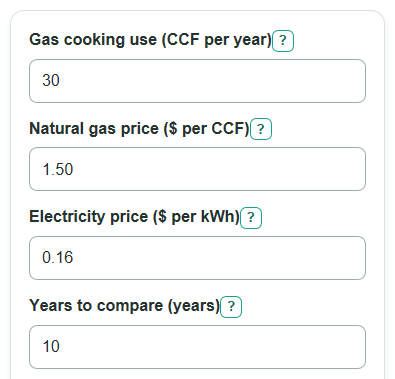
- Enter Gas cooking use, Natural gas price, Electricity price, Years to compare, and Induction extra upfront cost using your bills or best estimates.
- Use Induction extra upfront cost as induction cost minus gas cost, including installation, wiring, gas work, cookware, and rebates; enter a negative number if induction is cheaper up front.
- Open Advanced options only if you want to change Gas cooking efficiency, Induction cooking efficiency, Gas CO2 factor, Electricity CO2 factor, or Number display.
- Click Calculate, then read Cost gap after chosen years first: a positive dollar amount means induction costs more, and a negative dollar amount means induction costs less.
- Sanity-check the results by comparing Gas annual operating cost with a rough yearly gas-bill estimate and by making sure Estimated induction electricity use looks reasonable for cooking only, not your whole home.
Definitions
CCF: A natural gas billing unit equal to 100 cubic feet of gas. In this calculator, CCF is converted to energy using 30.3842 kWh per CCF.
kWh: Kilowatt-hour, a unit of electricity use. Electric bills usually price energy in $ per kWh.
Delivered price: The energy price that changes when you use more fuel or electricity. It can include supply and delivery charges, not just the fuel supply line item.
Cooking efficiency: The percent of input energy that becomes useful heat in the pan. A higher percent means less energy is needed for the same cooking heat.
CO2 factor: Pounds of carbon dioxide tied to one CCF of gas or one kWh of electricity. The defaults are editable because gas factors and grid electricity factors can differ by fuel and region [1].
Cost gap after chosen years: Induction total cost minus gas total cost over the selected period. Positive means induction costs more. Negative means induction costs less.
Break-even year for induction: The first whole year when induction's yearly operating savings have paid back its extra upfront cost.
Common mistakes and quick fixes
Mistake: Entering total home gas use in Gas cooking use instead of cooking-only CCF per year.
Fix: Use a cooking estimate or the stove portion of your bill, because Gas annual operating cost is based only on Gas cooking use.
Mistake: Using the supply price only for Natural gas price or Electricity price.
Fix: Use the delivered rate that changes with use, including supply and delivery charges when they are billed per CCF or per kWh.
Mistake: Treating Induction extra upfront cost as the full induction stove price.
Fix: Enter induction upfront cost minus gas upfront cost, including installation, wiring, gas work, cookware, and rebates.
Mistake: Reading Cost gap after chosen years as a savings number only.
Fix: Positive means induction costs more over Years to compare; negative means induction costs less over Years to compare.
Mistake: Leaving Gas cooking efficiency or Induction cooking efficiency at defaults when you have better test data or manufacturer information.
Fix: Update those fields in Advanced options, because they control Estimated induction electricity use.
Mistake: Using a national Electricity CO2 factor when your local grid is much cleaner or dirtier.
Fix: Replace Electricity CO2 factor with a utility or regional value if you have one, then recheck Annual CO2 change with induction.
Limitations & Key Assumptions / Boundary Conditions
- The calculator compares cooking energy only. It does not include fixed monthly gas or electric account fees unless you include them in the entered energy prices.
- Gas cooking use is treated as current gas input energy for cooking. If your CCF estimate includes heating, hot water, or dryer use, the results will be too large.
- Induction electricity use is estimated from the same useful cooking heat. Real use can change with cookware, burner size, cooking style, and appliance settings.
- Gas cooking efficiency and Induction cooking efficiency are editable assumptions. Values must be greater than 0 and no more than 100 percent.
- CO2 estimates cover direct gas combustion and grid electricity from cooking. They do not include upstream fuel production, appliance manufacturing, health effects, or ventilation impacts.
- Break-even year is rounded up to a whole year. If induction saves money but the break-even year is after Years to compare, the cost gap can still be positive for the chosen period.
- Induction extra upfront cost can be negative. That means induction is cheaper up front after purchase, installation, cookware, wiring, gas work, and rebates.
Methodology
Energy conversion
The calculator starts with your annual gas cooking use in CCF. It converts that gas input energy to kWh-equivalent energy, then applies Gas cooking efficiency to estimate useful heat delivered to the pan.
gas_energy_kwh_per_year = annual_gas_ccf * 30.3842
useful_heat_kwh_per_year = gas_energy_kwh_per_year * gas_efficiency_percent / 100
Induction electricity use is the electricity needed to deliver the same useful heat with the entered Induction cooking efficiency. DOE describes induction as using electromagnetic energy to heat compatible cookware directly [2].
estimated_induction_kwh_per_year = useful_heat_kwh_per_year / (induction_efficiency_percent / 100)
Cost formulas
Annual gas cost uses the entered gas use and gas price. Annual induction cost uses estimated induction electricity use and the entered electricity price.
annual_operating_cost_gas = annual_gas_ccf * gas_price_per_ccf
annual_operating_cost_induction = estimated_induction_kwh_per_year * electricity_price_per_kwh
annual_operating_cost_change_with_induction = annual_operating_cost_induction - annual_operating_cost_gas
The multi-year gap adds the extra upfront cost of induction to the yearly operating-cost change over the selected years.
total_cost_gap_after_period = induction_extra_upfront + annual_operating_cost_change_with_induction * comparison_years
A positive cost gap means induction costs more than gas over the chosen period. A negative cost gap means induction costs less.
Break-even formula
When induction has a positive extra upfront cost and saves money each year, the calculator divides the extra upfront cost by yearly savings and rounds up to the next whole year.
break_even_year_for_induction = ceiling(induction_extra_upfront / (annual_operating_cost_gas - annual_operating_cost_induction))
If induction is cheaper up front and no more expensive to run, break-even is shown as immediate. If induction does not save money each year and costs more up front, break-even is shown as not applicable.
CO2 formulas
Annual CO2 estimates use the editable gas and electricity CO2 factors. The default gas CO2 factor is based on carbon dioxide emission coefficients for natural gas combustion [1].
gas_direct_co2_per_year = annual_gas_ccf * gas_co2_lb_per_ccf
induction_grid_co2_per_year = estimated_induction_kwh_per_year * electricity_co2_lb_per_kwh
annual_co2_change_with_induction = induction_grid_co2_per_year - gas_direct_co2_per_year
Mini-example
With 30 CCF per year, $1.50 per CCF, $0.16 per kWh, 10 years, $800 extra upfront cost, 40 percent gas efficiency, and 85 percent induction efficiency, estimated induction use is about 429.0 kWh per year. Gas costs $45.00 per year, induction costs about $68.63 per year, and the 10-year cost gap is about $1,036.33. The positive gap means induction costs more in this example. Using 12.1 lb CO2 per CCF and 0.86 lb CO2 per kWh, the annual CO2 change is about 5.9 lb per year, so induction is slightly higher with those factors.