
Calculate how long water stays in a tank or reactor using volume, flow rate, and an optional effective volume adjustment.
Advanced options
Effective (usable) volume
Main result display
How to use our Hydraulic Retention Time Calculator
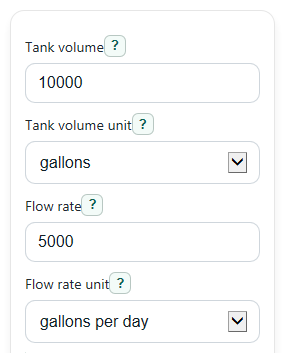
- Enter Tank volume and pick the matching Tank volume unit.
- Enter Flow rate and choose the correct Flow rate unit for your average operating flow.
- Open Advanced options if needed, then set Effective volume factor below 1.00 when only part of the tank volume is active and choose Show main result in.
- Click Calculate to see Hydraulic retention time, plus the same value in hours and days.
- Sanity-check the result: if doubling flow would roughly cut time in half, or doubling volume would roughly double time, your inputs are probably consistent.
Definitions
Hydraulic retention time: The average time water stays in a tank or reactor. It is the main result shown by the calculator.
Tank volume: The total volume of the tank, basin, reactor, or other unit you are evaluating.
Flow rate: How much water moves through the system in a given amount of time, such as gallons per day or gallons per minute.
Effective volume factor: A fraction from 0 to 1 that represents how much of the total volume is actually active for flow.
Effective volume used: The usable volume after multiplying Tank volume by the Effective volume factor.
Adjusted retention time: A shorter retention time based on effective volume instead of full volume when only part of the system is active.
Common mistakes and quick fixes
Mistake: Entering Flow rate in gallons per minute but leaving Flow rate unit on gallons per day.
Fix: Match the unit selector to the number you typed before reading Hydraulic retention time .
Mistake: Typing total geometric volume in Tank volume when only part of the system actually carries flow.
Fix: Keep the full Tank volume , then enter an Effective volume factor such as 0.8 to get Adjusted retention time .
Mistake: Using 0 or leaving Flow rate blank.
Fix: Enter a value greater than 0 for Flow rate so the calculator can compute Hydraulic retention time .
Mistake: Entering an Effective volume factor above 1.00.
Fix: Use a fraction from more than 0 up to 1.00, where 1.00 means all entered Tank volume is usable.
Mistake: Reading Hydraulic retention time (days) when you really need a short process check in minutes or hours.
Fix: Change Show main result in to minutes or hours, then use the main Hydraulic retention time output.
Mistake: Comparing systems with different unit sets and assuming the numbers are directly comparable.
Fix: Use the built-in conversions and compare the standardized outputs Hydraulic retention time (hours) or Hydraulic retention time (days) .
Limitations & Key Assumptions / Boundary Conditions
- This calculator uses average steady flow, not changing flow during the day.
- It applies the simple relationship of volume divided by flow, so it does not model mixing patterns, short-circuiting, or tracer-based residence time distribution.
- The optional adjustment assumes the Effective volume factor is known or reasonably estimated by the user.
- If dead zones, media void space, clogging, or baffling are important, the nominal result can overstate actual contact time.
- Results are only as good as the unit choices for Tank volume unit and Flow rate unit.
- The calculator is intended for quick planning and checking, not detailed process design or performance certification.
Methodology
Core calculation
Hydraulic retention time means average time in the system. The basic idea is simple: divide volume by flow rate [1].
HRT = V / Q
Here, V is tank volume and Q is volumetric flow rate. If volume and flow use compatible units, the result comes out in the time unit implied by the flow denominator. For example, gallons divided by gallons per day gives days.
Adjusted calculation
If only part of the tank is hydraulically active, the calculator also computes an adjusted value using the effective volume factor.
HRT_adj = (V * f) / Q
Here, f is the Effective volume factor. A value of 1.00 means the full entered volume is used. A value of 0.50 means only half the entered volume is treated as active. This is useful when dead space, porous media void space, or non-ideal flow make the usable volume smaller than the full tank size [2].
Display conversions
The calculator keeps one underlying time result, then converts it for display.
hours = days * 24
minutes = hours * 60
It also shows standardized outputs in hours and days so you can compare systems even when your input units differ.
Mini example
Suppose Tank volume is 10,000 gallons and Flow rate is 5,000 gallons per day.
HRT = 10000 / 5000 = 2 days
2 days * 24 = 48 hours
If the Effective volume factor is 0.80, then:
effective volume = 10000 * 0.80 = 8000 gallons
HRT_adj = 8000 / 5000 = 1.6 days = 38.4 hours
Practical interpretation
A larger Hydraulic retention time means water stays in the system longer on average. A smaller value means water moves through faster. If the adjusted result is much lower than the nominal result, your full tank volume may not represent real active treatment volume very well.
Assumptions used
This method assumes average flow, a known system volume, and a user-chosen effective volume factor when adjustment is needed. Real systems can differ because of mixing, short-circuiting, clogging, or changing flow over time.