
Enter your horse's heart girth, body length, and age group to estimate its current weight in pounds and kilograms.
Formula estimate, not a livestock-scale measurement.
The same estimate converted from the unrounded pounds value.
Table of contents
How to use our Horse Weight Calculator
- Choose "Inches" or "Centimeters" to match the markings on your flexible measuring tape.
- Choose "Adult light horse," "Yearling," or "Weanling" for the horse's growth stage.
- Measure heart girth all the way around the barrel, just behind the withers and elbows, then enter the measurement.
- Measure body length in a straight line from the point of shoulder to the point of buttock while the horse stands square, then enter it.
- Select "Calculate" and check that the displayed age group, units, and both measurements match the horse before using the estimate.
Definitions
Heart girth: The full circumference around the horse's barrel just behind the withers and elbows.
Body length: A straight-line measurement from the point of shoulder to the point of buttock.
Adult light horse: The adult age-group choice that uses a divisor of 330 in this estimate.
Yearling: A horse in its yearling growth stage; this estimate uses a divisor of 301.
Weanling: A young horse after weaning; this estimate uses a divisor of 280.
Divisor: The number used to adjust the girth-and-length calculation for the selected age group.
Common mistakes and quick fixes
Mistake: Measuring a short saddle-girth area instead of the full barrel circumference.
Fix: Wrap the tape fully around the horse just behind the withers and elbows for "Heart girth."
Mistake: Laying the tape along the curve of the back for "Body length."
Fix: Measure a straight line from the point of shoulder to the point of buttock while the horse stands square.
Mistake: Choosing inches while entering measurements from the centimeter side of a tape.
Fix: Change "Measurement units" to centimeters, or enter values from the inches side of the tape.
Mistake: Using "Adult light horse" for a horse that is still a yearling or weanling.
Fix: Choose "Yearling" or "Weanling" when that describes the horse's growth stage.
Mistake: Treating the estimate as an ideal weight or an exact scale reading.
Fix: Use it for rough weight monitoring and use a livestock scale when an exact weight matters.
Limitations & Key Assumptions / Boundary Conditions
- This is an estimate from tape measurements, not a livestock-scale weight.
- The adult equation is intended for adult light horses and may be less suitable for ponies, draft horses, pregnant mares, or horses with unusually lean or heavy builds.
- Tape placement, coat thickness, posture, and failure to stand square can change the measurements and estimate.
- The calculation does not measure body condition or identify an ideal weight.
- Use a scale or professional guidance when an exact weight is needed for medication, anesthesia, transport limits, or another safety decision.
Methodology
Calculation method
The calculator converts centimeter entries to inches, then applies the divisor for the selected age group: 330 for an adult light horse, 301 for a yearling, or 280 for a weanling. [1]
estimated weight (lb) = heart girth (in) × heart girth (in) × body length (in) / divisor
It converts the unrounded pounds estimate to kilograms using 1 lb = 0.45359237 kg.
estimated weight (kg) = estimated weight (lb) × 0.45359237
Worked example
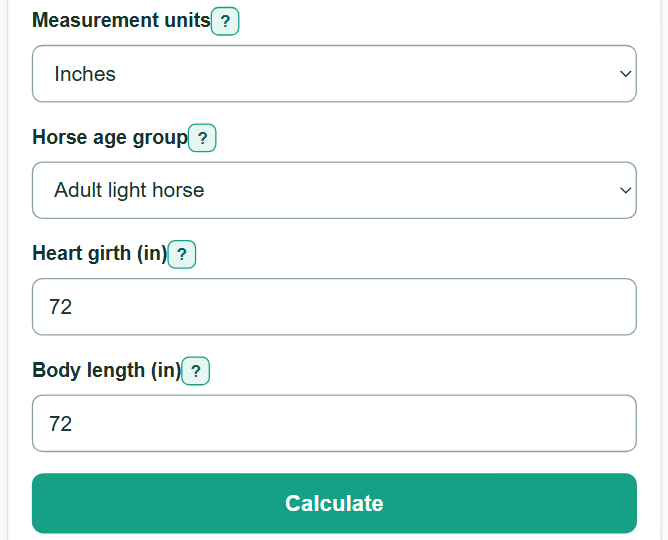
An adult light horse with a 72-inch heart girth and a 72-inch body length has an estimated weight of 72 × 72 × 72 / 330 = 1,131.0545 lb. The calculator displays 1,131 lb and 513.0 kg.
Taking the measurements
Place the heart-girth tape around the barrel just behind the withers and elbows. Measure body length as a straight shoulder-to-buttock line while the horse stands square on level ground. [1]