
Enter a breeding date, or the dates a buck had access, to estimate the expected kidding date and watch window.
Advanced options
Table of contents
How to use our Goat Gestation Calculator
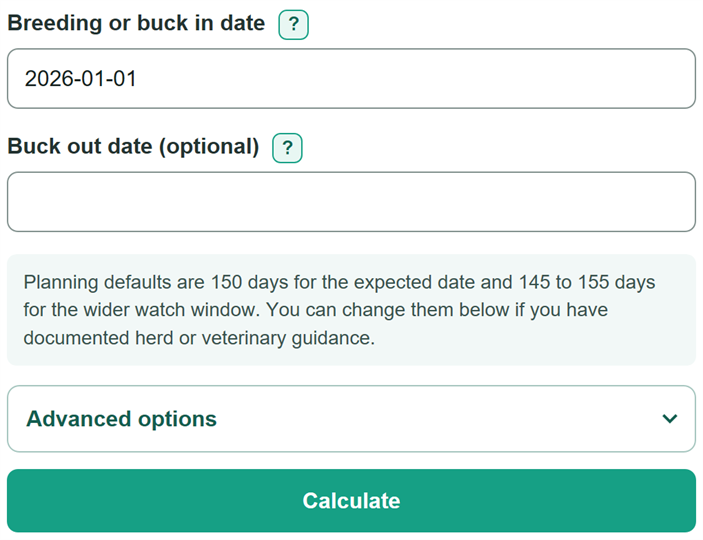
- Enter the Breeding or buck in date from a breeding record, artificial insemination record, herd notebook, or calendar.
- Enter a Buck out date only when the buck had access for more than one day. Leave it blank for one known breeding date.
- Click Calculate to see the expected kidding date first, then the wider kidding watch window.
- Check that the Buck out date is the same as or later than the buck in date and that the result fits your herd record.
- Use the 145, 150, and 155 day planning settings unless documented herd or veterinary guidance supports different values.
Definitions
Breeding date: The known date a doe was bred, including a recorded artificial insemination date.
Buck in date: The first day a buck had access to the doe when the exact mating date is unknown.
Buck out date: The final day a buck had access to the doe. It expands a one-date estimate into a possible date range.
Gestation length: The number of calendar days from breeding to kidding used for planning.
Kidding watch window: The range from the earliest planned kidding date to the latest planned kidding date.
Common mistakes and quick fixes
Mistake: Using the date the buck was removed as the Breeding or buck in date.
Fix: Enter the first date the buck had access as the start date, then enter the removal date as Buck out date.
Mistake: Guessing one mating date after the buck had access for several days.
Fix: Enter both access dates so the expected period and watch window cover the full exposure period.
Mistake: Treating the expected kidding date as a guaranteed delivery date.
Fix: Prepare and observe across the full kidding watch window.
Mistake: Counting five calendar months instead of calendar days.
Fix: Enter the recorded date and let the calculator add calendar days across month ends, year ends, and leap years.
Mistake: Changing the day settings so they are out of order.
Fix: Keep the earliest day at or below the expected day, and the expected day at or below the latest day.
Limitations & Key Assumptions / Boundary Conditions
- The result is a planning estimate, not a guaranteed kidding date.
- If a buck had access to a doe for several days, the calculator cannot identify the actual mating date and uses the full recorded access period.
- The default planning values are 145 days for the early watch date, 150 days for the expected date, and 155 days for the late watch date. Change them only with documented herd or veterinary guidance.
- The calculation adds whole calendar days and accounts for month ends, year ends, and leap years.
- Contact a veterinarian if a doe appears ill, distressed, or has concerning pregnancy or labor signs.
Methodology
Date calculation
The calculator adds whole calendar days to the recorded breeding or buck in date. If a Buck out date is entered, every date from buck in through buck out is treated as a possible breeding date.
expected date = breeding or buck in date + expected gestation days
expected period end = buck out date + expected gestation days
watch window = breeding or buck in date + earliest days through buck out date + latest days
Worked example
With a breeding date of January 1, 2026, 150 expected days gives May 31, 2026. The 145 to 155 day planning window runs from May 26 through June 5. If the buck remained with the doe through January 10, the expected period runs from May 31 through June 9, and the watch window runs from May 26 through June 14.
Calculation choices
Blank advanced day fields use the planning values of 145, 150, and 155 days. Any entered day value must be a positive whole number, and the early, expected, and late values must remain in that order. A Buck out date must be the same as or later than the Breeding or buck in date.