
Convert US gallons to pounds or pounds to gallons using a common liquid or your own density value.
Advanced options
How to use our Gallons to Pounds Converter
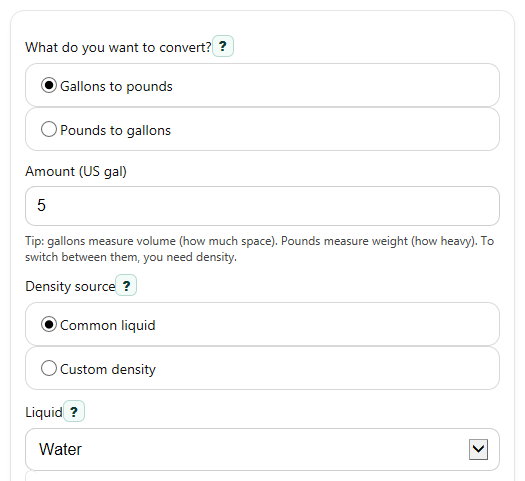
- Choose What do you want to convert? so the calculator knows whether your Amount is in US gallons or pounds.
- Enter the Amount, then choose Density source as either Common liquid or Custom density.
- If you picked Common liquid, select the Liquid. If you picked Custom density, enter Density and the matching Density unit.
- Open Advanced options if you want to change Result decimals or Number style, then click Calculate.
- Sanity-check the result by reviewing Density used and Note. If the density does not match your label or spec sheet, switch to Custom density and recalculate.
Definitions
US gallon: A unit of volume. It tells how much space a liquid takes up, not how heavy it is.
Pound (lb): A unit of weight or mass used here for the liquid amount.
Density: How much one unit of liquid weighs for its size. This calculator needs density to move between gallons and pounds.
lb/gal: Pounds per US gallon. This means how many pounds one US gallon of a liquid weighs.
kg/L: Kilograms per liter. This is another common way to state density on a spec sheet.
Converted amount: The main answer in pounds or US gallons, depending on the direction you chose.
Density used: The exact density value the calculator used, shown in both lb/gal and kg/L so you can verify the input.
Also in metric: A helper result that shows kilograms when the main answer is in pounds, or liters when the main answer is in US gallons.
Common mistakes and quick fixes
Mistake: Entering pounds in Amount while What do you want to convert? is set to Gallons to pounds.
Fix: Make sure Amount matches the selected direction, then check that Converted amount shows the unit you expect.
Mistake: Leaving Density source on Common liquid when you really need a product-specific value.
Fix: Switch Density source to Custom density and enter the exact Density from your source.
Mistake: Typing a custom Density in kg/L but leaving Density unit set to lb/gal.
Fix: Set Density unit to the same unit shown on your label or data sheet, then confirm it in Density used .
Mistake: Using a negative number in Amount .
Fix: Enter 0 or a positive value. Gallons and pounds in this converter must not be negative.
Mistake: Treating Note as if built-in liquid values are exact for every brand or temperature.
Fix: Use Liquid only for a quick estimate. For a closer answer, use Custom density .
Mistake: Rounding too early and thinking the math is off.
Fix: Increase Result decimals and compare both Converted amount and Also in metric before judging small differences.
Limitations & Key Assumptions / Boundary Conditions
- Built-in liquid presets are approximate typical values, so real products can differ by brand, blend, concentration, or temperature.
- The calculator uses US gallons, not Imperial gallons.
- For custom entries, the result is only as accurate as the Density value you enter and the matching Density unit you choose.
- Temperature can change density, especially for fuels and liquids that expand or contract noticeably.
- The converter assumes density stays constant across the amount entered, which is usually fine for basic estimating but may not match lab-grade work.
- Negative values are not allowed, and pounds-to-gallons requires a density greater than 0.
Methodology
Core idea
Gallons measure volume, while pounds measure weight. To convert between them, the calculator uses density, which links volume to weight.
Formulas used
pounds = gallons_us x density_lb_per_gal
gallons_us = pounds / density_lb_per_gal
density_lb_per_gal = density_kg_per_l x 3.785411784 x 2.20462262185
kilograms = pounds / 2.20462262185
liters = gallons_us x 3.785411784
How built-in liquids work
If you choose a preset Liquid, the calculator uses a stored typical density in lb/gal: water 8.33, milk 8.6, gasoline 6.17, diesel 7.05, honey 11.35, and olive oil 7.61. These are practical room-temperature estimates, not exact values for every product [1][2][3].
Worked mini-example
Suppose you choose Gallons to pounds, enter an Amount of 5, and use water.
pounds = 5 x 8.33 = 41.65 lb
kilograms = 41.65 / 2.20462262185 = 18.89 kg
So the main answer is 41.65 lb, and the metric companion output is about 18.89 kg.
If you instead start with a custom density of 1.2 kg/L, the calculator first converts that density.
density_lb_per_gal = 1.2 x 3.785411784 x 2.20462262185 = 10.01 lb/gal
pounds = 2 x 10.01 = 20.02 lb
Assumptions behind the result
The math assumes a positive density and uses US gallons throughout. Preset densities are approximate and can shift with temperature or product formula, so use Custom density when you have an exact spec value [1][2][3].