
Calculate feed cost, FCR, revenue, profit margin, and break-even sale price for one fish production cycle using actual records or a plan.
Table of contents
How to use our Fish Farm Feed Cost, FCR and Profit Margin Calculator
- Choose "Actual feed records" for a completed cycle, or choose "Plan from FCR and feed price" to estimate feed cost before harvest.
- Enter Harvested sale weight (lb), Starting fish biomass (lb), and Net sale price ($ per lb) from your harvest record, settlement, or plan.
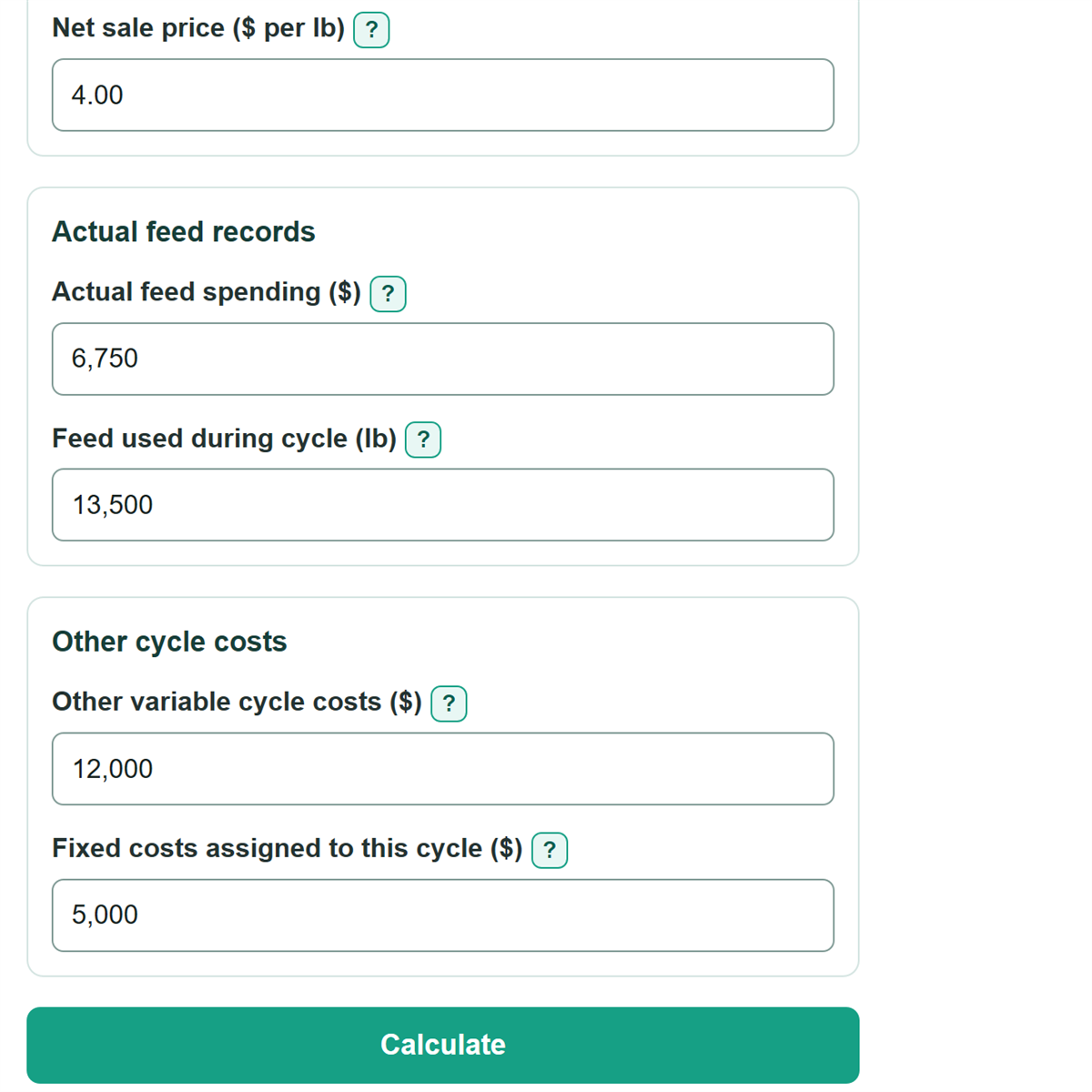
- For actual records, enter Actual feed spending ($) and Feed used during cycle (lb). For planning, enter Planned FCR (lb feed per lb gain), choose Feed price is listed by, and enter the matching visible price fields.
- Enter Other variable cycle costs ($) and Fixed costs assigned to this cycle ($), then select Calculate.
- Sanity-check Feed conversion ratio used and Break-even sale price against your records. A lower FCR uses less feed per pound of gain, and a sale price below break-even produces a loss with the entered costs.
Definitions
Feed conversion ratio (FCR): Pounds of feed used for each pound of fish biomass gain. Lower FCR means less feed is used for the same gain.
Fish biomass gain: Harvested sale weight minus starting fish biomass. This calculator uses gain, not total harvested weight, in the FCR calculation.
Actual feed spending: The feed cost assigned to a completed production cycle, usually from invoices and feed inventory records.
Planned FCR: An expected feed-to-gain ratio used to estimate feed needed before the cycle is complete.
Short ton: A US short ton equals 2,000 lb. The calculator divides a short-ton feed quote by 2,000 to find dollars per pound.
Profit margin: Net profit divided by sales revenue, shown as a percent.
Break-even sale price: The sale price per harvested pound that makes net profit equal zero using the entered cycle costs.
Common mistakes and quick fixes
Mistake: Entering both Actual feed spending ($) and a planned feed price as if both costs are added.
Fix: Choose the matching answer under How should feed cost be calculated? The calculator uses only one feed-cost method.
Mistake: Using Harvested sale weight (lb) as the denominator for Feed conversion ratio used.
Fix: Enter Starting fish biomass (lb) too. FCR is based on fish biomass gain, which is harvested weight minus starting biomass.
Mistake: Typing a short-ton quote into Feed price ($ per lb).
Fix: Choose "Short ton" under Feed price is listed by and enter the quote in Feed price ($ per short ton).
Mistake: Assuming every feed bag weighs 50 lb.
Fix: When using bag pricing, copy the package net weight into Feed weight per bag (lb).
Mistake: Leaving labor, energy, harvest handling, or allocated facility costs out of Other variable cycle costs ($) or Fixed costs assigned to this cycle ($).
Fix: Add the portion of each cost assigned to this production cycle before relying on Estimated profit margin.
Mistake: Entering malformed commas such as 1,01 in Actual feed spending ($).
Fix: Use commas only for thousands, such as 1,000.50, and use a decimal point for cents.
Limitations & Key Assumptions / Boundary Conditions
- This is a one-cycle estimate. It does not forecast future feed prices, fish growth, mortality, disease, market price changes, or cash flow timing.
- FCR is calculated from harvested sale weight minus starting fish biomass. Sorting losses, mortality, culls, retained inventory, and unrecorded feed can make farm accounting results differ.
- Actual feed records use Actual feed spending ($) directly. Planning results use planned FCR, biomass gain, and the selected feed quote; they are estimates, not invoice totals.
- Profit and margin include only the costs entered. Missing labor, energy, fingerlings, delivery charges, depreciation, insurance, interest, taxes, processing deductions, or other costs can overstate profit.
- Fixed costs must be the share assigned to this cycle. The calculator does not decide how annual costs should be allocated across ponds, tanks, species, or production cycles.
- Bag and short-ton prices are converted to dollars per pound. Confirm the quoted unit and bag net weight before using a planning result.
Methodology
Calculation method
The calculator first finds fish biomass gain. It stops with an error if starting biomass is equal to or greater than harvested sale weight.
Fish biomass gain = Harvested sale weight - Starting fish biomass
With Actual feed records selected, FCR is feed used divided by biomass gain and feed cost is Actual feed spending ($). With Plan from FCR and feed price selected, the entered Planned FCR is used to estimate feed quantity and cost. The two feed-cost paths are never added together.
FCR = Feed used during cycle / Fish biomass gain
Planned feed cost = Feed price per lb * Planned FCR * Fish biomass gain
A pound quote is used as entered. A short-ton quote is divided by 2,000 lb, and a bag quote is divided by the bag weight. A US short ton is 2,000 lb.
Feed price per lb = Short-ton price / 2,000
Feed price per lb = Bag price / Feed weight per bag
Revenue comes from harvested sale weight times net sale price. Total cycle cost adds feed cost, other variable cycle costs, and fixed costs assigned to the cycle. Net profit stays negative when costs exceed revenue.
Sales revenue = Harvested sale weight * Net sale price
Total cycle cost = Feed cost + Other variable cycle costs + Fixed costs assigned to this cycle
Net profit = Sales revenue - Total cycle cost
Profit margin = Net profit / Sales revenue * 100
Break-even sale price = Total cycle cost / Harvested sale weight
Worked example
For 10,000 lb harvested, 1,000 lb starting biomass, $4.00 per lb net sale price, $6,750 actual feed spending, $12,000 other variable costs, and $5,000 fixed costs, biomass gain is 9,000 lb, revenue is $40,000, total cost is $23,750, net profit is $16,250, and break-even sale price is $2.375 per lb.