
Calculate static compression ratio from bore, stroke, clearance volume, or engine-part measurements without guessing piston dish and dome signs.
Table of contents
How to use our Compression Ratio Calculator
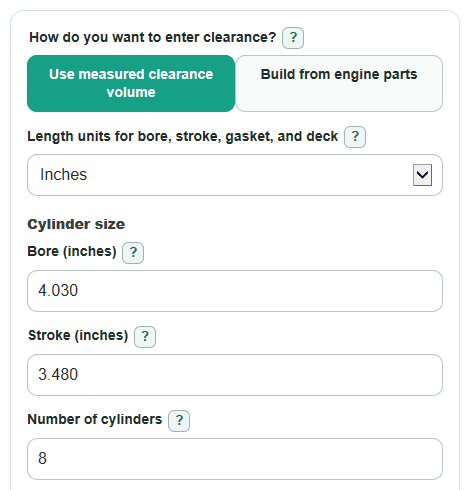
- Choose How do you want to enter clearance?: use Clearance volume per cylinder if you already measured it, or Build from engine parts if you want the calculator to add the chamber, gasket, deck, and piston volumes.
- Select Length units for bore, stroke, gasket, and deck, then enter Bore, Stroke, and Number of cylinders. Keep all length entries in that selected unit.
- In engine-parts mode, enter Combustion chamber volume, Piston top shape, Piston dish or dome size, Head gasket bore, Head gasket thickness, and Deck clearance. Enter piston dish or dome size as a positive cc number.
- Open Advanced options only if you want to enter Target compression ratio or Second gasket thickness, then click Calculate.
- Sanity-check the result: a larger Clearance volume per cylinder should lower Compression ratio, while a smaller chamber, thinner gasket, or dome-style Piston volume effect should raise it.
Definitions
Static compression ratio: The cylinder volume when the piston is at bottom dead center divided by the volume left when the piston is at top dead center [2].
Swept volume per cylinder: The volume one piston moves through during one stroke, based on Bore and Stroke.
Clearance volume per cylinder: The space left above one piston at top dead center. Smaller clearance raises Compression ratio.
Combustion chamber volume: The cc volume in one cylinder head chamber before adding gasket, deck, or piston effects.
Head gasket volume per cylinder: The volume inside the compressed head gasket opening for one cylinder.
Deck clearance: The distance between the piston top and block deck at top dead center. Positive means below deck; negative means above deck.
Piston volume effect: The signed clearance change from the piston top. A dish adds cc; a dome subtracts cc.
Second gasket thickness: An optional compressed gasket thickness used to compare a second Compression ratio without changing the main setup.
Common mistakes and quick fixes
Mistake: Entering a dome piston as a negative Piston dish or dome size.
Fix: Set Piston top shape to Dome and enter Piston dish or dome size as a positive cc number.
Mistake: Mixing inches and millimeters after choosing Length units for bore, stroke, gasket, and deck.
Fix: Change the unit selector first, then make Bore, Stroke, Head gasket bore, Head gasket thickness, and Deck clearance match it.
Mistake: Using cylinder Bore for Head gasket bore when the gasket opening is larger.
Fix: Enter the compressed gasket opening diameter in Head gasket bore if the gasket maker lists a separate size.
Mistake: Leaving Deck clearance positive when the piston is actually above the block deck.
Fix: Enter Deck clearance as a negative number when the piston sticks above the deck.
Mistake: Expecting Number of cylinders to change Compression ratio.
Fix: Use Number of cylinders for Total displacement only; Compression ratio is calculated per cylinder.
Mistake: Entering Target compression ratio as 0.5 or 1.
Fix: Enter Target compression ratio as a value greater than 1, such as 10.5.
Limitations & Key Assumptions / Boundary Conditions
- This is a static compression ratio calculator. It does not calculate dynamic compression ratio, cam timing effects, boost, fuel octane needs, or knock risk.
- The calculator treats all cylinders as the same size and volume. Real engines can vary by chamber cc, piston height, gasket crush, and machining tolerance.
- Volume entries are in cc, while length entries follow Length units for bore, stroke, gasket, and deck. Mixed units will give wrong results.
- Head gasket thickness should be the compressed thickness. Loose, uncompressed gasket thickness can overstate clearance volume.
- Negative Deck clearance is allowed because a piston can sit above the deck, but the final Clearance volume per cylinder must stay greater than zero.
- A negative Chamber volume needed for target ratio means the target is not practical with the other entered parts using this simple geometry model.
- Displayed values are rounded, so hand calculations may differ slightly in the last decimal place.
Methodology
How the calculator works
The calculator first converts the selected length inputs to centimeters, because cubic centimeters are the same volume unit as cc. Static Compression ratio compares the full cylinder volume at bottom dead center with the clearance volume at top dead center [2].
length_cm = length_in x 2.54
length_cm = length_mm x 0.1
swept volume (cc) = (π / 4) x bore_cm^2 x stroke_cm
If you use measured-clearance mode, the entered Clearance volume per cylinder is used directly. If you build from engine parts, the calculator adds the chamber, gasket, deck, and piston effects.
gasket volume (cc) = (π / 4) x gasket_bore_cm^2 x gasket_thickness_cm
deck volume (cc) = (π / 4) x bore_cm^2 x deck_clearance_cm
piston effect (cc) = 0 for flat, +piston_volume_cc for dish, -piston_volume_cc for dome
clearance volume (cc) = chamber_volume_cc + gasket_volume_cc + deck_volume_cc + piston_effect_cc
compression ratio = (swept_volume_cc + clearance_volume_cc) / clearance_volume_cc
Total displacement uses swept volume only, not clearance volume.
total displacement (L) = swept_volume_cc x cylinder_count / 1000
total displacement (cu in) = swept_volume_cc x cylinder_count / 16.387064
Target and gasket checks
When Target compression ratio is entered, the needed clearance volume is solved by rearranging the compression ratio formula.
target_clearance_cc = swept_volume_cc / (target_compression_ratio - 1)
In engine-parts mode, the calculator also solves the chamber volume that would be needed if gasket, deck, and piston values stayed the same.
target_chamber_cc = target_clearance_cc - gasket_volume_cc - deck_volume_cc - piston_effect_cc
chamber_change_to_target_cc = target_chamber_cc - chamber_volume_cc
If Second gasket thickness is entered in engine-parts mode, the calculator recalculates gasket volume with that thickness, rebuilds clearance volume, and then recalculates Compression ratio.
Mini-example
For a 4.030 inch bore, 3.480 inch stroke, 8 cylinders, and 64 cc measured Clearance volume per cylinder, the swept volume is about 727.41 cc per cylinder. The Compression ratio is:
(727.41 + 64) / 64 = 12.37:1
The total displacement is about 5.819 L, or about 355.1 cu in.
Calculation notes
The calculator blocks blank or invalid required inputs, rejects zero or negative Bore, Stroke, Number of cylinders, and clearance values that cannot work in the formula, and only reads inputs that apply to the selected clearance mode. Optional Target compression ratio must be greater than 1, and optional Second gasket thickness must be greater than 0 when entered.