
Calculate fish to stock or projected harvest biomass, then check whether harvest-stage density fits your usable water volume and target.
Table of contents
How to use our Aquaculture Biomass and Stocking Density Calculator
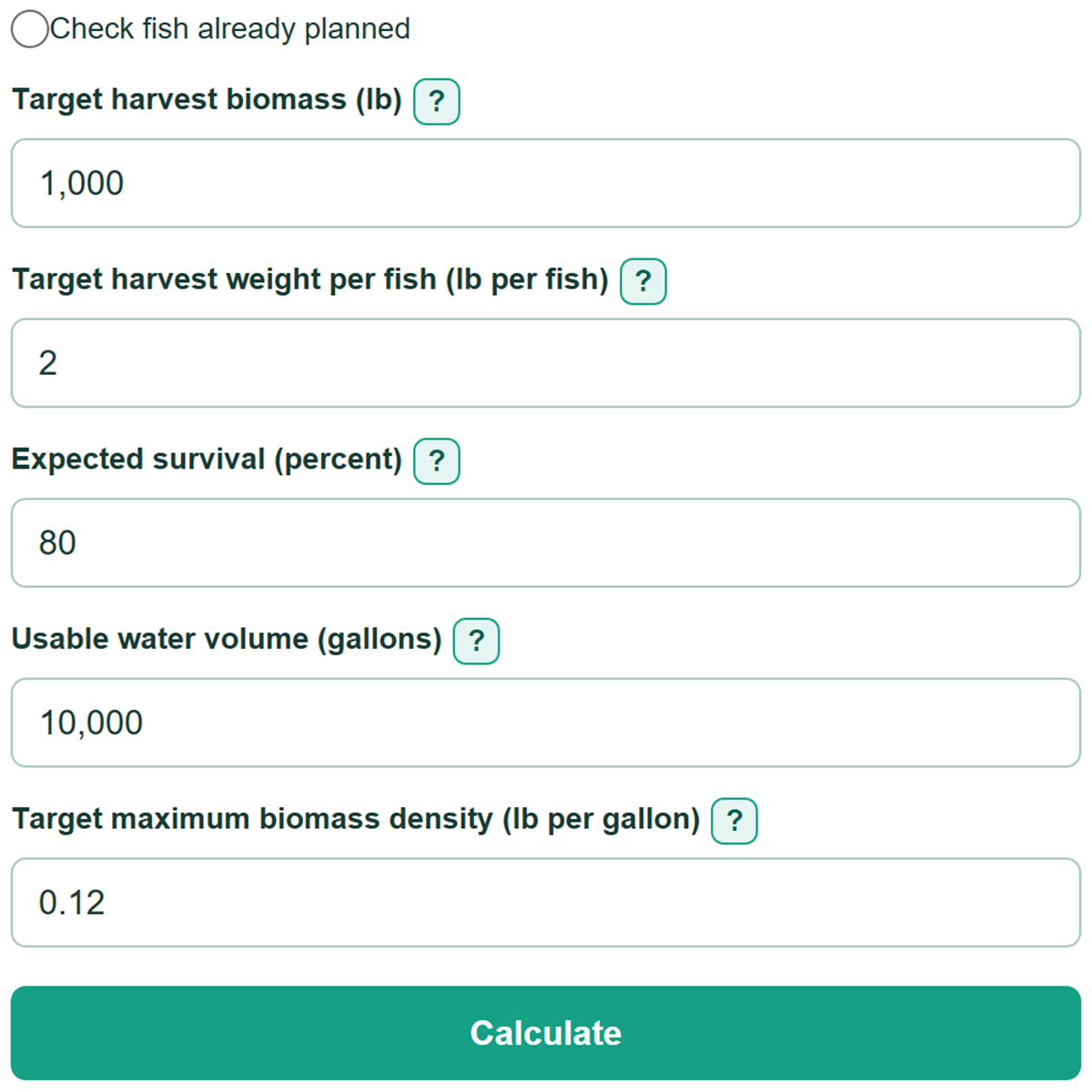
- Choose "Plan fish to stock" for a harvest goal, or "Check fish already planned" if you already know the starting fish count.
- Enter the target harvest biomass or Fish stocked, then enter Target harvest weight per fish and Expected survival from your farm plan or records.
- Enter Usable water volume at its normal operating level and your Target maximum biomass density.
- Click Calculate. Check the Harvest density target margin: a positive value is below your target, zero is at it, and a negative value exceeds it.
- Sanity-check the result by confirming that the harvest weight is for one market-size fish, not a fingerling, and that the water volume is not the empty tank size.
Definitions
Fish to stock: Starting fish count needed for the harvest goal after allowing for expected mortality. The calculator rounds this count up to a whole fish.
Expected survival: The percent of stocked fish expected to still be alive at harvest.
Expected survivors at harvest: Stocked fish multiplied by expected survival. It can be a fractional planning estimate.
Projected harvest biomass: Total expected fish weight at harvest, based on expected survivors and target harvest weight per fish.
Projected harvest biomass density: Projected harvest biomass divided by usable operating water volume, shown in lb per gallon and kg per m3.
Harvest density target margin: Target maximum biomass density minus projected harvest biomass density. Positive is below target; negative is above target.
Usable water volume: Water available at the normal operating level, rather than an empty tank's listed capacity.
Common mistakes and quick fixes
Mistake: Entering gross tank capacity as Usable water volume.
Fix: Enter the gallons actually held at the operating water level.
Mistake: Using fingerling weight for Target harvest weight per fish.
Fix: Use the planned sale or harvest weight of one surviving fish.
Mistake: Treating Expected survival as a universal rate.
Fix: Replace the example with a species-, stage-, and farm-specific estimate from records or an SOP.
Mistake: Reading Projected harvest biomass as guaranteed production.
Fix: Treat it as a planning estimate based on the Expected survival and harvest weight you entered.
Mistake: Ignoring a negative Harvest density target margin.
Fix: A negative margin means Projected harvest biomass density is above your entered Target maximum biomass density.
Limitations & Key Assumptions / Boundary Conditions
- This is a harvest-stage planning calculation. It does not model fish growth over time, grading, partial harvests, feed, or changing mortality.
- The density comparison uses your Target maximum biomass density. It does not provide a universal safe density for a species, tank, pond, cage, or recirculating system.
- A within-target density result does not confirm adequate dissolved oxygen, aeration, flow, filtration, temperature, ammonia control, health status, or permit compliance.
- Use usable operating water volume. A reduced water level changes biomass density even if fish count stays the same.
- Expected survival and target harvest weight are estimates. Actual harvest can differ because of disease, losses, growth variation, culling, and management decisions.
- Fish to stock is rounded up in planning mode, so projected harvest biomass can be slightly above the requested Target harvest biomass.
Methodology
Calculation method
In Plan fish to stock mode, the calculator works backward from the harvest goal. It divides the target harvest biomass by the harvest weight expected from each stocked fish after survival, then rounds up to a whole fish.
fish to stock = ceiling(target harvest biomass / (target harvest weight per fish × expected survival / 100))
In Check fish already planned mode, Fish stocked is the starting count. In both modes, expected survivors are calculated first, then harvest biomass and harvest-stage density.
expected survivors = fish to stock × expected survival / 100
projected harvest biomass = expected survivors × target harvest weight per fish
projected harvest biomass density = projected harvest biomass / usable water volume
harvest density target margin = target maximum biomass density - projected harvest biomass density
Worked example
For a 1,000 lb harvest goal, 2 lb per fish, and 80 percent expected survival, the calculation calls for 625 fish. That projects 500 survivors and 1,000 lb of harvest biomass. With 10,000 gallons of usable water, density is 0.10 lb per gallon. If the target maximum is 0.12 lb per gallon, the margin is 0.02 lb per gallon, so the plan is below that target.
Metric equivalents
Metric results use 1 lb = 0.45359237 kg and 1 US gallon = 0.003785411784 m3.
projected harvest biomass in kg = projected harvest biomass in lb × 0.45359237
projected harvest density in kg per m3 = projected harvest density in lb per gallon × 0.45359237 / 0.003785411784