
Calculate the isocyanate charge for a polyurethane batch using material test values, target NCO/OH index, and optional resin corrections.
Resin corrections
Calculation details
This is theoretical formulation arithmetic. Confirm current-lot properties and validate the formulation before production.
Table of contents
How to use our Polyurethane NCO/OH Index Calculator
- Choose "Basic batch" for a standard polyol-side calculation, or choose "Batch with resin corrections" when measured acid number and moisture apply to the resin blend.
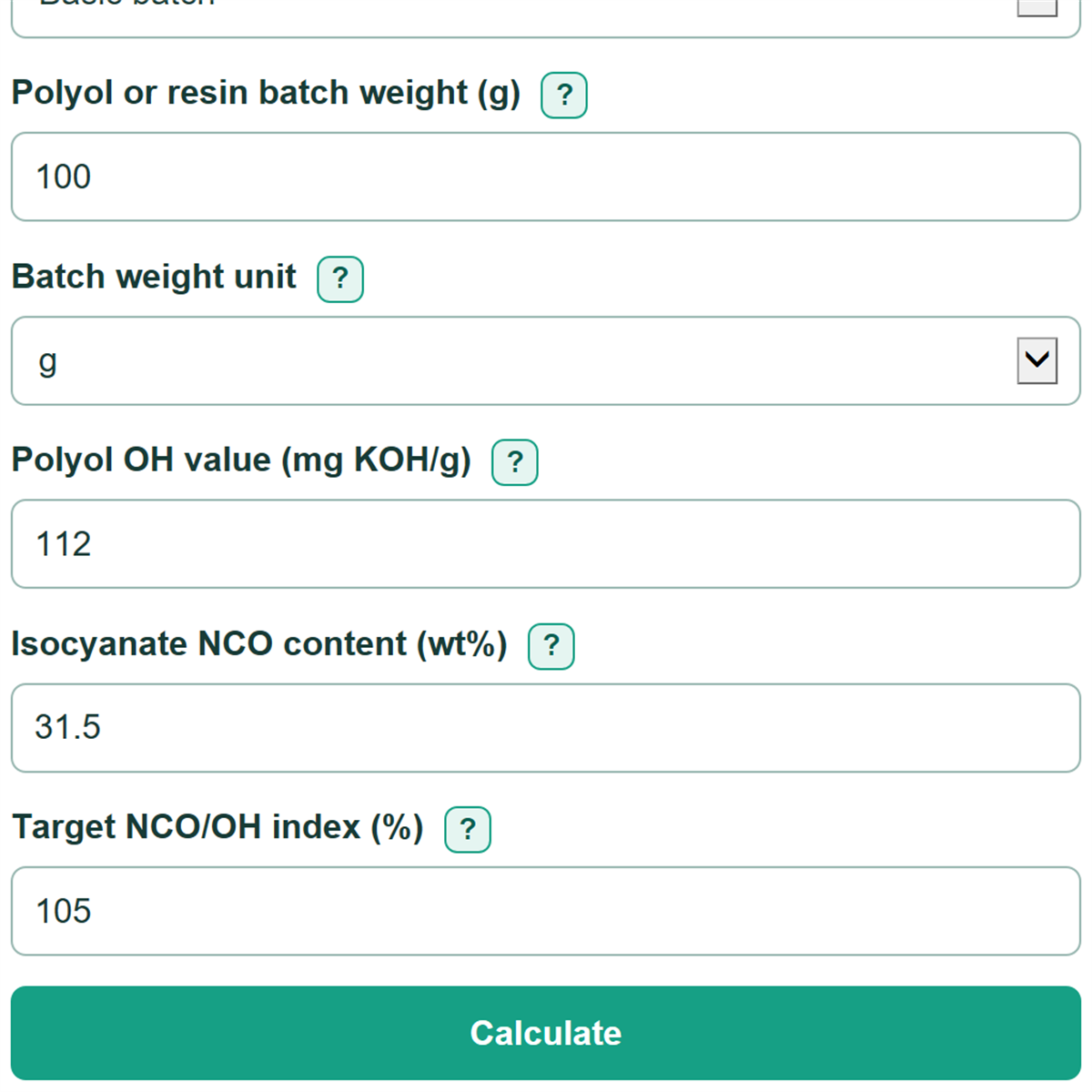
- Enter the planned "Polyol or resin batch weight" and choose the matching "Batch weight unit" from the batch card or formula sheet.
- Copy "Polyol OH value", "Isocyanate NCO content", and "Target NCO/OH index" from current material records and the approved formula.
- For resin correction mode, enter the measured "Resin acid number" and "Resin moisture" for the same resin batch basis.
- Check that "Required isocyanate mass" uses the intended unit and compare "Isocyanate per 100 parts polyol or resin" with the formula sheet before scaling or mixing.
Definitions
NCO/OH index: Planned NCO equivalents divided by reactive-hydrogen equivalents, multiplied by 100. Index 100 is the one-to-one stoichiometric reference; 105 equals a ratio of 1.05. [1]
OH value: A hydroxyl measurement in mg KOH/g used to calculate hydroxyl equivalents in the polyol or resin.
NCO content: The weight percent of isocyanate (NCO) groups in the isocyanate material.
Equivalent: A chemistry accounting unit for one reactive NCO group or one reactive-hydrogen site in this calculation.
Equivalent weight: Material mass in g/eq. A lower equivalent weight means more reactive equivalents per gram.
Acid number: A resin acidity measurement in mg KOH/g. In resin correction mode, it adds reactive-hydrogen equivalent demand.
Resin moisture: Water content as a weight percent of the resin blend. Water supplies two reactive-hydrogen equivalents per mole in this calculation.
Parts by weight: The mass of isocyanate needed for 100 parts by weight of the entered polyol-side or resin-side material.
Common mistakes and quick fixes
Mistake: Including isocyanate in "Polyol or resin batch weight."
Fix: Enter only the polyol-side or resin-side charge; "Required isocyanate mass" is added separately.
Mistake: Entering percent OH as "Polyol OH value."
Fix: Use hydroxyl value or hydroxyl number in mg KOH/g from the supplier record.
Mistake: Typing 1.05 into "Target NCO/OH index" when the approved target is index 105.
Fix: Enter 105; the calculator shows 1.05 separately as "Planned NCO to reactive-hydrogen ratio."
Mistake: Using a nominal data-sheet value instead of a current-lot "Isocyanate NCO content."
Fix: Use the current certificate of analysis or test result when it is available.
Mistake: Leaving out measured water while using "Batch with resin corrections."
Fix: Enter the resin test result in "Resin moisture" so its demand appears in "Moisture reactive-hydrogen equivalents included."
Mistake: Entering a negative "Resin acid number" or moisture above 100 in "Resin moisture."
Fix: Correct the source value or its unit; acid number cannot be negative and moisture must be from 0 to 100 percent.
Limitations & Key Assumptions / Boundary Conditions
- The calculation is theoretical charge arithmetic. It does not predict cure speed, viscosity, foam behavior, emissions, heat release, adhesion, or finished-product performance.
- It treats the entered polyol or resin batch as one OH-value basis and the entered isocyanate as one NCO-content basis. Other reactive ingredients are not included unless their demand is already represented by the entered values.
- Basic batch mode uses OH equivalents only. Acid number and moisture are included only in "Batch with resin corrections."
- Resin correction results depend on acid number and moisture measured for the applicable resin blend and lot. Nominal data-sheet values can differ from current-lot values.
- Water is counted as two reactive-hydrogen equivalents per mole. This does not model side reactions, gas generation, catalyst effects, or process losses.
- Use the approved formulation, plant procedures, safety controls, and validation testing before production mixing.
Methodology
Equivalent calculation
The calculator first converts the entered batch mass to grams. It then converts the OH value into hydroxyl equivalents using 56,100 mg KOH per equivalent. In resin correction mode, acid number adds another equivalent term, and resin moisture is converted to water mass and divided by 9.00764 g/eq.
polyol_OH_equivalents = batch_mass_g * OH_value / 56100
acid_equivalents = batch_mass_g * acid_number / 56100
moisture_equivalents = batch_mass_g * moisture_percent / 100 / 9.00764
total_reactive_hydrogen_equivalents = polyol_OH_equivalents + acid_equivalents + moisture_equivalents
Isocyanate charge
The entered index is divided by 100 to get the planned NCO-to-reactive-hydrogen ratio. Isocyanate equivalent weight is calculated from 42.02 g/eq for an NCO group and the entered NCO content. The needed NCO equivalents are then converted to material mass. This follows the usual index relationship of NCO equivalents to active-hydrogen equivalents. [1]
NCO_equivalent_weight = 42.02 * 100 / NCO_content_percent
required_isocyanate_mass_g = total_reactive_hydrogen_equivalents * index_percent / 100 * NCO_equivalent_weight
For a 100 g basic batch with OH value 112 mg KOH/g, NCO content 31.5 wt%, and index 105, hydroxyl demand is about 0.1996435 eq. The isocyanate equivalent weight is about 133.3968 g/eq, producing a required isocyanate mass of about 27.9634 g. The mix ratio is therefore about 27.9634 parts isocyanate per 100 parts polyol.
Mass units
All equivalent calculations use grams internally. The required charge and total mixed batch mass are converted back to the selected batch unit. When lb is selected, the calculator uses 453.59237 g per lb.