
Calculate how many days existing manure storage can hold, or find the usable storage needed for your chosen local period.
Table of contents
How to use our Manure Storage Volume and Days Capacity Calculator
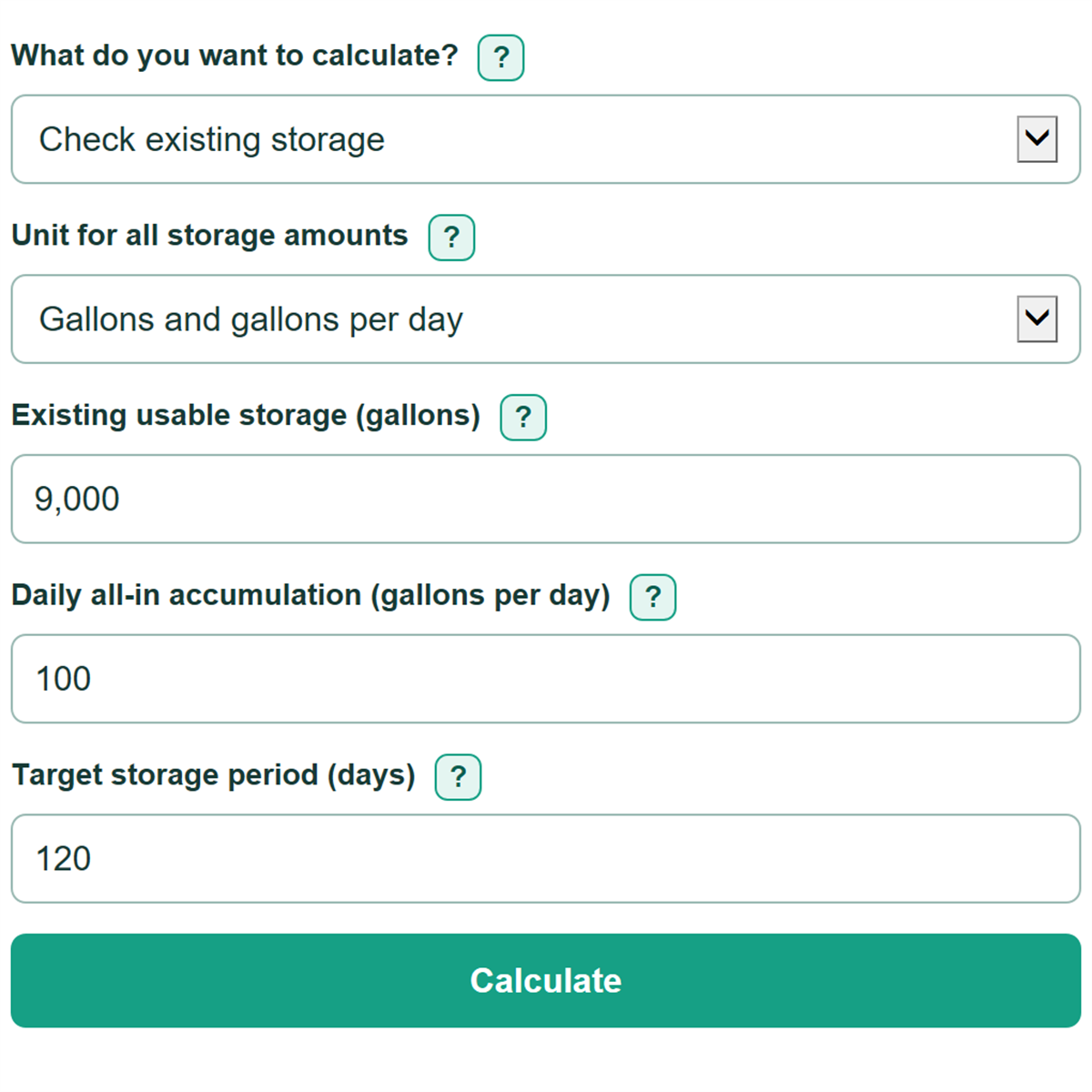
- Choose "Check existing storage" to test a current structure, or "Size storage for target days" to find the usable capacity needed.
- Choose the unit used in your records. Enter all storage amounts in that same unit, such as gallons and gallons per day.
- For a storage check, enter "Existing usable storage" after excluding freeboard and other unusable space.
- Enter "Daily all-in accumulation" and "Target storage period" from farm records, a plan, permit condition, or removal schedule.
- Check that the required usable capacity and storage gap make sense for your records. A negative "Storage gap for target period" means more usable capacity is needed.
Definitions
Usable storage: Working capacity available for manure or slurry. It excludes freeboard and other space that cannot be used safely. [2]
Daily all-in accumulation: The total material added to the storage each day in one matching unit. It can include manure, bedding for solids, wash water, or runoff when those materials enter the same storage.
Target storage period: The number of days the storage is expected to hold material before removal or land application.
Days existing storage can hold: The number of days until usable storage is filled at the entered daily all-in accumulation.
Storage gap for target period: Existing usable storage minus the usable storage needed for the target days. A negative gap is a shortfall.
Common mistakes and quick fixes
Mistake: Entering gross tank or pond volume as "Existing usable storage."
Fix: Check What do you want to calculate? and then recalculate. Enter working capacity only. Leave out freeboard and any space that cannot safely hold manure or liquid.
Mistake: Choosing gallons for "Unit for all storage amounts" but entering "Daily all-in accumulation" in cubic feet per day.
Fix: Use matching units throughout: gallons with gallons per day, cubic feet with cubic feet per day, or tons with tons per day.
Mistake: Adding manure-only production to a "Daily all-in accumulation" number that already includes wash water or runoff.
Fix: Check What do you want to calculate? and then recalculate. Enter one daily total for everything that enters this storage, without counting the same liquid twice.
Mistake: Treating the example "Target storage period" of 120 days as a rule for every farm.
Fix: Check What do you want to calculate? and then recalculate. Replace it with the period from your local plan, permit, field-access conditions, or expected removal schedule.
Mistake: Reading a negative "Storage gap for target period" as zero extra capacity.
Fix: The negative amount is the additional usable storage needed to meet the selected target period.
Limitations & Key Assumptions / Boundary Conditions
- This is a quick planning check using a known usable capacity and one steady daily accumulation rate. It does not design a storage structure.
- Use only compatible units. The calculator does not convert gallons, cubic feet, and tons because converting volume to weight depends on the material and its conditions.
- For liquid storage, the entered daily all-in accumulation must already account for applicable wash water, process water, precipitation, and runoff. Do not add an item twice.
- The target storage period is local and management-specific. Permits, field access, weather, hauling schedules, and nutrient-management requirements can change the needed period.
- The calculator does not calculate gross volume, freeboard, sludge, agitation reserve, design storms, irregular lagoon stage-storage curves, or structural and safety requirements.
- Daily accumulation can vary with animal numbers, bedding, water use, and management. Update the rate when those conditions change.
Methodology
Calculation method
The calculator uses the same selected unit for existing usable storage and daily all-in accumulation. Days of capacity are usable storage divided by the daily rate. This follows the capacity-days relationship used in manure-storage worksheets. [1]
days_available = existing_usable_storage / daily_accumulation
Required usable capacity is the daily all-in accumulation multiplied by the selected storage period.
required_usable_capacity = daily_accumulation * target_storage_days
For an existing-storage check, the storage gap compares working capacity with the capacity needed for the target period. The sign is kept: positive means extra usable capacity, while negative means a shortfall.
storage_gap = existing_usable_storage - required_usable_capacity
Worked example
With 9,000 gallons of usable storage and 100 gallons per day of all-in accumulation, the storage lasts 90 days. For a 120-day target, needed usable storage is 12,000 gallons, so the gap is -3,000 gallons. That means 3,000 more gallons of usable capacity are needed for that target.
Input checks
Daily all-in accumulation must be greater than zero because dividing by zero cannot produce days of capacity. Existing usable storage and the target storage period can be zero, but neither can be negative.