
Estimate current tree biomass, stored carbon, and CO2e from DBH, species group, tree count, and an optional measured plot area.
Advanced options
Root estimate
Carbon assumption
Calculation details
Table of contents
How to use our Forest Biomass, Carbon Stock and CO2e Calculator
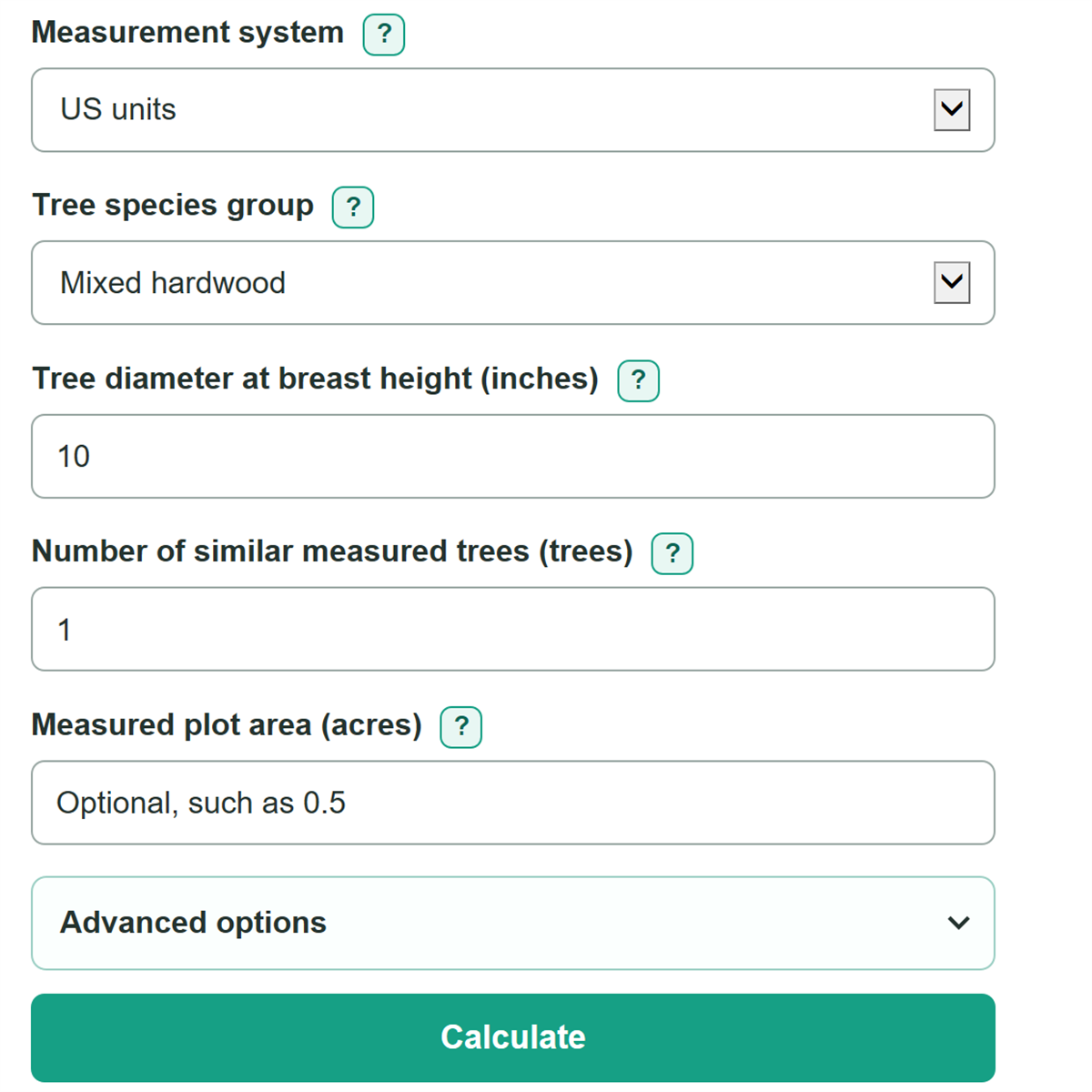
- Choose the Measurement system that matches your field notes, then select the closest Tree species group.
- Enter Tree diameter at breast height, measured across the trunk 4.5 feet above ground in US practice, and enter the Number of similar measured trees.
- Enter Measured plot area only if those counted trees come from that exact plot. Leave it blank for a tree-group total without per-area results.
- Open Advanced options only if needed. Choose Include estimated root biomass and replace the Root-to-shoot ratio or Carbon share of dry biomass when your method specifies different values.
- Click Calculate. Check that the reported unit and basis match your notes, and remember that Current CO2e stored in the measured trees is a current stock estimate, not a yearly removal amount.
Definitions
DBH: Diameter at breast height, the trunk diameter measured at a standard height above the ground. This calculator uses DBH as its main tree measurement.
Aboveground biomass: Estimated dry mass of the tree parts above the ground that are covered by the selected equation.
Root-to-shoot ratio: Estimated root mass divided by aboveground biomass. It is used only when Include estimated root biomass is set to Yes.
Carbon share of dry biomass: The decimal part of dry biomass counted as carbon. A value of 0.5 means 50% of the included dry biomass is treated as carbon.
Carbon stock: The current mass of carbon stored in the included estimated living biomass.
CO2e: Carbon dioxide equivalent. For carbon mass, the calculator multiplies by 44/12 to express the equivalent mass of carbon dioxide.
Per measured area: A total divided by the entered plot area, shown per acre in US units or per hectare in metric units.
Common mistakes and quick fixes
Mistake: Entering the distance around the trunk for Tree diameter at breast height.
Fix: Enter the diameter across the trunk, not circumference. Measure at 4.5 feet above ground in US practice.
Mistake: Using one average Tree diameter at breast height for trees with very different sizes.
Fix: Group similar trees by size and Tree species group, then calculate each group separately because biomass does not increase in a straight line with diameter.
Mistake: Entering a whole property under Measured plot area when Number of similar measured trees only covers a sample plot.
Fix: Use the area containing the counted trees. Leave Measured plot area blank if you only need the measured-tree total.
Mistake: Treating Current carbon stored in the measured trees as the same mass as Current CO2e stored in the measured trees.
Fix: Carbon is the mass of carbon atoms. CO2e is the larger equivalent carbon dioxide mass after the 44/12 conversion.
Mistake: Selecting Include estimated root biomass without checking Root-to-shoot ratio.
Fix: Use a ratio required by your local inventory method when available. The default is an editable planning assumption, not a root measurement.
Limitations & Key Assumptions / Boundary Conditions
- This estimates current dry living biomass from DBH, a broad US species group, and one representative tree size. It is a screening estimate, not a certified inventory, carbon-credit calculation, or field verification.
- The selected equation may not fit every local species, tree form, site, or size range. Use local or project-required equations when they are available.
- The Number of similar measured trees must represent trees with roughly the entered DBH and selected species group. Calculate separate groups for strongly different diameters or species.
- Root biomass is optional and is estimated from the entered Root-to-shoot ratio; it is not directly measured.
- Per-area results are valid only when the entered Measured plot area contains the same trees counted in Number of similar measured trees.
- The calculator does not estimate annual sequestration, growth, mortality, disturbance, harvested wood products, avoided emissions, soil carbon, or future carbon stock.
Methodology
Calculation steps
The calculator first converts the entered tree diameter to centimeters when US units are selected. It then applies the coefficient pair for the selected broad species group to estimate dry aboveground biomass for one representative tree.
dbh_cm = dbh * 2.54 (US mode) or dbh_cm = dbh (metric mode)
single_tree_aboveground_biomass_kg = exp(beta0 + beta1 * ln(dbh_cm))
The one-tree estimate is multiplied by Number of similar measured trees. If roots are included, estimated root biomass is added using the entered ratio.
plot_aboveground_biomass_kg = single_tree_aboveground_biomass_kg * tree_count
plot_belowground_biomass_kg = plot_aboveground_biomass_kg * root_shoot_ratio, or 0 when roots are excluded
plot_total_living_biomass_kg = plot_aboveground_biomass_kg + plot_belowground_biomass_kg
Carbon and CO2e
Total included dry biomass is multiplied by Carbon share of dry biomass. Carbon mass is then converted to carbon dioxide equivalent using the molecular-mass ratio of carbon dioxide to carbon.
plot_carbon_stock_kg = plot_total_living_biomass_kg * carbon_fraction
plot_co2e_stock_kg = plot_carbon_stock_kg * (44 / 12)
If Measured plot area is entered, each displayed total is divided by that same area. US mode shows short tons and acres; metric mode shows metric tonnes and hectares.
per_area_value = displayed_total / entered_plot_area
Worked mini-example
For 10 mixed-hardwood trees with a 10-inch DBH, a 0.5-acre plot, roots included at 0.2, and a carbon share of 0.5, the calculator estimates about 3.41 short tons of included living biomass, 1.71 short tons of carbon, and 6.26 short tons CO2e. Dividing by 0.5 acre gives about 12.52 short tons CO2e per acre.