
Estimate usable silage inventory, feed days remaining, daily face advance, and any extra tons needed before your next supply date.
Storage measurements
Feed properties
Daily use
Advanced options
Loss and face assumptions
Next supply date
Calculation details
Table of contents
How to use our Silage Bunker and Pile Inventory Calculator
- Choose Storage shape. Select Rectangular bunker for straight sides or Drive-over pile for a pile with a narrower top.
- Measure and enter the visible dimensions in feet. For a pile, measure both Pile base width and Pile top width.
- Enter Packed as-fed density from a farm density check or reconciled records, then copy Silage dry matter from a forage test.
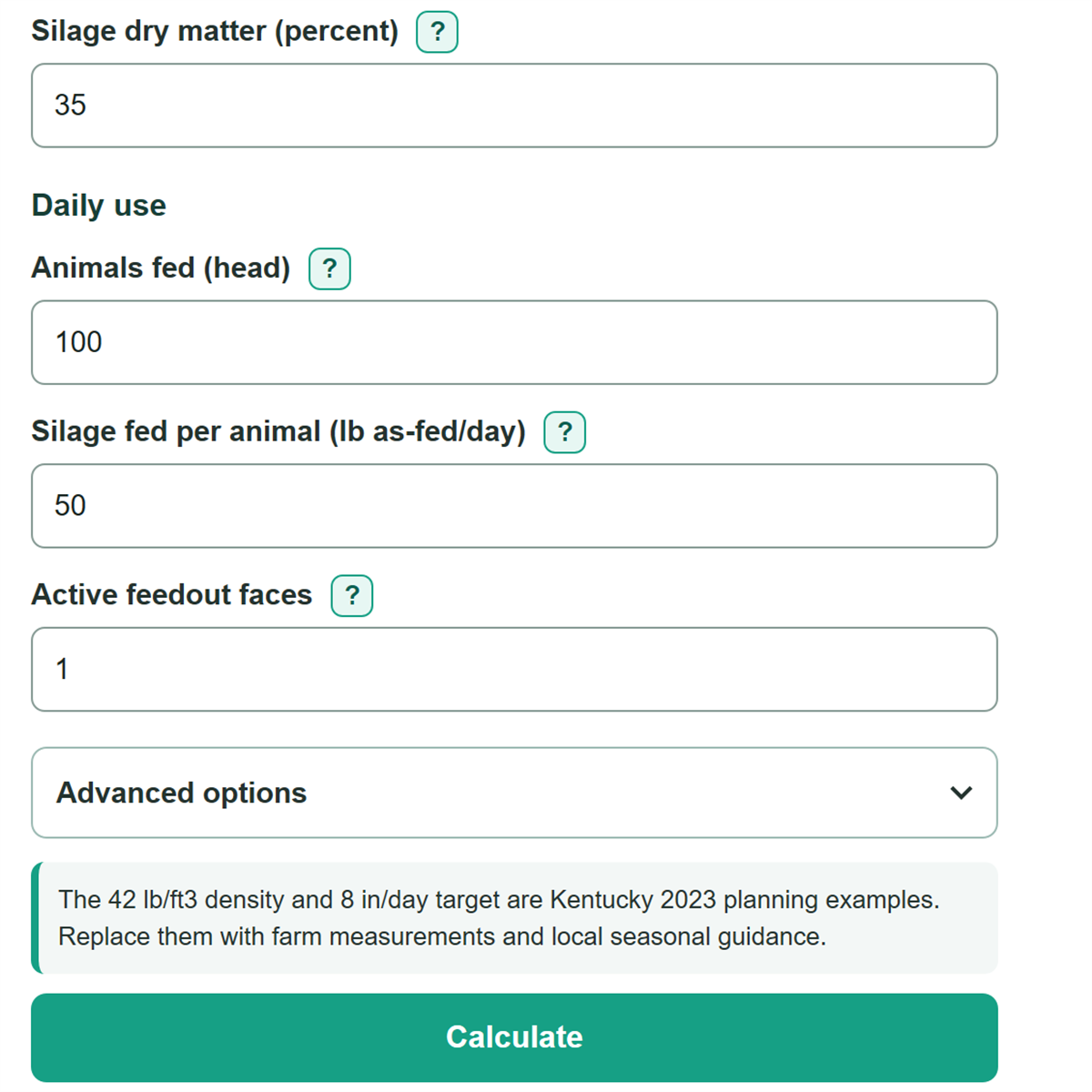
- Enter Animals fed, Silage fed per animal, and Active feedout faces, then select Calculate.
- Compare Estimated daily face advance with the target. Open Advanced options to adjust losses or compare inventory with a next supply date; check that the result fits recent feed removal and inventory records.
Definitions
As-fed: The weight of silage as it sits in storage, including its water.
Dry matter: The portion of silage left after water is removed. A forage test may report it as a percent.
Packed as-fed density: As-fed silage weight per cubic foot after packing, entered as lb/ft3.
Storage loss: Inventory lost before feedout, such as shrink or spoilage. It is applied before feedout loss.
Feedout and refusal loss: Silage removed from storage that is not delivered or eaten. It is applied after storage loss.
Active feedout face: A silage face currently being removed. More simultaneous faces spread the same daily removal over more area.
Face advance: How far the active silage face moves in one day, shown in in/day.
US short ton: A weight of 2,000 lb.
Common mistakes and quick fixes
Mistake: Using bunker wall height instead of Average packed depth when the silage is below the wall or crowned above it.
Fix: Measure packed depth at several representative points and enter the average.
Mistake: Entering a dry-matter density for Packed as-fed density .
Fix: Enter density in lb/ft3 on an as-fed basis; use Silage dry matter separately for the dry-matter calculation.
Mistake: Entering moisture percent in Silage dry matter .
Fix: Subtract moisture from 100 first. For 65% moisture, enter 35% dry matter.
Mistake: Treating a tapered pile as a rectangular bunker or entering Pile top width wider than Pile base width .
Fix: Choose Drive-over pile and measure the base and flatter top separately; the top width must be no greater than the base width.
Mistake: Entering pounds of dry matter in Silage fed per animal .
Fix: Enter the ration amount in lb as-fed/day. Convert a dry-matter ration amount before entering it.
Mistake: Counting bunkers used one after another as multiple Active feedout faces .
Fix: Count only faces that are being removed at the same time.
Limitations & Key Assumptions / Boundary Conditions
- The bunker estimate assumes a rectangular packed block. The pile estimate assumes one trapezoidal cross-section repeated along the entered length.
- Irregular ends, ramps, crowns, sloped surfaces, voids, and uneven packing can make actual volume different from the estimate.
- The calculation uses one average packed as-fed density and one dry-matter percentage. Density and dry matter can vary by crop, location, depth, and time.
- Feed days and depletion date assume that Animals fed and Silage fed per animal stay constant every day.
- Storage loss and feedout and refusal loss are planning assumptions. Replace the defaults with farm reconciliation, refusal, and spoilage records when available.
- Face advance is a planning comparison, not a feed-safety, structural, or sales-transaction certification.
- The additional-ton result assumes added silage has the same retained fraction after storage and feedout losses as the inventory entered.
Methodology
Inventory calculation
The calculator first estimates stored volume from the selected shape. A rectangular bunker uses inside width times average packed depth times length. A drive-over pile uses a trapezoid: average height times the average of base width and top width, then multiplies by length.
storage_volume_ft3 = length_ft * cross_section_ft2
cross_section_ft2 = bunker_width_ft * packed_depth_ft
cross_section_ft2 = pile_average_height_ft * (pile_base_width_ft + pile_top_width_ft) / 2
Measured volume is multiplied by packed as-fed density, then divided by 2,000 lb per US short ton. Feed inventory planning commonly connects estimated stored feed with daily feed needs and losses. [1]
physical_as_fed_tons = storage_volume_ft3 * packed_density_lb_ft3 / 2000
Loss-adjusted inventory and feed days
Storage loss and feedout and refusal loss happen at separate stages, so the calculator multiplies their retained fractions instead of adding the percentages. Feedout losses can affect how much forage is available to feed. [2]
retained_fraction = (1 - storage_loss_percent / 100) * (1 - feedout_loss_percent / 100)
usable_as_fed_tons = physical_as_fed_tons * retained_fraction
usable_dry_matter_tons = usable_as_fed_tons * dry_matter_percent / 100
days_remaining = usable_as_fed_tons * 2000 / (herd_head * feed_per_head_lb)
Example:
a 100 ft by 30 ft bunker with a 10 ft average packed depth has 30,000 ft3. At 42 lb/ft3, that is 630 physical as-fed tons. With 8% storage loss and 5% feedout loss, usable inventory is 630 x 0.92 x 0.95 = 550.62 as-fed tons. Feeding 100 animals 50 lb as-fed/day uses 5,000 lb/day, so the estimate is 220.248 feed days.
Face advance and date comparison
Daily feed delivered is converted to removed volume after accounting for feedout loss. That volume is divided by the storage cross-section and the number of simultaneous active faces, then changed from feet to inches.
daily_removed_volume_ft3 = daily_herd_use_lb / ((1 - feedout_loss_percent / 100) * packed_density_lb_ft3)
face_advance_in_day = daily_removed_volume_ft3 / (cross_section_ft2 * active_faces) * 12
When date comparison is turned on, calendar days from the Inventory date to the Next harvest or supply date are compared with estimated feed days. A positive days-ahead value means feed remains. A negative value means the inventory runs short. The additional-ton result is floored at zero because it asks only for extra feed needed.
extra_as_fed_tons_needed = max(0, daily_herd_use_lb * days_to_supply / (retained_fraction * 2000) - physical_as_fed_tons)
Calculation boundaries
The calculator stops for nonpositive dimensions, density, herd use, target face advance, or face count; loss percentages of 100% or more; dry matter above 100%; a pile top wider than its base; and a next supply date earlier than the inventory date. It uses local calendar-date arithmetic for depletion dates so daylight-saving time does not shift the displayed day.